
Nalini Malani and the Formation of a Feminist Visual Language
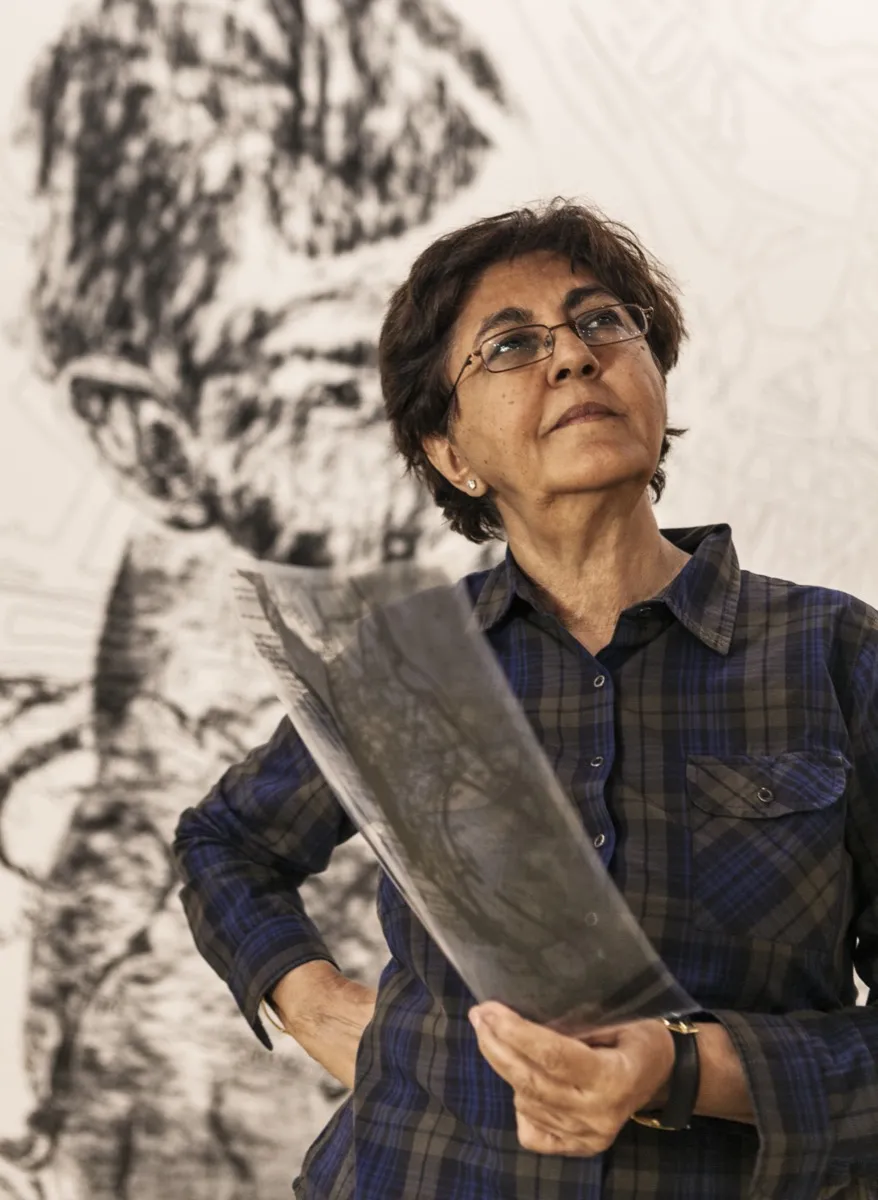
Nalini Malani is a leading figure of contemporary art in South Asia, known for a multidisciplinary practice that spans video art, animation, painting, installation, performance, and theatre-related work. Among the first artists in India to explore video and experimental film, she has built an expansive visual language that brings together myth, memory, and social history with particular attention to women’s voices and experiences. Her idiom is transhistorical and transmedia, articulating a feminist critique through an art of montage and illumination that draws from classical painting, camera-based experiments, and immersive installation environments.
From early experiments in the late 1960s to large-scale installations and video-shadow plays, Malani’s oeuvre navigates the intertwined legacies of colonialism, Partition, and migration alongside contemporary inequities and their psychic afterlives. This constellation of concerns is filtered through a distinctly feminist lens, attentive to forms of silencing and erasure. Mythological female protagonists, literary figures, and archetypes stand as agents and witnesses across her work, enabling narratives that refract personal and collective histories. Her layered compositions-whether painted on transparent surfaces, projected as animations, or staged as theatrical environments-place viewers within living palimpsests of time, language, and image.
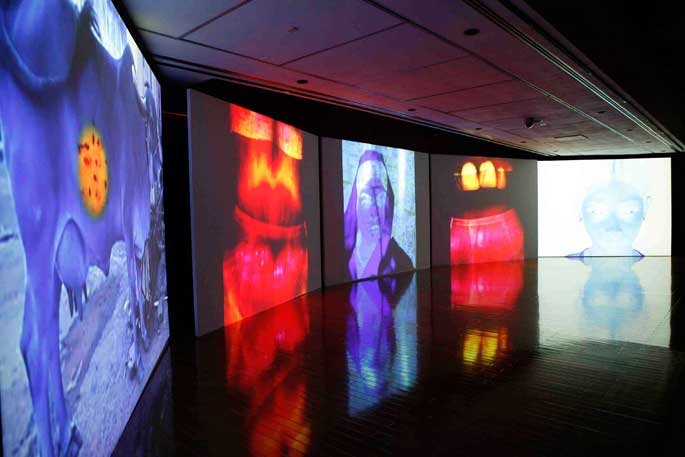
Malani’s art has been widely exhibited and critically acknowledged for its intellectual rigor, formal innovation, and ethical urgency. Yet her significance also lies in the cultural work she has sustained around feminist discourse, including curatorial activism and collaborative projects that broaden the frame through which contemporary art in India engages public memory and social justice. The following account traces the artist’s formation, the evolution of her visual strategies, and her contribution to feminist art history.
Early Life & Formation
Nalini Malani was born in 1946 in Karachi when it was part of British India, a period immediately preceding widespread upheaval and displacement during the Partition. In the aftermath, her family moved first to Kolkata and, by 1958, settled in Mumbai. This early experience of migration and the dislocations of Partition formed a lasting substratum for her later meditations on trauma, memory, and belonging. Though the details of her family history are not the focus of her public narrative, the contours of departure and resettlement, threaded with the national rupture of 1947, became a recurring point of return in her sensibility.
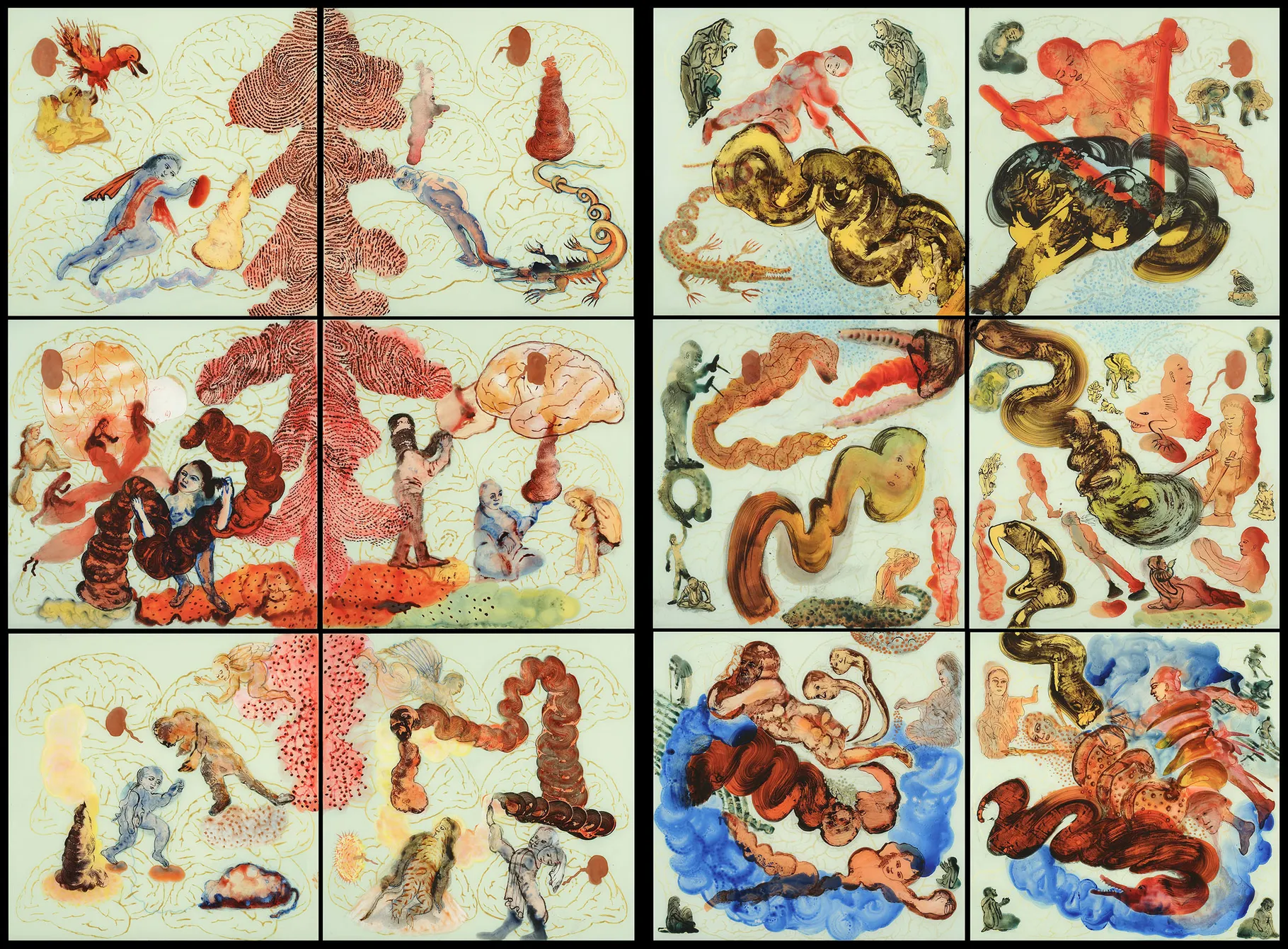
Between 1964 and 1969, Malani studied at the Sir Jamsetjee Jeejebhoy School of Art in Mumbai, where she received rigorous training in painting and drawing while absorbing a broader spectrum of modernist and contemporary practices. During this period she had a studio at the Bhulabhai Memorial Institute, an interdisciplinary hub that fostered exchanges across music, theatre, dance, and the visual arts. The Institute’s atmosphere of cross-pollination proved formative, opening pathways to methods that would later define her practice, including performance-inflected projects and multimedia installations in which image, text, and sound act in concert.
In the late 1960s, Malani participated in the Vision Exchange Workshop (VIEW), a crucial initiative led by Akbar Padamsee that brought together artists and filmmakers for experimental research in Bombay. Within VIEW she created early experimental films and produced photograms, testing the limits of the camera and the materiality of light-sensitive surfaces. These works aligned with an emergent art infrastructure alert to the moving image, while foreshadowing her later use of video and animation as central vehicles for narrative and critique.
A French government scholarship took Malani to Paris from 1970 to 1972. There she encountered European avant-garde practices and the intellectual reverberations of the political movements that followed 1968. The Paris years broadened her frame of reference, connecting her Indian modernist grounding to diverse international approaches in conceptual art, cinema, and performance. Exposure to a global artistic discourse during this period, together with her earlier experiments in Bombay, set the stage for a practice that would resist medium-specific boundaries, adopt a consciously feminist orientation, and return persistently to questions of social justice and historical memory.
Artistic Development & Style
Malani’s earliest mature work emerged through filmic experimentation. Stop-motion sequences, camera-less photograms, and hand-processed images cultivated a sensitivity to temporality, rhythm, and montage that would carry through her subsequent installations and animations. By refusing the stable singularity of the painted tableau, these early projects asserted the primacy of sequence and palimpsest-the image as something layered and transitional, rather than closed and complete.
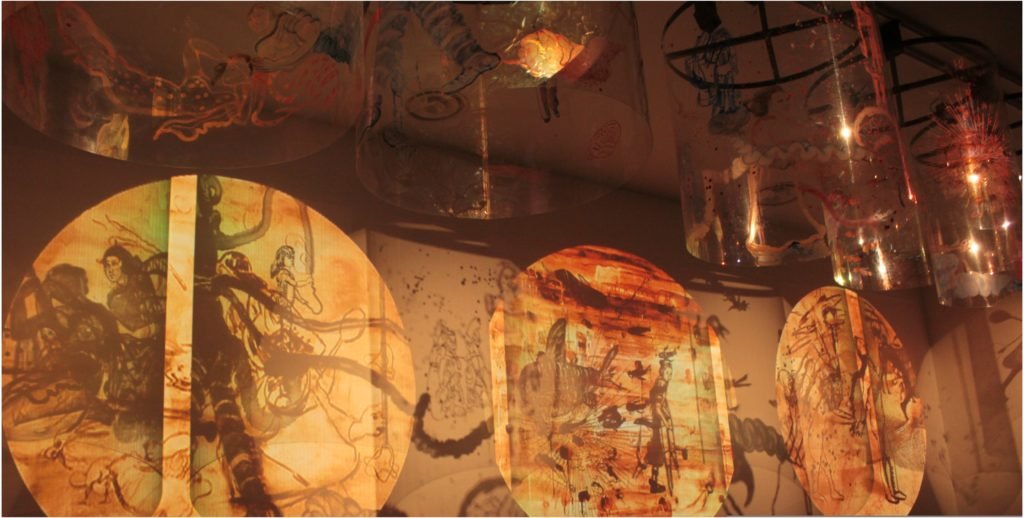
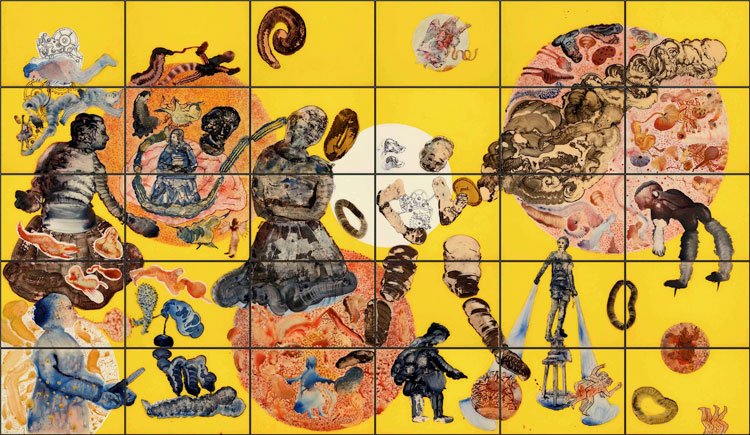
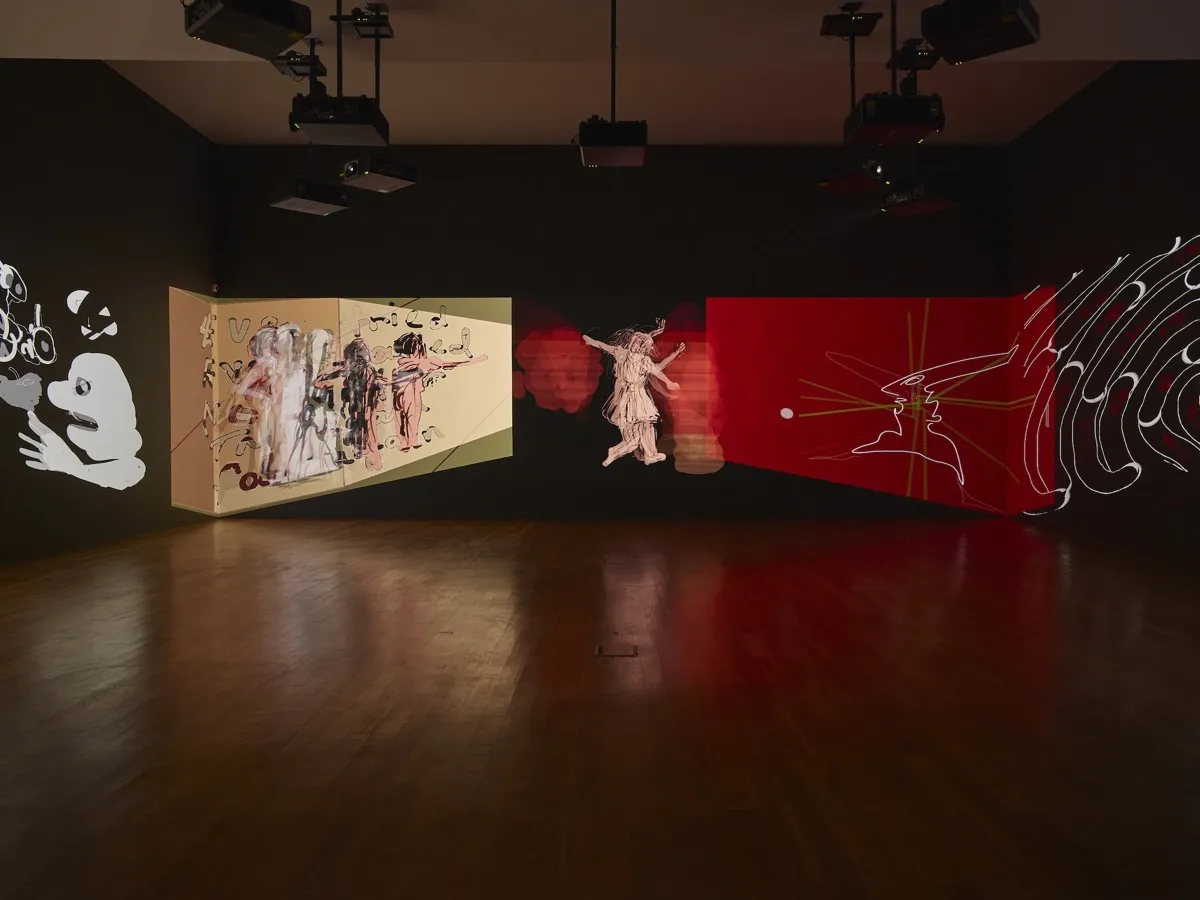
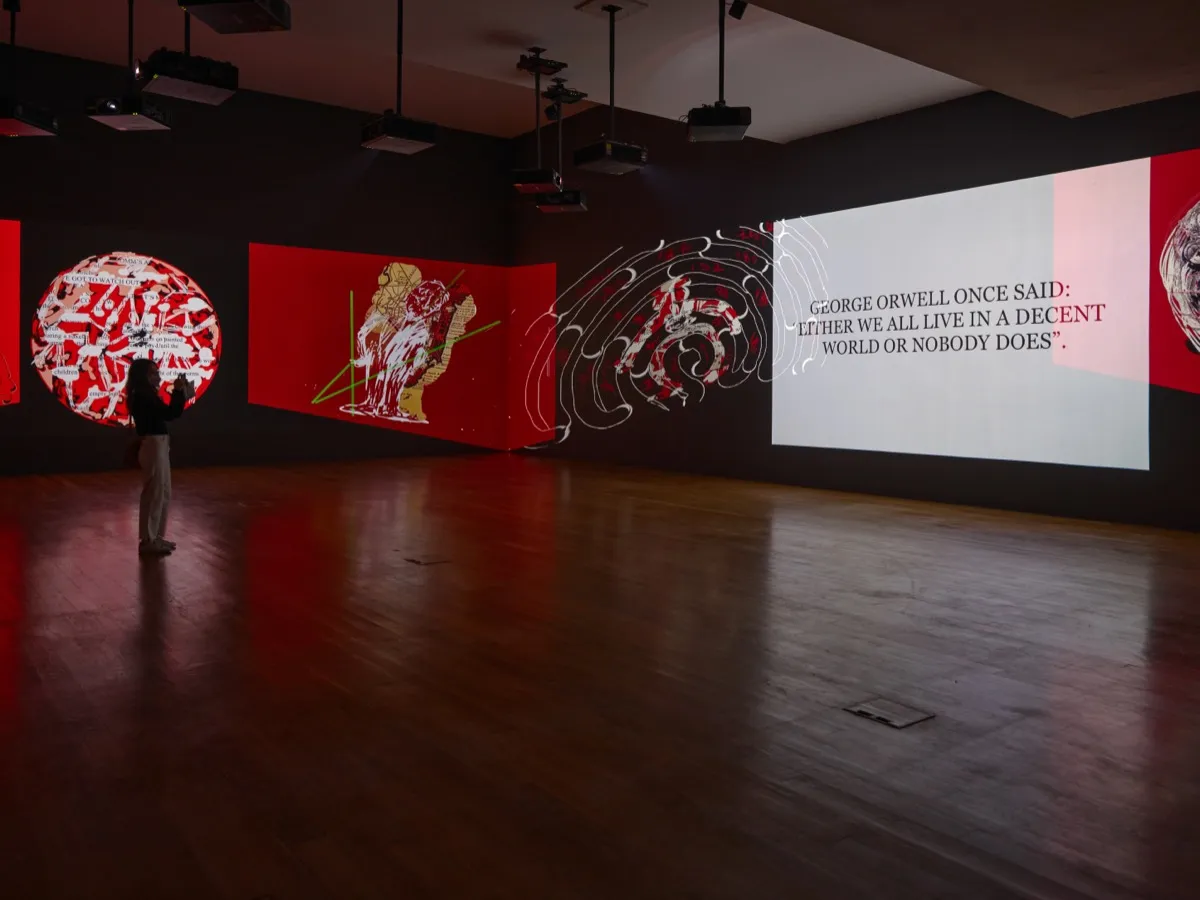
From this foundation she developed a painterly approach that expanded the notion of surface and transparency. Her reverse painting on acrylic sheets and Mylar-executed on the back of transparent supports-allowed her to build images in superimposed strata. When installed, lit, or combined with projected animation, these layered surfaces create complex spatial and optical effects. Figures and fragments slide across one another; text may hover over a face; an archetype appears and recedes in translucent depth. In many installations, painted cylinders, rotating elements, and suspended panels are illuminated so that shadows and reflections animate the surrounding space, transforming viewers into participants within a choreographed visual field.
The lexicon that informs Malani’s imagery draws from both Eastern and Western literary and visual traditions. Greek myths-Cassandra, Medea-and figures from the Ramayana and Mahabharata supply archetypes through which she considers prophecy, agency, violence, and exile. Her affinities include the work of Joan Miró, Louise Bourgeois, and Nancy Spero, as well as the moral gravitas and compositional density found in historical painters such as Hieronymus Bosch, Rembrandt, and Goya. These references are less a matter of stylistic borrowing than of dialogic resonance; they structure a multidirectional conversation across epochs and cultures, allowing her installations to speak simultaneously to the present and to a shared, transhistorical inheritance of images and stories.
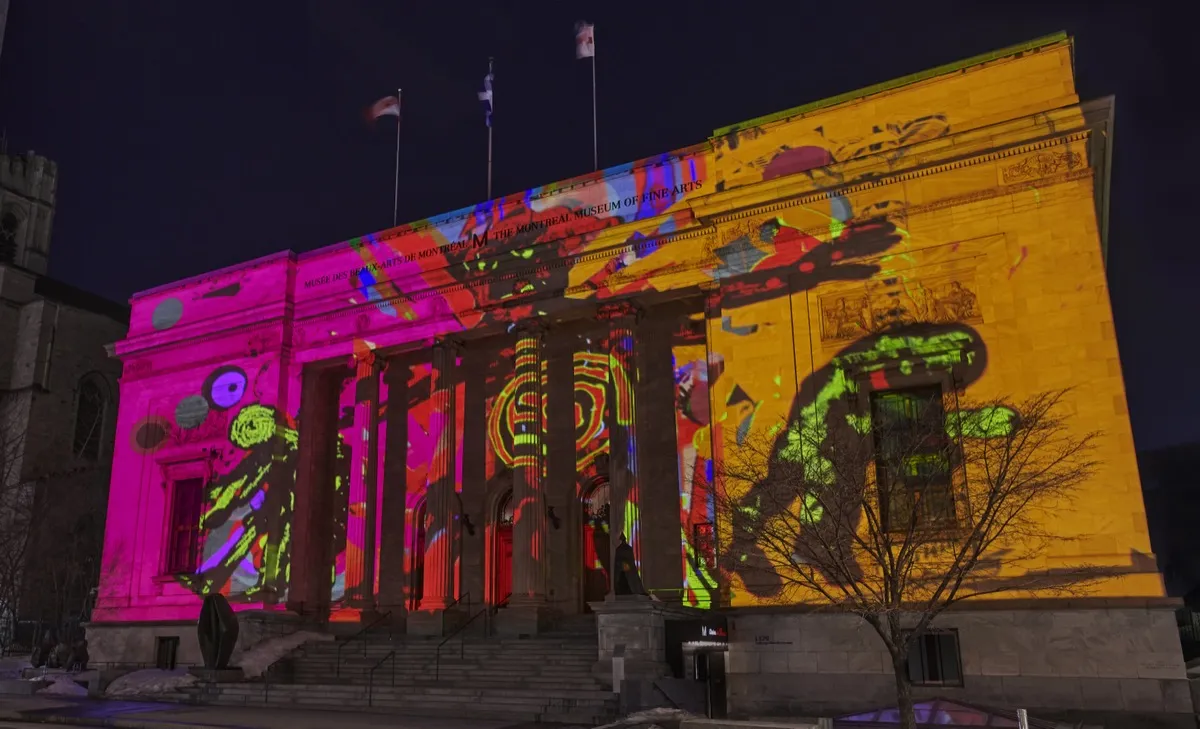
As her practice unfolded, Malani expanded into video-shadow plays and animation chambers-immersive environments where hand-drawn animations, often made with digital tablets, are combined with sound, text, and translucent painted elements. This fusion of traditional and new media underscores her resistance to disciplinary silos. Collaborations with anthropologists, dancers, theatre directors, and writers further enriched the dramaturgy of her installations, grounding her imagery in embodied performance and the social textures of speech and movement.
Malani’s aesthetic strategy often entails a dissonant coupling: visually alluring pigments and fluid lines are set against narratives of displacement, oppression, or historical trauma. Rather than resolve this tension into a didactic message, her works sustain ambivalence and multiplicity. The viewer encounters not a single perspective but a polyphony of voices, montaged across time and medium-an approach that articulates a specifically feminist skepticism of master narratives and singular authority.
Major Works & Exhibitions
Malani’s earliest films established a vocabulary of formal economy and psychological charge. Works such as Dream Houses (1969), Utopia (1969–1976), Still Life (1969), Onanism (1969), and Taboo (1973) explored the frame as an elastic container of desire, repetition, and memory. In their pared-down marks and experimental techniques, these films inaugurated a trajectory that would later expand into large-scale projection-based installations while retaining the emphasis on process, temporality, and montage.
From the late 1990s onward, Malani developed a series of video-shadow plays that epitomize her mature language. Remembering Toba Tek Singh (1998) invoked Saadat Hasan Manto’s story about Partition through a spectral theatre of shadows, voices, and painted transparencies. Hamletmachine (1999/2000) examined the political resonances of Heiner Müller’s text in a postcolonial frame. Gamepieces (2003) and Unity in Diversity (2003) articulated how social and political contradictions unfold as choreographed conflicts within the public imaginary. Mother India: Transactions in the Construction of Pain (2005) revisited the nation as a contested body, while Remembering Mad Meg (2007–2011) interwove apocalyptic female archetypes with contemporary anxieties. In Search of Vanished Blood (2012) crystallized her method: myth, testimony, and moving image layered into an immersive field where prophecy and witness become inseparable.
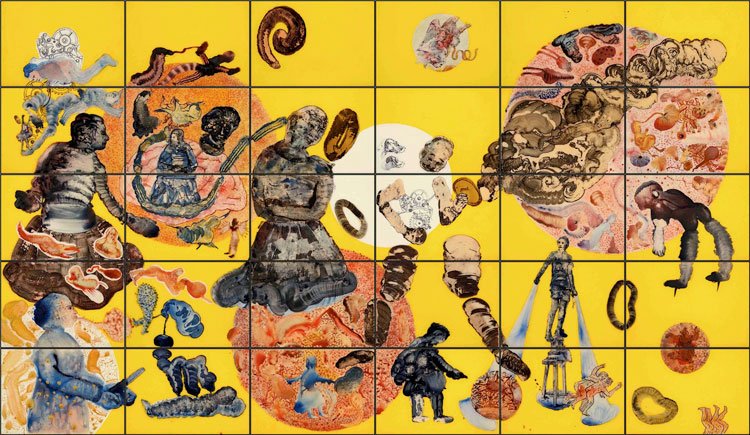
Parallel to these environments, Malani has pursued painting series that sustain narrative over time. Stories Retold (2004–ongoing) reconsiders canonical tales as living archives, while Listening to the Shades (2007) and Part Object (2008) turn to the spectral residues within objects and bodies. Sita I and II (2006) and Radha (2006) address female figures from Indian epics and devotional traditions, placing them in dialogue with present-day agency and vulnerability. All We Imagine as Light (2017) extends this engagement with illumination as both metaphor and technique, cohering the artist’s long-standing interest in luminescent surfaces, layered images, and ephemerality.
Installations such as City of Desires (1992–present) map urban aspiration and precarity through evolving constellations of imagery and text. Can You Hear Me? (2018–2020) marked a synthesis of hand-drawn animations-produced on digital tablets-and a charged response to gendered violence, configuring a chamber where drawings, sound, and projection form a lattice of signs and appeals. Ballad of a Woman (2023) continued this trajectory, as does Of Woman Born (2026), which underscores Malani’s enduring attention to the psychic and material conditions of women’s lives. These installations are not static displays; they unfold as temporal spaces, their painted or projected forms often altered, erased, or reconfigured in subsequent iterations, emphasizing the contingency of memory and the ethics of witnessing.
Malani’s institutional presence is well established. Over the course of her career she has presented more than three hundred exhibitions worldwide, including twenty solo museum exhibitions in the last two decades. Major retrospectives have taken place at the Centre Pompidou, Paris (2017), Castello di Rivoli Museo d’Arte Contemporanea, Italy (2018), and the Kiran Nadar Museum of Art, New Delhi (2014). Her work has been shown at the Whitechapel Gallery, London; M+, Hong Kong; Art Gallery of South Australia, Adelaide; the National Gallery, London; the Montreal Museum of Fine Arts; the Irish Museum of Modern Art, Dublin; the New Museum, New York; the Stedelijk Museum, Amsterdam; and the Peabody Essex Museum, Salem, among other institutions. She has also participated in major international biennials, including the Venice Biennale (2005, 2007), dOCUMENTA 13 (2012), the Shanghai Biennale (2018), the Biennale of Sydney (2008), and the Seoul Biennale (2004). Her works are held in over thirty museum collections globally.
Themes, Philosophy & Approach
Malani’s practice is anchored by a feminist commitment to amplify silenced and marginalized voices, particularly those of women. This commitment operates at several levels. It informs the figures and stories she chooses to stage, the collaborative and interdisciplinary methods she adopts, and the installations’ organization as plural, multi-perspectival spaces. Rather than presenting the viewer with a singular thesis, her works assemble testimony-images, texts, and sounds that accumulate into an ethical demand. The viewer is asked not only to see but to listen, to hold contradictory narratives, and to remain attentive to what official histories neglect.
Myth and literature form the conceptual spine of this approach. Characters such as Cassandra and Medea appear not as distant relics but as living metaphors for prophecy ignored, rage contained, or agency wrested from constraint. Figures from the Ramayana and the Mahabharata likewise emerge as lenses for understanding contemporary gendered forms of violence, exile, and endurance. By placing these archetypes beside modern social realities, Malani activates them as diagnostic tools, revealing how mythic structures persist within everyday life and how they can be reimagined to counter marginalization.
Formally, her installations cultivate a collage-like sensibility, both visual and sonic. Partial images overlay one another across transparent surfaces; text slips between languages; whispered testimonies mingle with ambient sound. The result is not a seamless synthesis but a deliberately open weave, attentive to disjunction and rupture. Malani frequently stages a tension between seductive chroma and difficult content, a strategy that slows looking and asks viewers to negotiate beauty’s proximity to violence. This dynamic is central to her feminist visual language: the surface is a lure that discloses the structures beneath it, and the artwork’s luminosity becomes a site where seeing is inseparable from ethical response.
Ephemerality is a recurring principle. Works are often provisional, with wall drawings erased, surfaces repainted, and installations reconfigured. This embrace of impermanence carries philosophical weight. It resists commodification by refusing the permanent, singular object, and it mirrors the fragility of memory that her narratives continually evoke. In tandem with these strategies, Malani’s use of animation chambers and video-shadow plays underscores her investment in theatrical temporality. The installation becomes an environment of duration and change, where stories do not end but cycle, overlap, and refract. Such staging is consistent with a feminist critique of closure: by sustaining openness, her works allow for counter-narratives to remain audible and for histories to be retold.
Critical Reception & Influence
Critics and scholars have long recognized Malani as a pioneering figure in Indian video art and experimental film. Her work is distinguished for integrating feminist perspectives with political and social critique, articulated through a vocabulary that merges painting, drawing, projection, and sound into immersive experiences. The capacity to align mythic narrative with contemporary testimony has been widely noted, producing a visual language that resonates across cultural contexts without flattening difference. Commentators emphasize the intellectual rigor and emotional reach of her projects, as well as the formal ingenuity with which she adapts techniques from disparate media to serve a coherent dramaturgy of witnessing.
Malani’s influence extends beyond her studio practice. She has played a significant role in advancing feminist art discourse in India and internationally, including organizing the first all-female art exhibition in India in 1985. Her curatorial activism and interdisciplinary collaborations have expanded the terrain in which women’s histories and voices are engaged within institutional and public spaces. Subsequent generations of artists cite her example in adopting multimedia strategies, exploring myth as a contemporary tool, and foregrounding ephemerality as both a formal and ethical choice.
Her contributions have been recognized through major awards, among them the Joan Miró Prize (2019), the Fukuoka Asian Art Prize (2013), the St Moritz Art Masters Lifetime Achievement Award (2014), and the Asia Game Changer Award (2016). She received an Honorary Doctorate from the San Francisco Art Institute (2010) and was selected for the first National Gallery Contemporary Fellowship in London. Critical discourse has attended in particular to her use of erasure and transience as strategies that challenge market permanence while insisting on art’s responsibility to social memory. In this light, her installations are read as civic acts: spaces where complex histories can be encountered and where the presence of the viewer is folded into the ethics of remembrance.
Conclusion
Nalini Malani’s achievement lies in forging a feminist visual language that is at once historically grounded and formally expansive. Drawing from early experiments in film and photography, she developed a poetics of layering and illumination that has reshaped how narratives can be staged in contemporary art. Her persistent engagement with Partition, colonial legacies, and social inequities-articulated through the voices of mythic and literary figures-yields works that function as laboratories of memory and empathy. By combining traditional and digital media, and by embracing ephemerality as a principle, she maintains an art of process rather than monument, attuned to the fluidity of histories and to the need for continual retelling.
Malani’s installations do not resolve contradictions; they orchestrate them, making space for silenced perspectives to become audible and for viewers to assume the responsibility of listening. In doing so, she has shaped a path for artists seeking to link aesthetics with ethical inquiry, and she has expanded the possibilities of what feminist art can look like and how it can operate within institutions and public culture. Her work remains a touchstone for the integration of myth, memory, and social critique in multimedia form, and its influence endures in the evolving conversations about art’s capacity to hold and transform shared histories.