
Kumartuli and the Tradition of Idol Sculpture in Kolkata
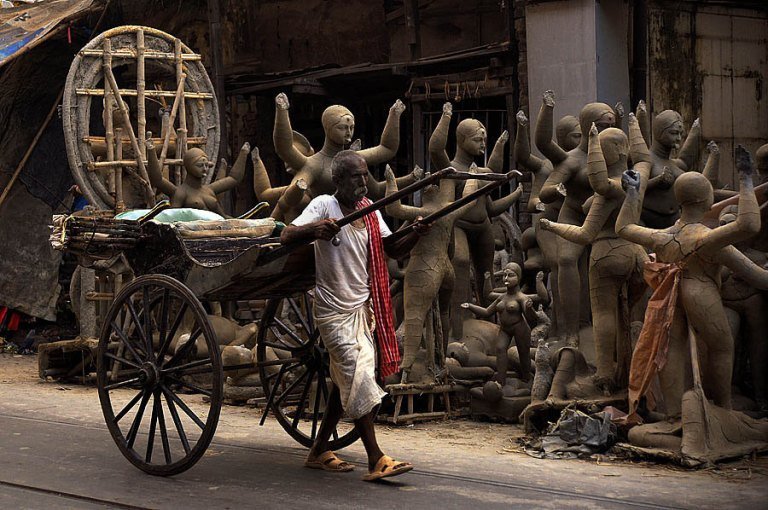
Kumartuli, in the northern quarters of Kolkata, West Bengal, is a historic enclave of potters whose livelihood and identity are closely tied to the crafting of clay idols for religious worship. The neighbourhood’s reputation rests largely on its role in producing unfired clay idols of Hindu deities, most notably the goddess Durga and her familial retinue, for annual festivals including Durga Puja, Lakshmi Puja, and Kali Puja. This work is not merely artisanal production but an embedded cultural practice in which material techniques, ritual timelines, and community relations converge. The locality is also a spatial arrangement where living and working conditions overlap: modest homes double as workshops, and narrow lanes become corridors of seasonal transformation as raw bamboo, straw, and clay are reshaped into ephemeral sacred images.
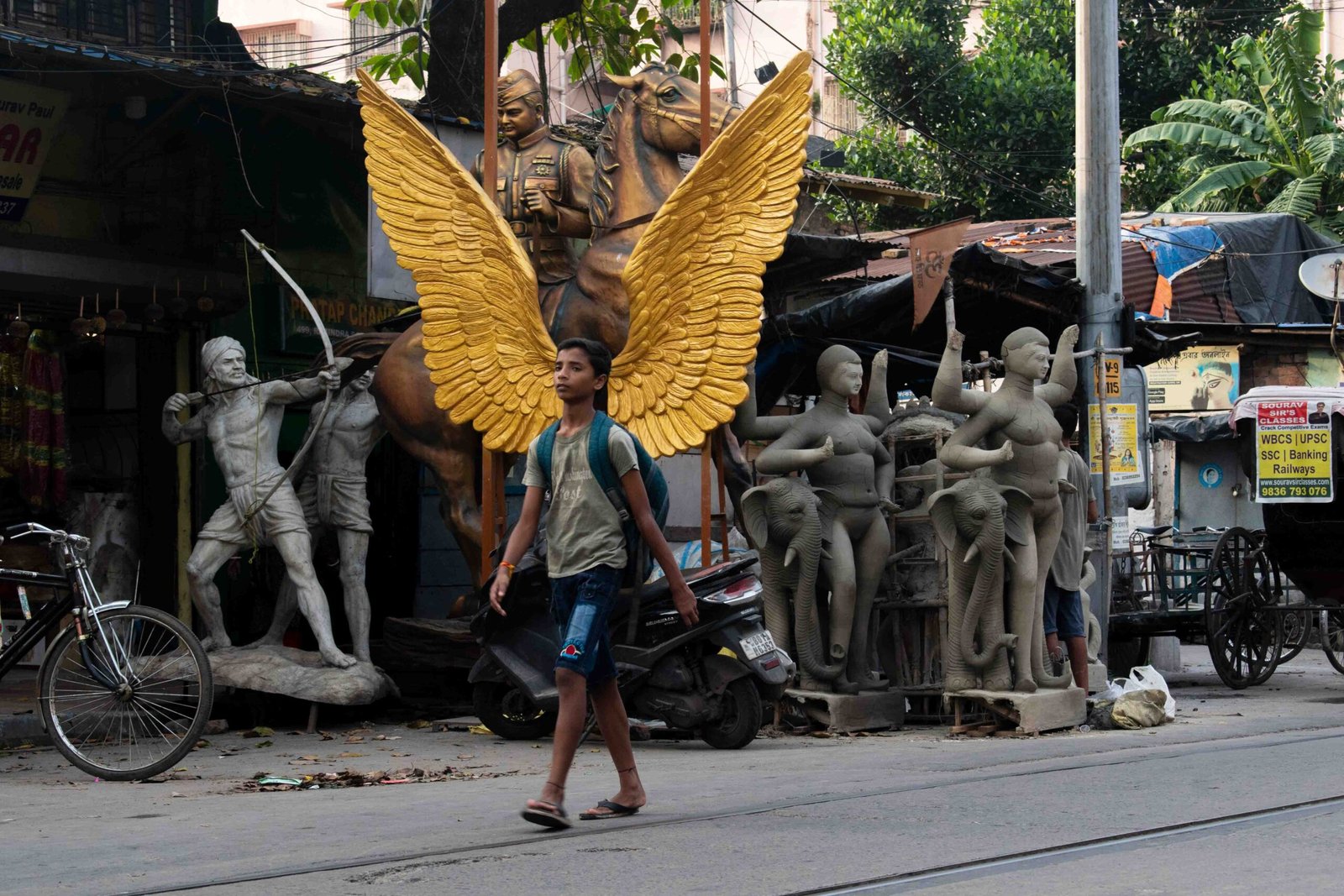
Kumartuli’s craft economy belongs to the largely informal sector and is sustained by overlapping networks of kinship and caste, seasonal migration, and longstanding client relationships. Alongside the potters’ studios, a dense assemblage of ancillary trades-such as shola (pith) carving, ornament production, and pandal construction-contributes to the seasonal ecology of festival preparation. As a whole, the neighbourhood functions as a specialized cluster that aligns material practice with ritual demand, shaping Kolkata’s religious calendar and, in a broader sense, the cultural identity of Bengal.
Origins & Historical Background
The formation of Kumartuli as a potters’ quarter dates to the seventeenth and eighteenth centuries, when artisans of the kumar caste migrated from regions including Krishnanagar and Nabadwip to the growing urban center of Kolkata. The Bengali words for potter (kumar) and neighbourhood (tuli) combine to name the settlement and signal its occupational focus. Early on, the potters’ proximity to affluent zamindars and babu households proved foundational. These elites commissioned clay idols for household worship and ritual events, providing reliable patronage and anchoring the community’s artisanal specialization in a specific urban locale.
The occupational identity of the kumar caste, part of the Sudra group within Bengal’s caste system, historically encompassed pottery and idol-making. This social positioning, coupled with urban patronage, set the conditions for the craft’s growth. Over time, the pattern of demand shifted significantly. While Durga Puja had been primarily an elite household ritual, the late eighteenth and early nineteenth centuries saw the rise of community-sponsored celebrations-known as baroyari or sarbojonin pujas. This transition from private to collective worship increased the scale and frequency of idol commissions and further concentrated specialized makers within Kumartuli’s lanes.
Migration continued to shape the neighbourhood’s craft ecology. The Partition of Bengal and India in 1947 brought an influx of potters from East Bengal to Kolkata. Their arrival complicated local dynamics, introducing social tensions alongside an expanded pool of skilled labour. Yet the broader effect was the reinforcement of Kumartuli as an artisanal hub where shared occupation, caste affiliation, and migration histories gave rise to overlapping networks of collaboration and competition. The layering of patronage, occupational identity, and mobility yielded a place that is both historically specific and dynamic, adapting to shifts in ritual practice and urban society.
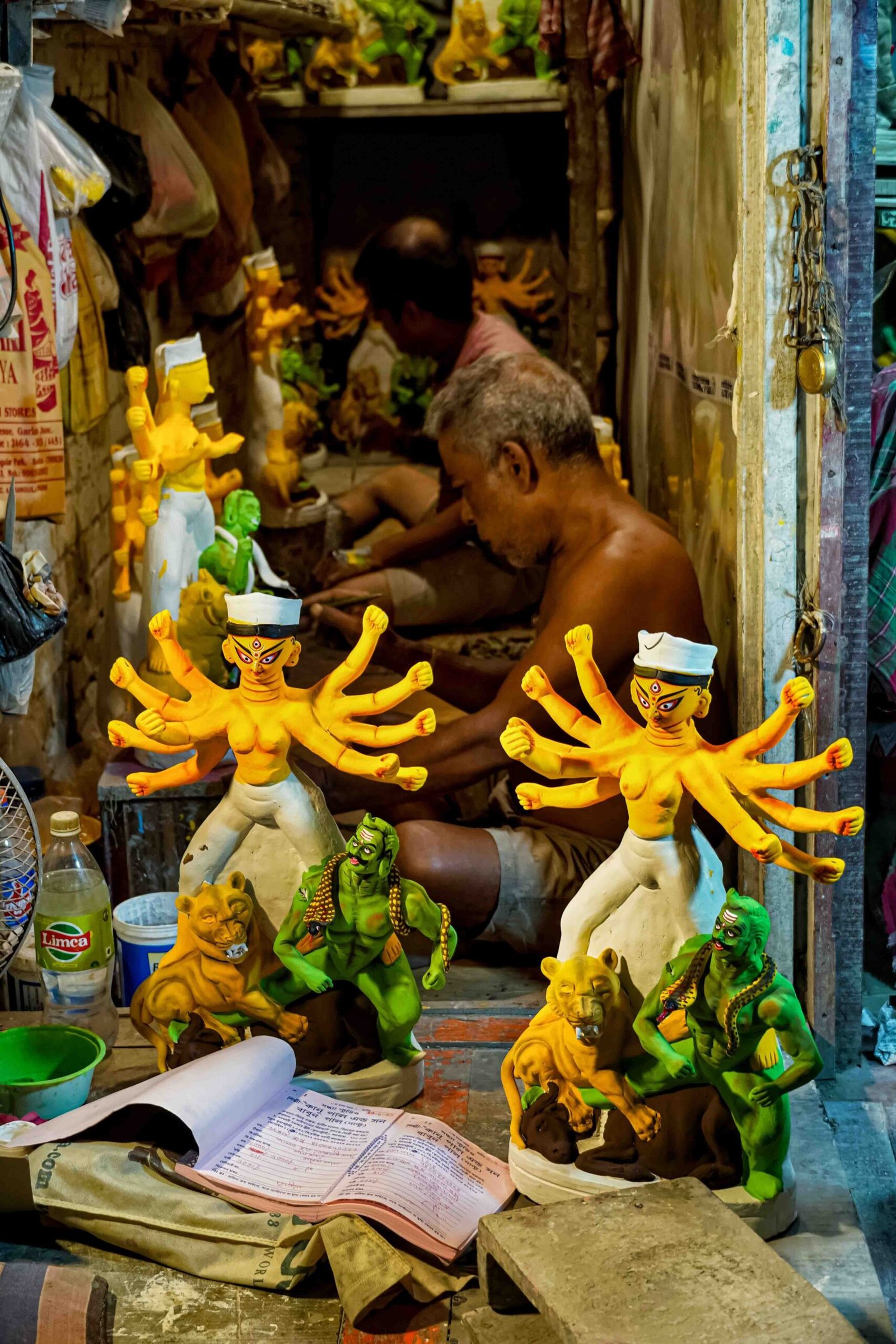
Across these transformations, Kumartuli evolved into a recognizable cultural landmark: a neighbourhood identified not by monumental architecture or formal institutions but by the seasonal rhythms of making and the continuity of techniques and forms. Its history is legible in the ways clay and straw continue to be assembled and imbued with sacred meaning, even as the styles and client base diversify.
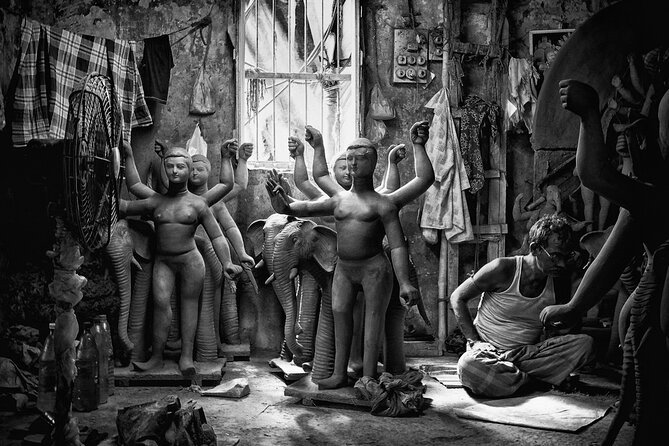
Materials & Techniques
At the core of Kumartuli’s practice is a multi-stage process that turns humble materials into large-scale, iconographically precise images. The foundation is the kathamo, a structural skeleton constructed from bamboo and wooden slats. Artisans cut and bind these elements to define posture and mass, engineering stability for figures that often rise above human height. Bamboo has traditionally arrived along river routes, particularly via the Hooghly, embedding the river within the material geography of the craft.
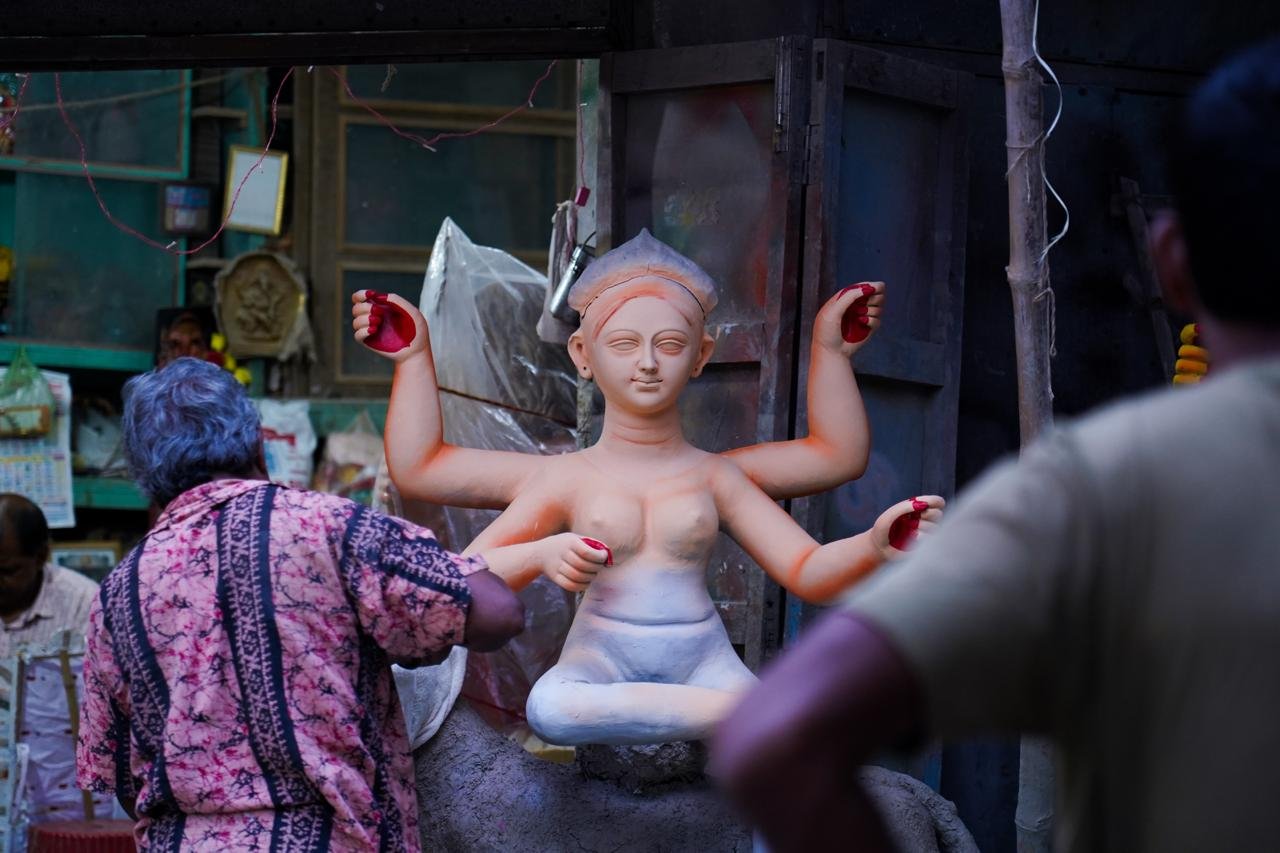
Over the frame, artisans build the straw core known as the bena. Straw-procured seasonally from rural agricultural areas-is wrapped and tightened with jute or coconut fibre ropes to establish the volume of torsos, limbs, and other forms. The process is both sculptural and architectural, requiring an understanding of balance, weight distribution, and the dynamic gestures associated with divine iconography. The straw understructure is then prepared for clay application, which occurs in carefully timed layers to achieve both durability and detail.
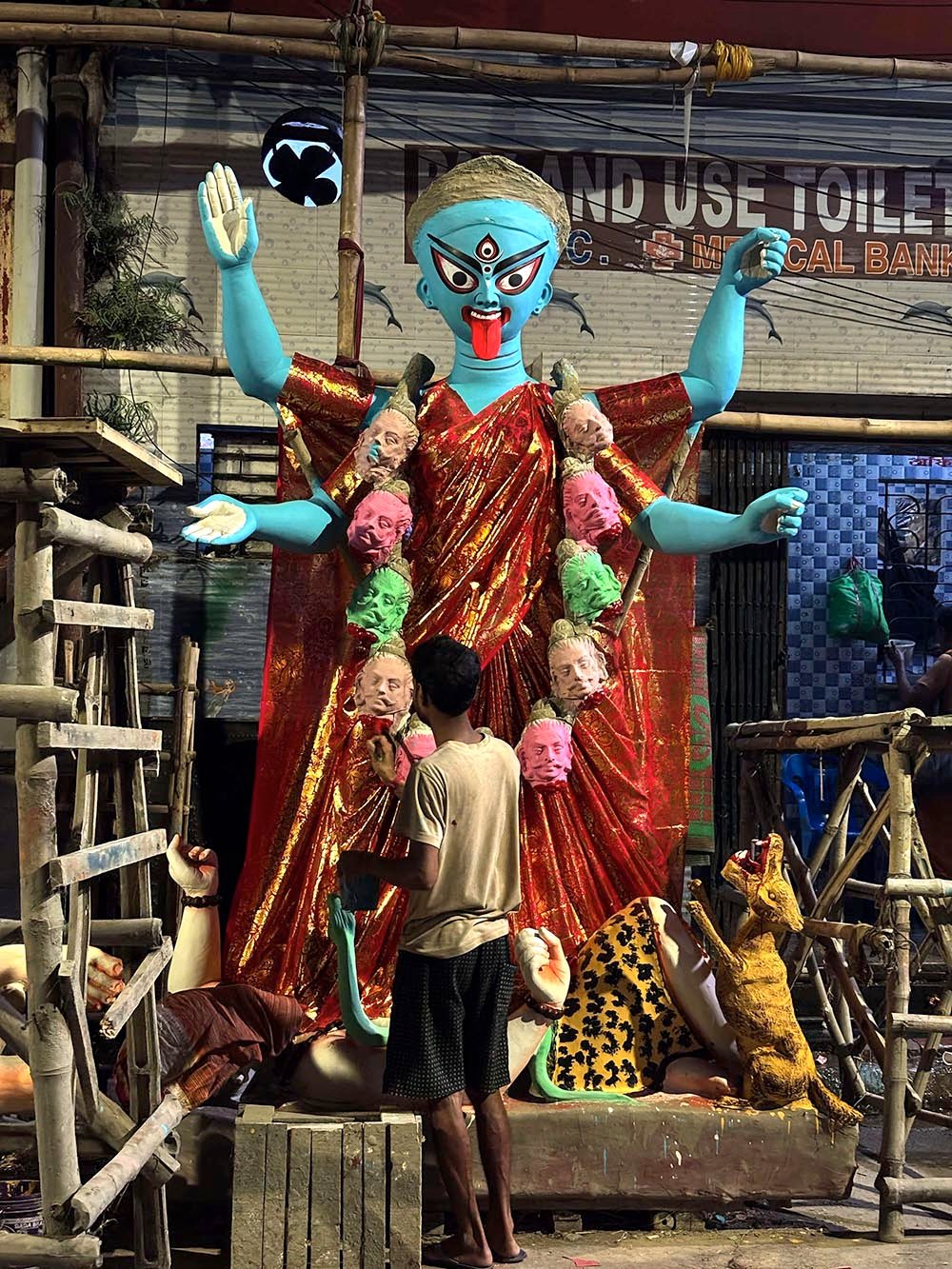
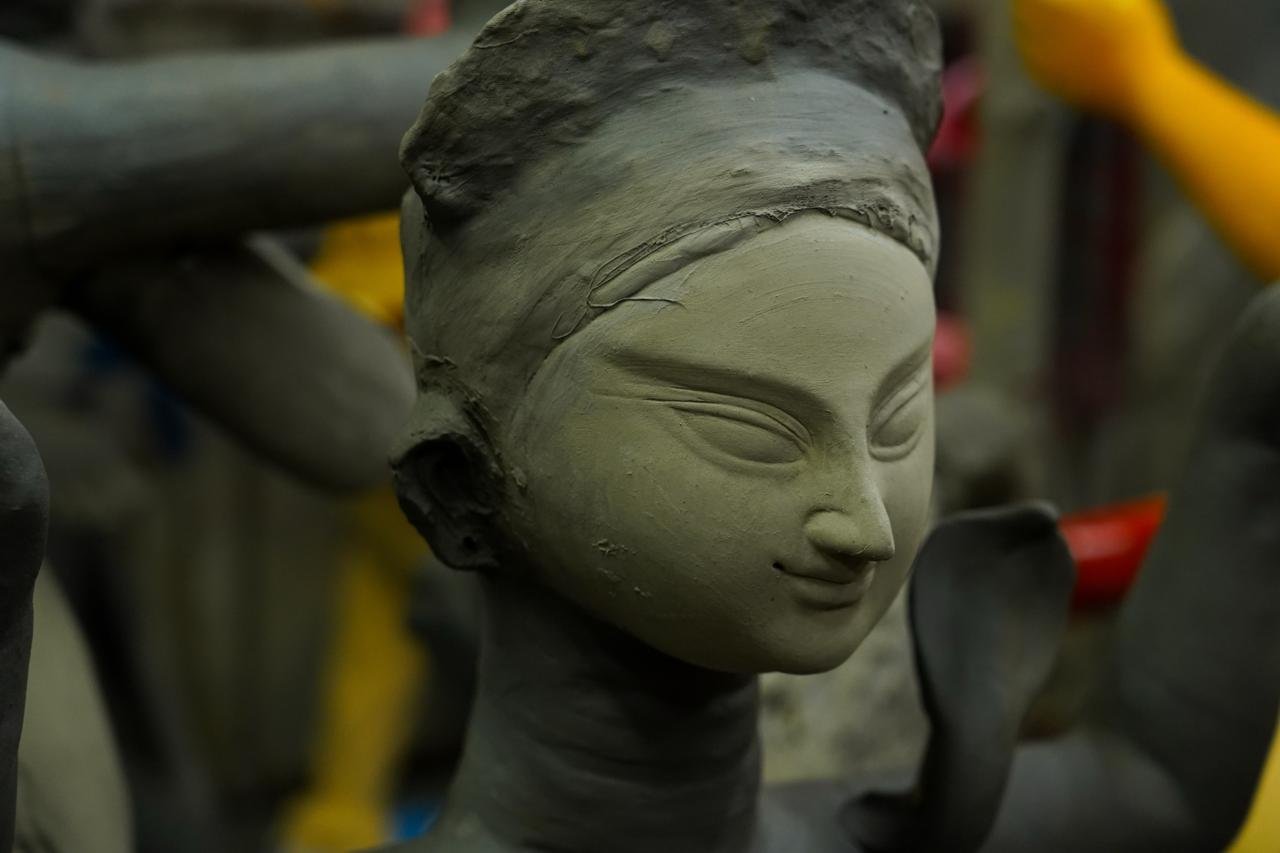
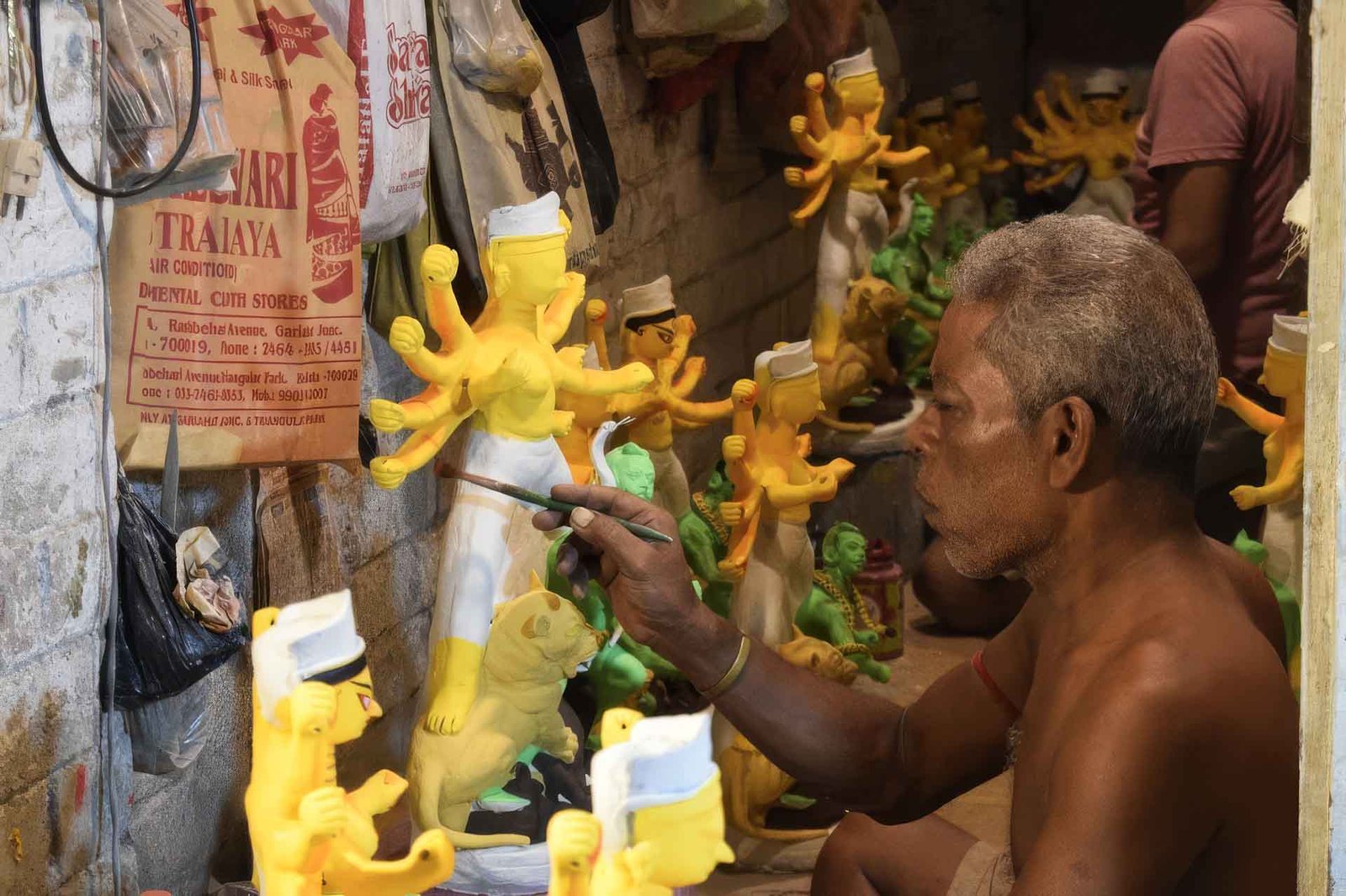
Two principal clays-bele mati, a sandy variety, and entel mati, a sticky humus-rich clay-are used in combination. Artisans apply initial coats of clay to consolidate the straw and refine contour, often reinforcing the surface with cotton cloth dipped in liquid clay. The layered approach stabilizes the figure and provides a ground for fine modeling. As the structure gains coherence, makers turn to detailing. Hands, feet, and facial elements are formed either from molds or by direct modeling with hand tools known as chiari, allowing for both standardized replication and individual expression. The concluding sculptural steps involve minutely adjusting line, proportion, and texture so that the figures respond convincingly to light and distance.
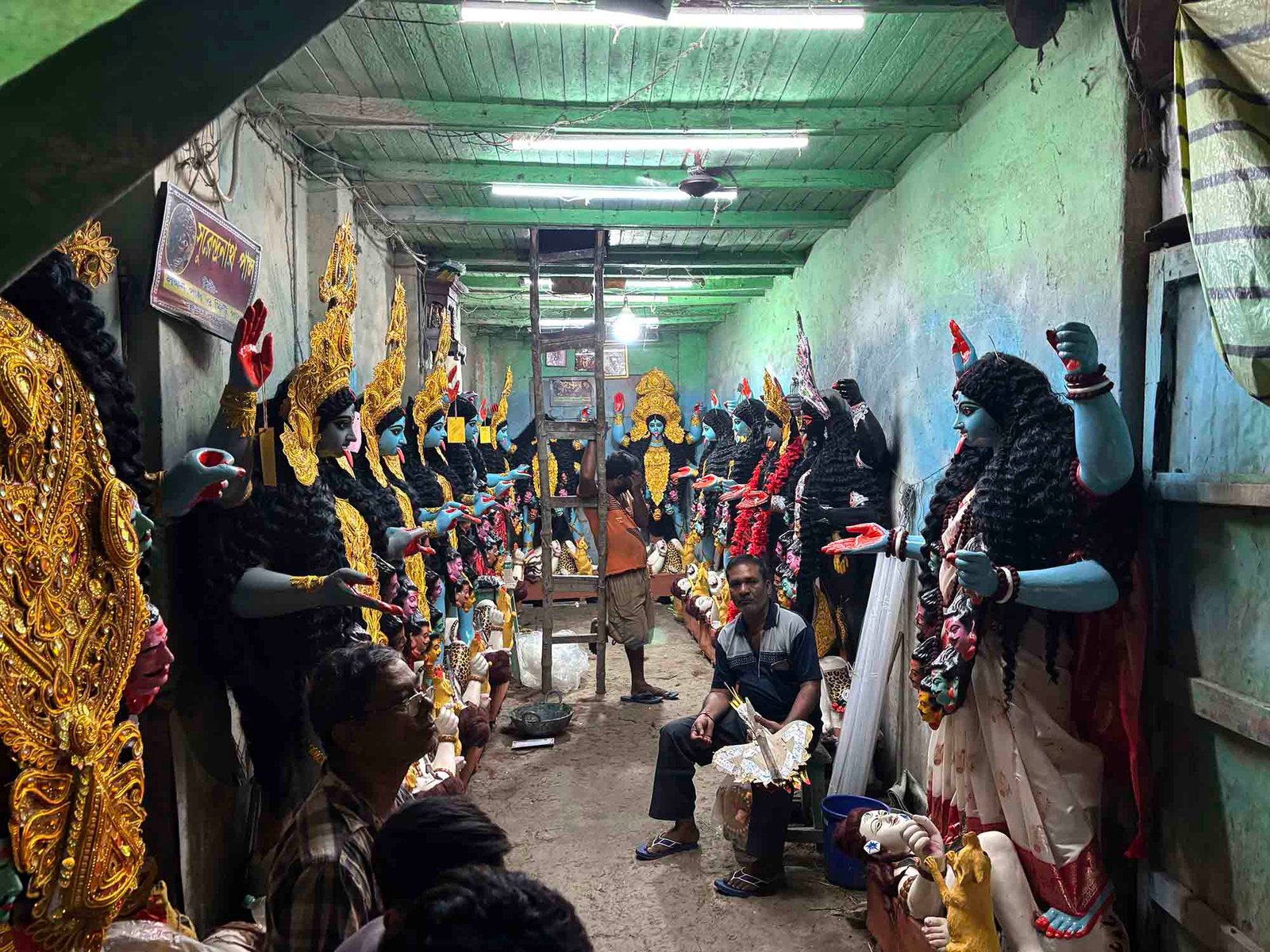
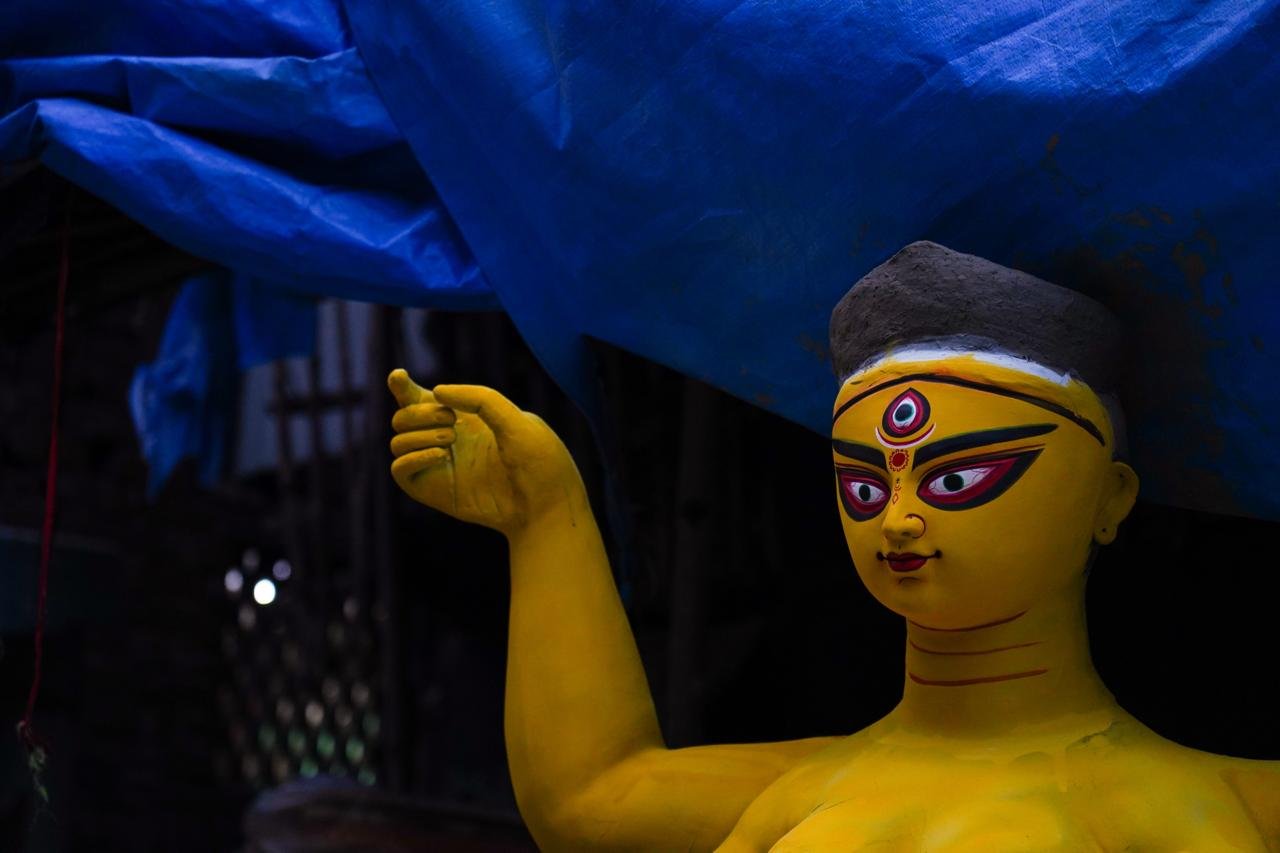
Once the clay is fully applied, the idols are sun-dried to prepare the surfaces for paint. Historically, natural pigments were used, but today chemical dyes and synthetic paints are common, reflecting shifts in availability, cost, and desired intensity of color. After base coats, features are articulated, and the idols are dressed with ornaments ranging from carved shola (pith) to zari work and a variety of synthetic embellishments. The final ritual act, chokkhudaan or eye painting, is traditionally reserved for the most skilled artist within the workshop. This moment marks the transition from crafted form to ritually charged image, a point at which the aesthetic and the sacred converge in a careful hand-painted gaze.
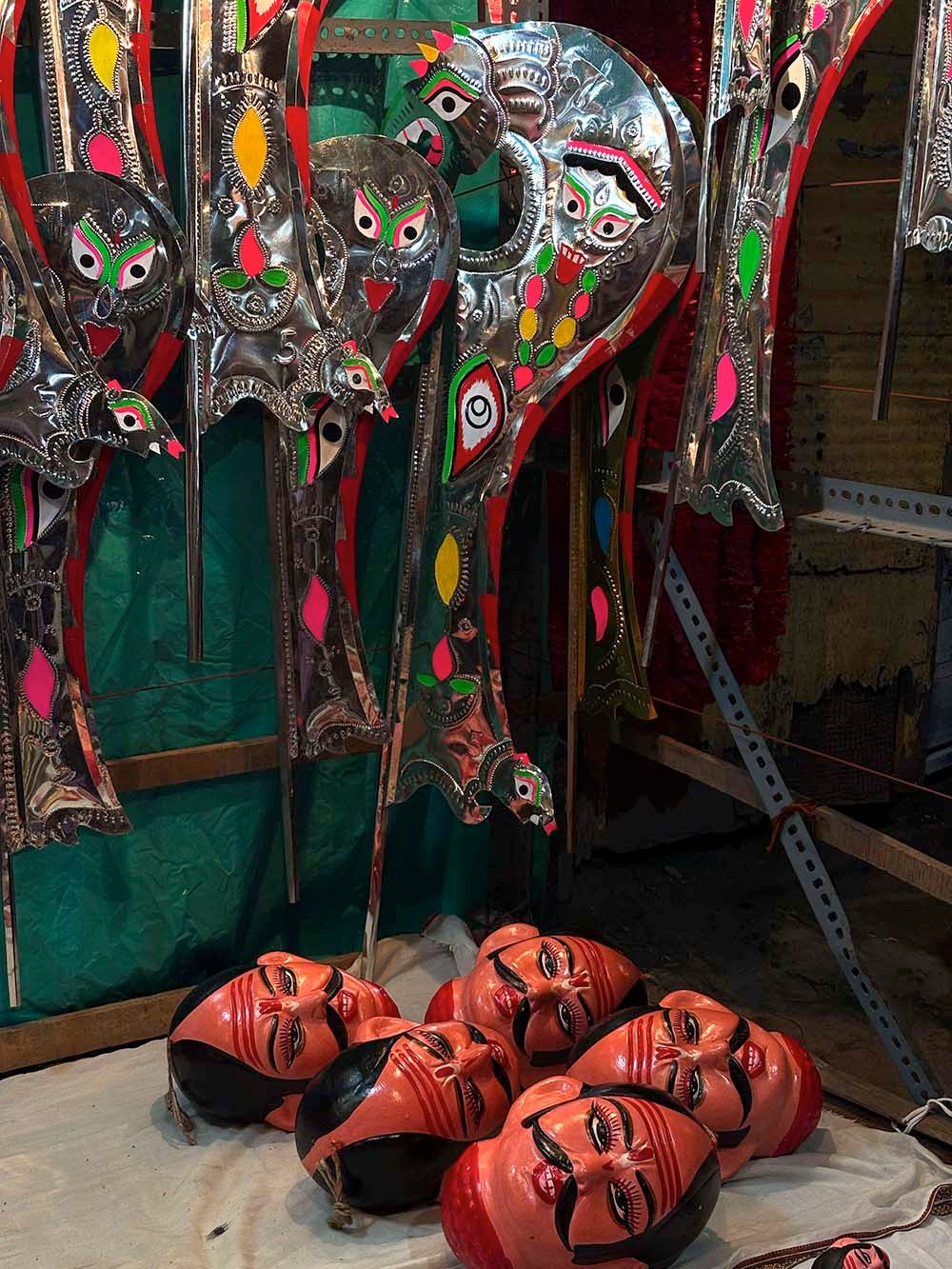
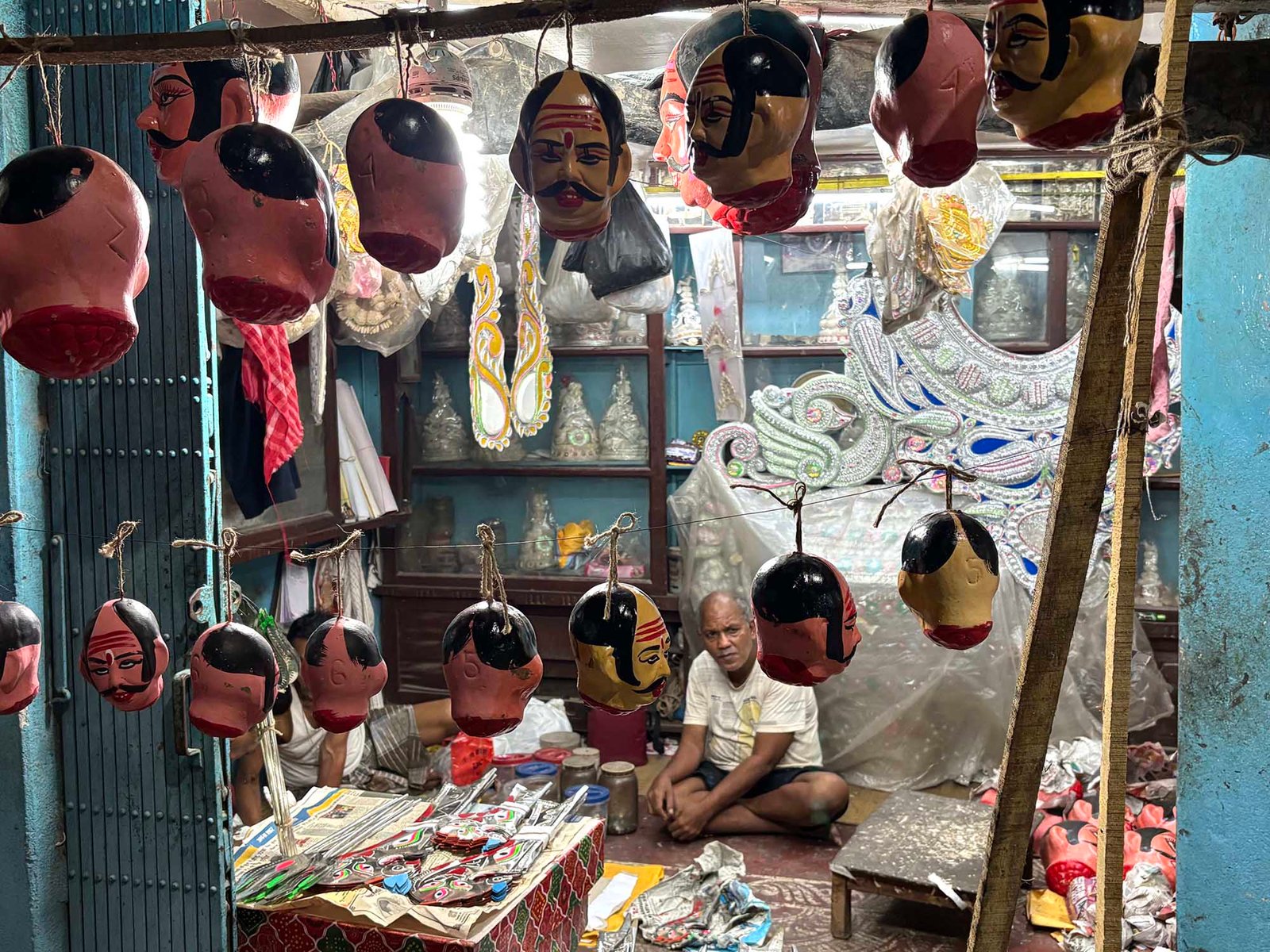
The production cycle is seasonal, with the most intense period leading up to Durga Puja. Workshops operate in tight coordination, relying on teams of principal artisans and assistants as well as seasonal migrant workers who handle clay mixing, straw binding, and painting. Modern adaptations include the use of fiber-based materials for certain commissions and the development of thematic or contemporary styles, particularly for high-budget festivities and international orders. These adaptations do not replace the clay-based canon so much as expand the repertoire of techniques and visual effects that artisans deploy in response to evolving tastes and logistical demands.
Aesthetic Language & Variations
Kumartuli’s aesthetic vocabulary is neither static nor idiosyncratic; it is a cumulative language shaped by regional tastes, historical encounters, and the circulation of images through patronage networks. A traditional strand, often referred to as sabeki, carries traces of colonial-era beauty ideals. In this register, the faces of Durga and her attendants show a resemblance to the refined, stylized features associated with British women of that period, reflecting the sensibilities of elite patrons who commissioned idols for household worship.
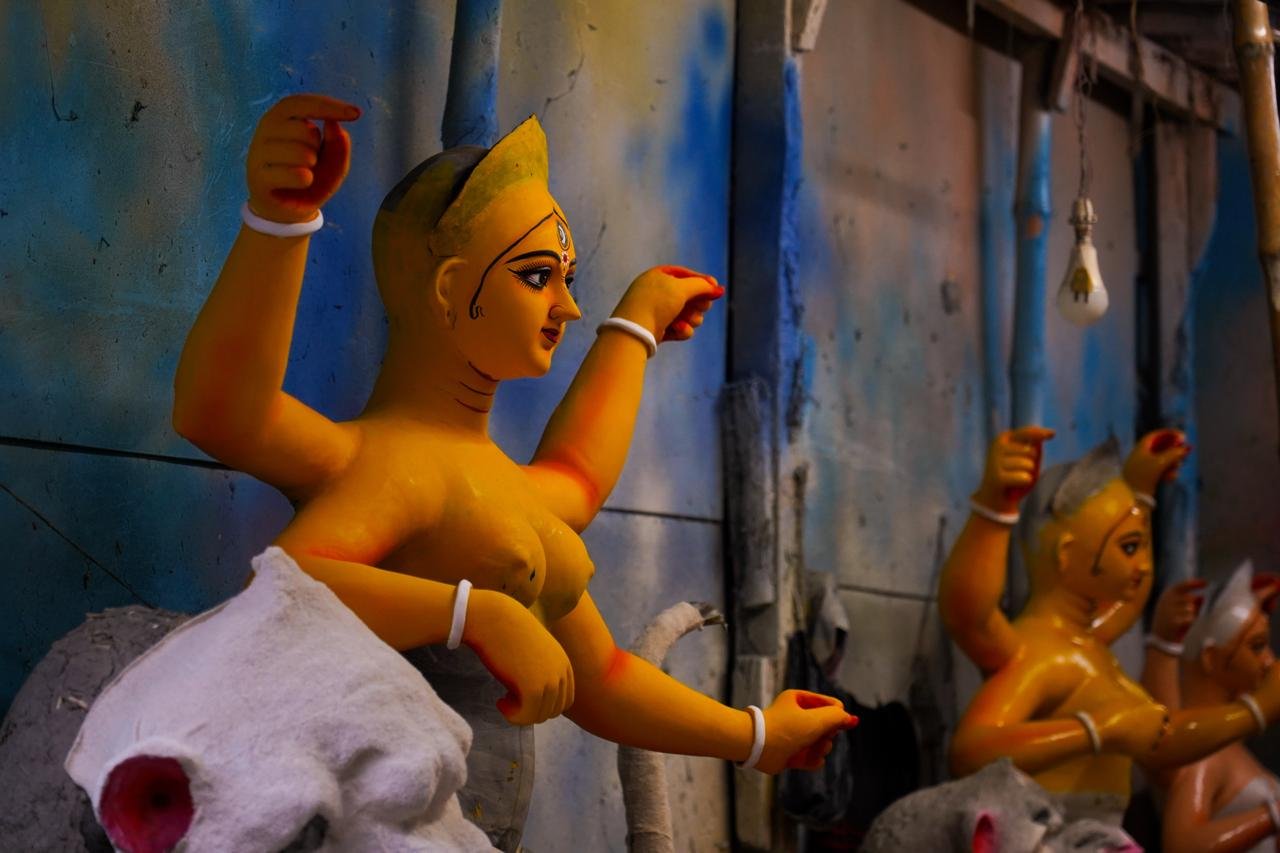
Alongside this strand, the Bangla style-introduced by potters migrating from East Bengal-offers a different articulation of divinity. Faces are fuller and more anthropomorphic, with softer contours and human-like eyes evoking Bengali familial femininity. This approach reads the goddess through the lens of the mother figure, emphasizing approachability without diluting the majesty of the icon. The co-presence of these idioms in Kumartuli reveals an internally diverse aesthetic field in which artisans navigate preferences that vary by neighbourhood, patronage lineage, and community committee.
Contemporary trends add further dimensions. Some idols incorporate elements drawn from popular culture and media, with facial features echoing contemporary celebrity templates or stylizations associated with fashion imagery. Color palettes have become more vibrant, driven by the availability of synthetic pigments and a desire for visual impact within elaborate festival spaces. Ornamentation, too, has grown more profuse, integrating shola carving, zari work, synthetic jewels, and textiles ranging from traditional saris to designer-inspired drapery. These augmentations often spill into pandal architecture, creating immersive thematic environments in which the idol serves as the central node of a larger, coordinated display.
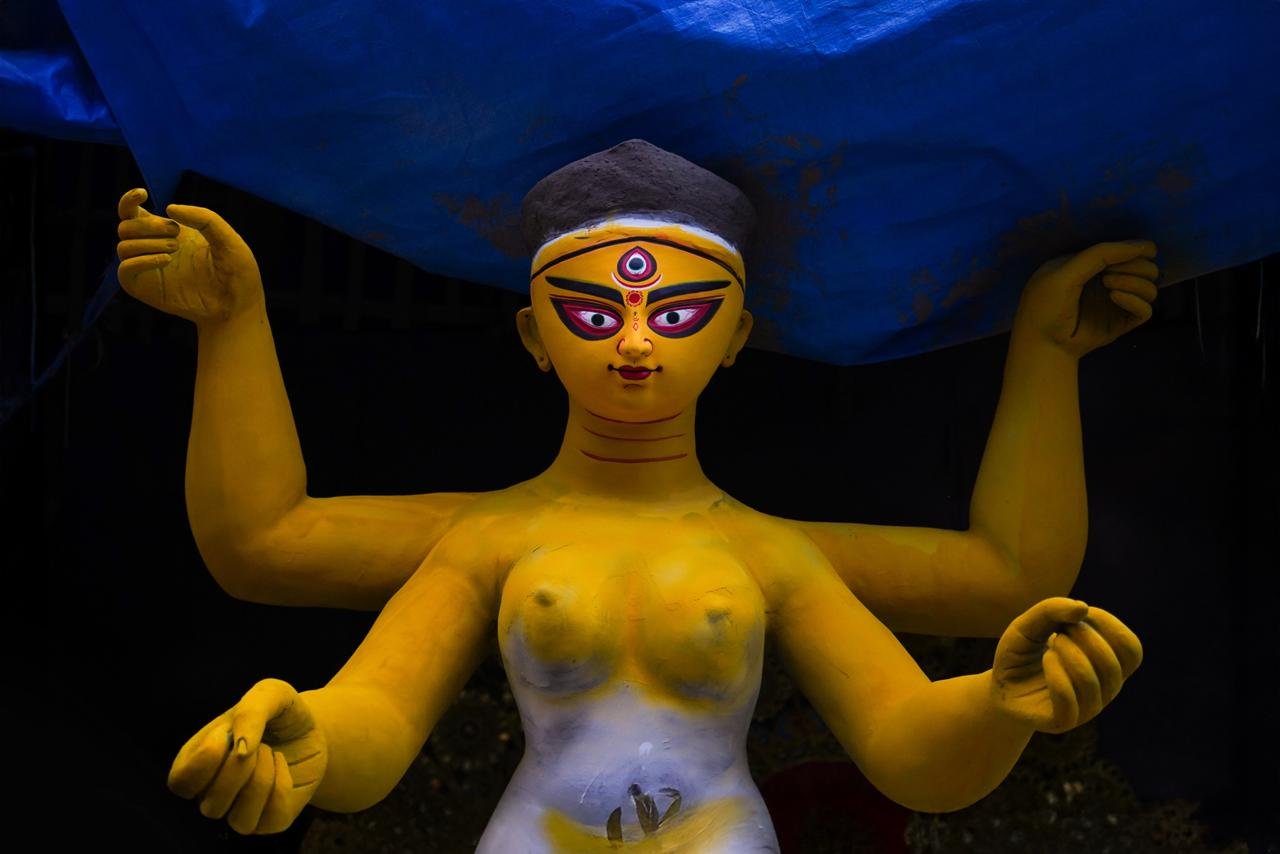
Despite these variations, the core iconography remains stable, grounded in religious texts and ritual expectations. Durga is depicted with ten arms, weapons at the ready, poised in triumph over Mahisasura, the buffalo demon. She is flanked by her children-Kartikeya, Ganesha, Lakshmi, and Saraswati-each with their designated attributes and vehicles. Even when the idiom shifts toward high theatricality or minimal abstraction, artisans preserve fundamental symbolic elements to safeguard ritual legibility. The result is a visual culture that is both codified and elastic, capable of absorbing new references while maintaining the integrity of its devotional grammar.
Makers & Knowledge Transmission
The artisans of Kumartuli are part of a caste-defined occupational community, and most trace their skills through familial lineage. Many begin as children, internalizing the rhythms of measurement, material handling, and iconographic proportion by assisting elders. Training is largely informal and embedded in the household-workshop. Apprentices observe and execute discrete tasks-rolling clay coils, preparing straw bundles, smoothing surfaces-before attempting more intricate modeling. This incremental pedagogy grounds aesthetic judgment in practice, with craft competence emerging from sustained repetition and close mentorship.
Gender roles in Kumartuli reflect longstanding social patterns. The profession has been largely male-dominated, particularly in structural and sculptural tasks. Women often contribute to painting, decoration, and the management of family businesses. There are female artisans who take on more central roles in modeling and design, though such trajectories remain less common and can involve navigating social challenges. This quiet diversification reflects changes in both opportunity and aspiration, yet detailed documentation of women’s roles requires further study to fully understand their contributions and constraints.
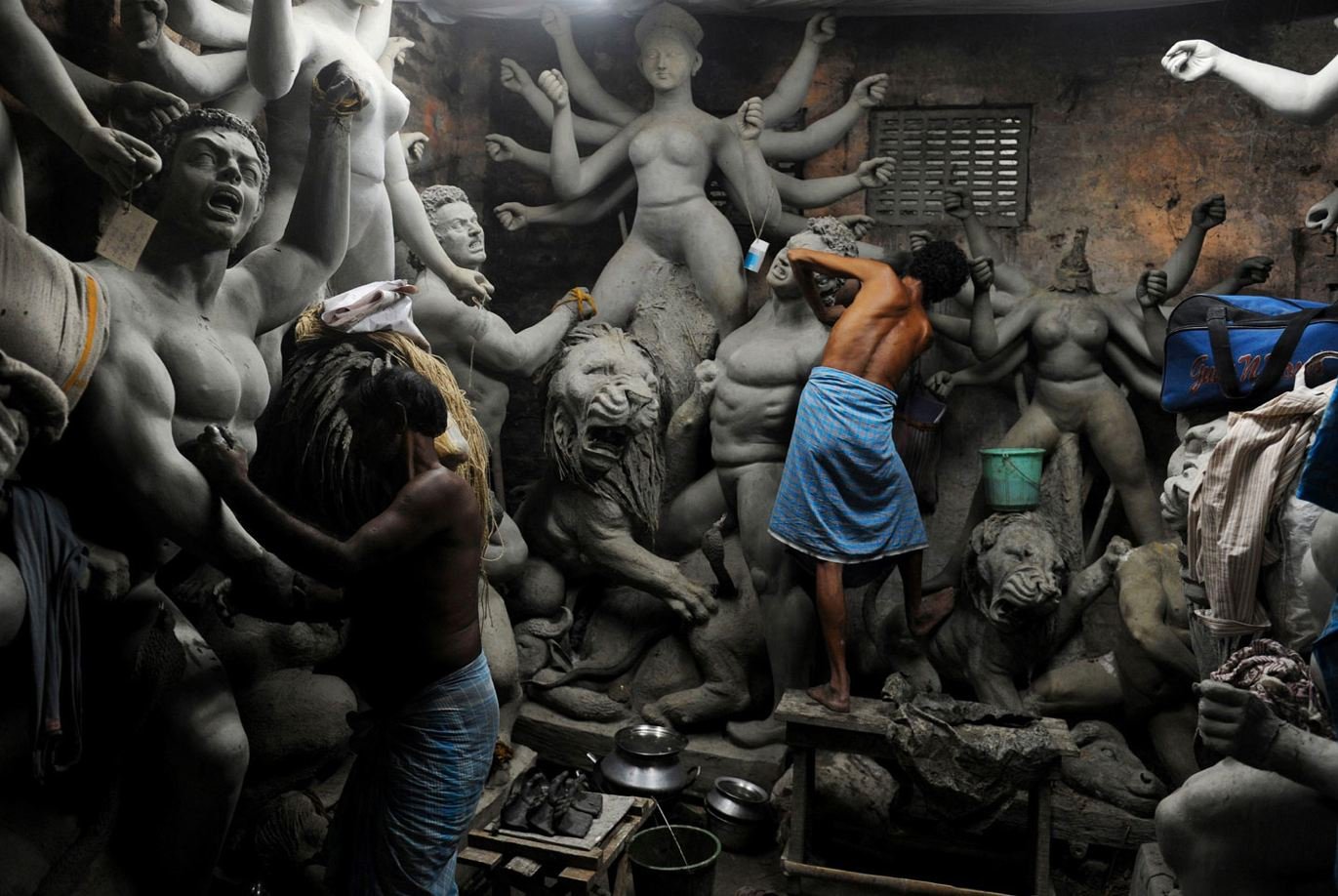
Within the craft economy, a delineated division of labour shapes production. Principal artists-often referred to as maliks-lead the design and detailed sculpting while maintaining relationships with clients and suppliers. Around them, seasonal workers handle physically demanding and time-sensitive stages such as clay preparation and basic form-building. Many of these workers migrate seasonally from rural areas of Bengal and adjoining states, contributing an essential yet often unrecorded workforce that allows the neighbourhood to meet peak-season demand. The social fabric of Kumartuli thus comprises established families with intergenerational continuity and an extended periphery of temporary labour bound to the centre by cycles of ritual time.
Cooperative associations play supporting roles by facilitating loans, offering financial assistance, and providing materials such as kerosene at subsidized rates. These intermediaries can moderate seasonal risk and cash-flow constraints, although they do not replace the primacy of family networks and long-term client ties in sustaining livelihoods. Challenges persist, including the absence of formal training institutions, social stigma associated with manual craft, and declining interest among some younger members. At the same time, a subset of newer practitioners with formal training in fine arts has entered the field, bringing experimental sensibilities and alternative career pathways. How such entrants integrate into Kumartuli’s social and occupational hierarchies remains an evolving story.
Contemporary Presence & Market Context
Kumartuli operates within a predominantly informal economy characterized by verbal contracts, unregulated wages, and family-run studios. The craft is deeply seasonal, with activity surging before major festivals and ebbing thereafter. Raw materials-bamboo, straw, and clay-are sourced from rural hinterlands and transported by river and road, underscoring the regional interdependence of agriculture, transport, and urban craft production. The cluster’s proximity to waterways and distribution channels helps synchronize the arrival of supplies with the workshop calendar.
The client base spans a broad spectrum. Traditional zamindar and babu families continue to commission idols on a household scale, while community puja committees coordinate larger, public displays. Corporate sponsorships have become an important component of some high-profile celebrations, shaping budgets and expectations for scale and spectacle. International buyers, including diaspora communities, commission idols or components, prompting some workshops to adapt techniques and materials-such as fiber-based forms-to suit transport, storage, and regulatory requirements outside India. This diversification has extended the reach of Kumartuli’s aesthetic while keeping its ritual orientation intact.
Pricing varies widely in line with size, materials, ornamentation, and the reputation of the workshop. Small household idols may be around ₹15,000, while large, elaborately decorated installations can reach or exceed ₹1,000,000. Yet profitability does not simply track visibility. Rising costs of raw materials and labour compress margins, and many artisans face constraints in raising prices due to loyalty to longstanding clients and competitive pressure within the cluster. Access to formal credit also remains limited, compelling studios to rely on advance payments, cooperative-backed loans, or personal networks to finance the intensive pre-festival production period.
Competition has increased as fine arts-trained artists and thematic designers enter the field, contributing to a dynamic marketplace of styles and display strategies. While such entrants can widen aesthetic possibilities, they may also recalibrate the distribution of opportunities within the cluster, particularly when corporate sponsorships favor novelty and large-scale set-pieces. Government-led redevelopment plans aimed at reorganizing or relocating parts of the neighbourhood have encountered complications around land tenure and community consent, resulting in stalled initiatives and spatial uncertainty. These conditions have, at times, shifted production across lanes and peripheral spaces, with workshops improvising to accommodate changing constraints.
Tourism and media coverage have elevated Kumartuli’s profile as a cultural destination, aligning the neighbourhood with broader narratives of Kolkata as a center of art and learning. This visibility can yield benefits in the form of new clients and patronage, yet it also shapes public expectations for spectacle and novelty. Meanwhile, aspects of the craft’s environmental footprint-such as the long-term effects of synthetic pigments and materials-require further documentation, as do the outcomes of cultural tourism policies and any heritage nominations. Quantitative data on the number of artisans, seasonal workers, and total economic turnover also remains incomplete, making it difficult to fully assess the sector’s scope and vulnerabilities.
Conclusion
Kumartuli stands as a living archive of techniques, iconography, and social relations that have sustained an intricate craft tradition for centuries. Its artisans operate within a matrix of ritual demand, historical patronage, and kinship-based knowledge, transforming materials gathered from fields and riverbanks into images that mediate between community and divinity. The craft’s technical choreography-from the bamboo frame through clay layering to the final act of eye painting-reflects a disciplined synthesis of engineering, sculpture, and ritual timekeeping. The aesthetic field is similarly layered, encompassing sabeki and Bangla idioms alongside contemporary reinterpretations, all negotiated within the stable grammar of Hindu iconography.
As an artisanal economy, Kumartuli thrives on interdependencies: between principal makers and seasonal workers, between potters and ancillary trades, and between longstanding clients and emerging patrons. These ties support livelihoods while exposing the cluster to familiar pressures, including rising input costs, informal financing, competition for commissions, and unresolved questions surrounding redevelopment. Cooperatives and family networks buffer some of these risks, yet gaps remain in training infrastructure, credit access, and comprehensive data-gathering. Moreover, knowledge transmission faces subtle challenges as younger generations weigh social perceptions of manual craft against other career opportunities.
Despite these complexities, Kumartuli’s significance is durable. It serves a religious function that is central to Bengali cultural identity, provides employment across a chain of related trades, and contributes to the seasonal spectacle that structures Kolkata’s civic life. The idols’ immersion at the close of the festival cycle underscores an ethos of renewal; so too, the neighbourhood’s continuity depends on periodic reinvention-material, aesthetic, and institutional-without severing links to inherited practice. Future sustainability will likely rest on the careful calibration of innovation with tradition, strengthened knowledge pathways, and supportive policies that respect the cluster’s socio-spatial fabric. In that balance, Kumartuli’s clay will continue to hold the impressions of both past and present, shaped by many hands into a form that communities recognize as their own.