
Fushimi Inari Taisha: Art, Architecture, and Living Tradition on Kyoto’s Mount Inari
Fushimi Inari Taisha, founded in 711 CE, is among Japan’s most enduring religious sites and a defining landmark of Kyoto’s cultural landscape. Dedicated to Inari, the Shinto kami of rice, agriculture, prosperity, and business success, the shrine unites architecture, landscape design, sculpture, and ritual practice into a coherent, living tradition. Its celebrated Senbon Torii—thousands of vermilion gates lining the wooded slopes of Mount Inari—has become an international emblem of Japanese sacred architecture. Yet the site is more than a visual icon. It is a complex, multi-century palimpsest of building campaigns, patronage systems, and devotional customs that have adapted to political shifts, economic change, and evolving modes of worship while preserving core Shinto principles. As both a head shrine for a vast nationwide network and a neighborhood locus of regular ceremonies, Fushimi Inari offers an instructive case study in how art, architecture, and ritual co-produce meaning across time.
Historical Context
Established during the early Nara period and predating the selection of Kyoto as the imperial capital in 794 CE, Fushimi Inari Taisha arose at the intersection of agricultural practice and emerging state structures. The shrine’s founding is associated with the Hata clan, immigrants from the Korean Peninsula known for introducing advanced agricultural and brewing technologies to Japan. Inari worship thus took root in an environment where successful rice cultivation and related economic activities depended not only on skill and resource management but also on religious rites addressing fertility, protection, and abundance. As Kyoto developed into a political and cultural center, the shrine’s profile rose accordingly, and by the early Heian period it had acquired imperial patronage, reinforcing its role as a guardian of agrarian welfare and community prosperity.
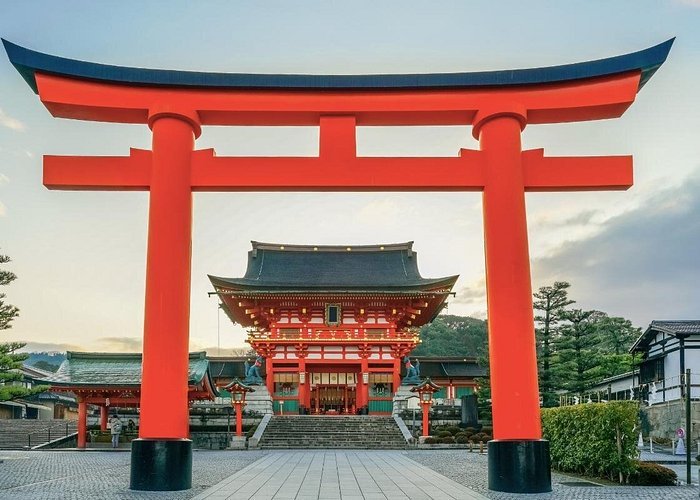
The shrine endured the violent ruptures of the fifteenth century, including destruction during the Onin War in the 1470s. The rebuilding that followed shaped much of the current complex, with significant work undertaken through the late medieval and early modern eras. The main hall (honden), dating from 1499, stands as a focal point of post-war reconstruction and would later be recognized as an Important Cultural Property. In 1589, Toyotomi Hideyoshi, a central military and political figure of the Sengoku period, donated the Romon Gate, a monumental two-storied entrance that marked the shrine’s increasing prominence among elite patrons alongside its popular devotional base.
During the Edo period, practices that linked personal or corporate fortunes to the shrine’s protective power expanded, including the custom of donating torii gates—an offering of tangible architectural form in thanks for wishes fulfilled or in hope of future success. Under the modernizing reforms of the Meiji period (1871–1946), Fushimi Inari Taisha was elevated to the highest rank of government-supported shrines (Kanpei Taisha), formalizing its status within a nationalized Shinto system. Throughout these shifts, the shrine remained a living site of seasonal ritual, including events aligned with agricultural cycles and ceremonies for prosperity that continue to this day.
Stylistic Characteristics
Fushimi Inari’s architecture and spatial organization are embedded in the landscape of Mount Inari, a 233-meter peak that rises from Kyoto’s southern districts. The shrine complex extends from the base into forested slopes, interweaving pathways, sub-shrines, and altars with vernacular topography. This vertical and horizontal layering cultivates an experience of pilgrimage rather than a single, centralized viewing encounter. Visitors traverse a roughly four-kilometer route of ascending and descending ways, offering prayers and making small devotions as they progress through the site’s varied nodes. The mountain is not a backdrop but a sanctified medium, a shaping force in the shrine’s overall aesthetic and ritual structure.
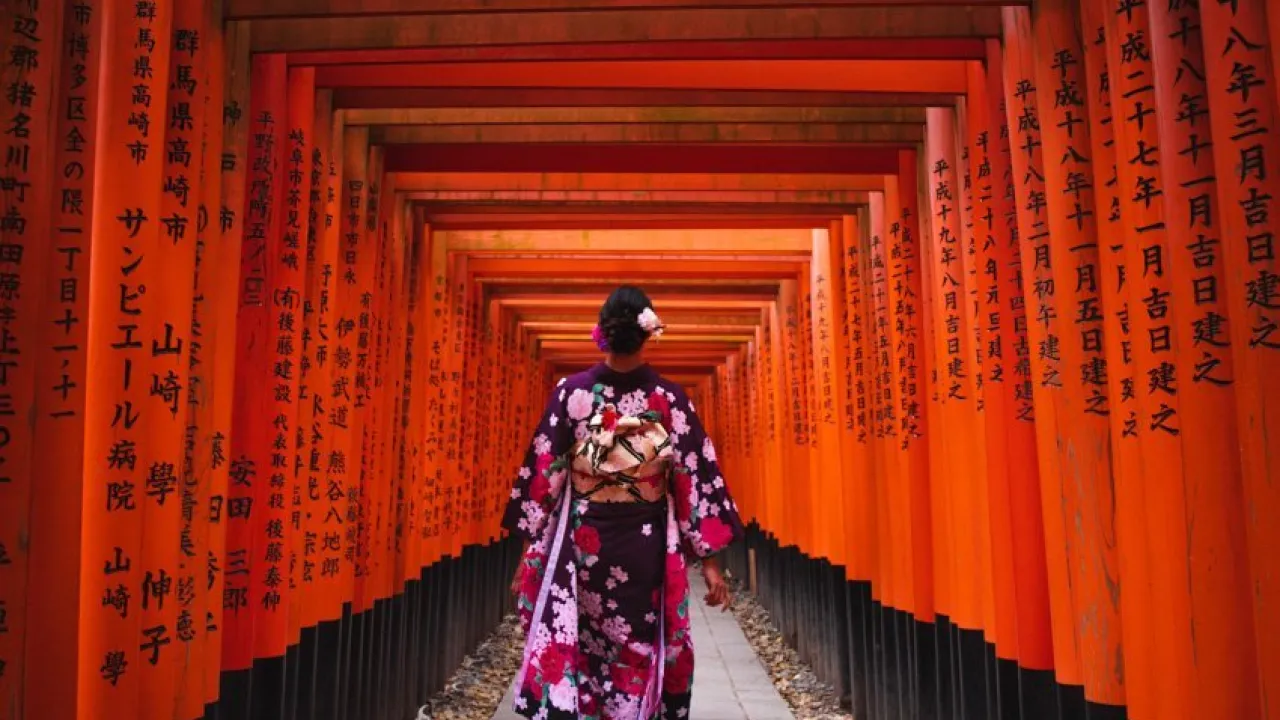
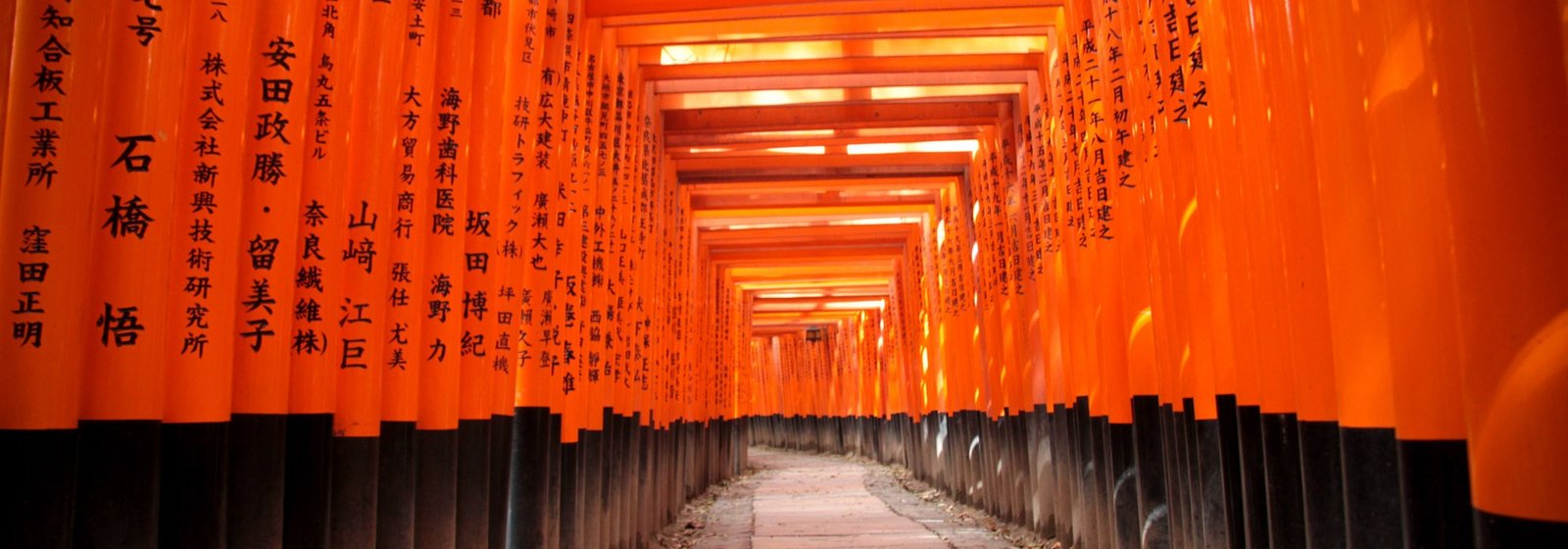
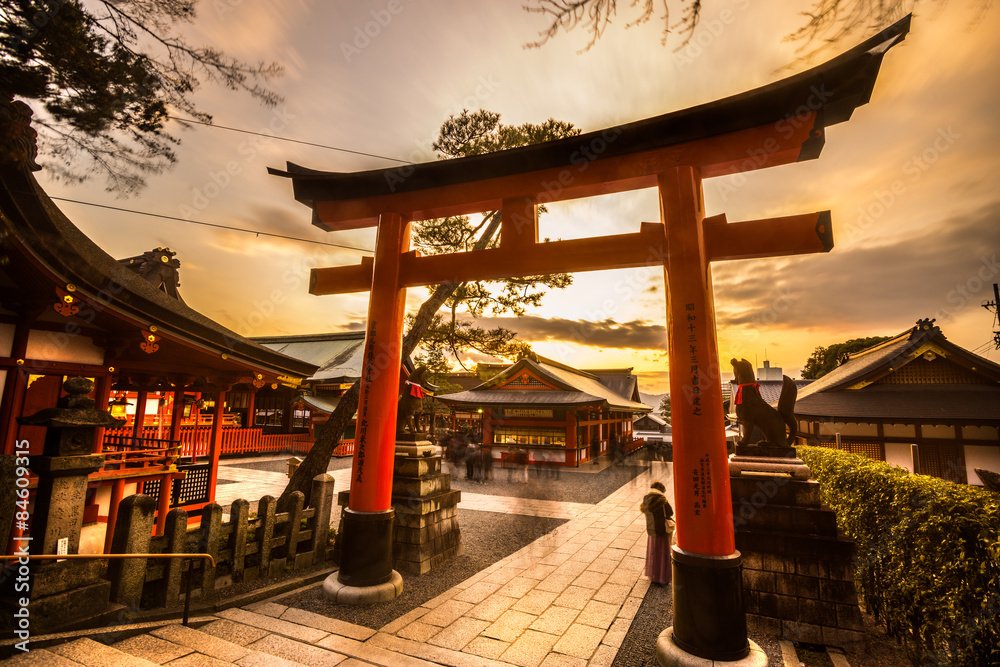
The Senbon Torii, often translated as “thousands of torii,” is the shrine’s most visible and distinctive feature. Donated by individuals and businesses, the gates create tightly sequenced corridors of vermilion that modulate light and perspective into rhythmic passages. Each gate is inscribed with the name of its donor and date, making the architecture simultaneously a devotional record, a civic register, and a collective artwork. The gates’ density, combined with the curving terrain, produces an evolving succession of thresholds that emphasize movement and repetition, aligning physical passage with the spiritual concept of continual petition and gratitude.
Complementing the torii are the shrine’s many fox statues (kitsune), regarded as messengers of Inari. These sculpted figures frequently hold keys, scrolls, or rice sheaves—iconographic attributes that underscore their role in safeguarding agricultural stores, transmitting divine instruction, and symbolizing prosperity. Distributed across precincts and sub-shrines, the foxes serve a protective function and maintain a visual language that unites disparate zones of the complex through consistent imagery.
Architecturally, the shrine draws on Kasuga-zukuri traditions, which typically feature a compact layout, graceful rooflines, and an emphasis on ritual purity. Within the main hall, the primary object of worship is a mirror rather than a figural image, reflecting Shinto’s preference for symbolic presence over anthropomorphic representation. The Romon Gate, with its two-storied tower form, operates as a grand threshold between secular and sacred realms, while the honden grounds the complex with dignified restraint. These formal elements cohere with the surrounding environment and with the site’s broader ritual program.
Beyond major structures, the grounds include sub-shrines, rock altars known as otsuka, and numerous smaller torii that attest to personalized modes of devotion. This fine-grained field of offerings expands the shrine’s visual and architectural vocabulary at intimate scales. Visitors encounter many micro-sites of worship that are locally meaningful yet legible within the larger syntax of Inari practice, showing how individual piety and communal tradition are accommodated within a single, integrated sacred terrain.
Key Artists & Works
Fushimi Inari Taisha is a monument to collective craftsmanship and sustained patronage rather than the production of named individual artists. Its forms arise from long-established Shinto building practices, the skills of timber and stone artisans, and the sustained engagement of donors over centuries. A notable exception to the absence of specific attributions is the Romon Gate, donated in 1589 by Toyotomi Hideyoshi, whose patronage aligned the shrine with the political authority of the period. The main hall, dating to 1499, represents a key moment in post-Onin War reconstruction and is designated an Important Cultural Property. But even these anchor points operate within an ecosystem of continual additions: the torii gates bear the names and dates of their donors, inscribing authorship as a persistent, distributed ledger across the landscape. In this sense, the shrine’s most impactful “work” is the cumulative Senbon Torii itself, a spatial archive of social and devotional history realized through an evolving network of patrons.
Materials & Techniques
The material palette at Fushimi Inari Taisha reflects both functional demands and symbolic priorities. The torii are primarily wood, painted in a distinctive vermilion, a hue understood to ward off evil spirits and to help preserve the timber. The color’s high visibility also creates a coherent visual field across the mountain paths, uniting dispersed segments of the route into a single, legible procession. Wood’s warmth and reparability suit the shrine’s incremental growth: as donors continue to commission torii, the corridor expands in a manner compatible with existing fabric.
Stone is the predominant medium for fox statues, whose durable surfaces and crisp carving retain legibility in an outdoor context. These sculptures are often sited at approaches, intersections, or in precincts where their semi-guardian roles can be most effectively performed, visually signaling power and protection while integrating with the material language of altars and platforms.
The larger shrine buildings rely on traditional Japanese timber construction consistent with Kasuga-zukuri features. While specific craftsmen remain largely undocumented in historic records, the buildings demonstrate careful proportioning, refined roof profiles, and a construction logic centered on rhythmic column grids and joinery methods appropriate to the climate and ritual uses of Shinto complexes. Decorative restraint supports the primacy of ritual function, with emphasis on purity, cleanliness, and openness around the locus of worship—a mirror—rather than on elaborate figural ornament.
A pervasive technology of inscription anchors the relationship between architecture and patronage. Donor names and dates, applied to the torii, formally encode acts of devotion into the site’s fabric. These inscriptions support art-historical analysis by preserving layers of chronological data, even as the overall number of gates remains in flux. Published estimates of torii counts vary widely—ranging from several thousand to tens of thousands—reflecting ongoing donations and replacements. As a result, precise inventories are challenging to maintain, and scholars often focus on the phenomenon’s continuity and social function rather than on fixed totals.
Influence & Legacy
As the head shrine of approximately 30,000 Inari shrines across Japan, Fushimi Inari Taisha exerts a far-reaching influence on Shinto worship. Its model of devotional offering—especially the donation of torii to acknowledge wishes fulfilled or to petition for prosperity—has been central since at least the Edo period. This practice provides a template for how economic aspiration, community identity, and sacred architecture can be in continuous dialogue. The shrine’s endurance from the early Nara period through Heian and into the modern era underscores its capacity to anchor tradition while accommodating new contexts of patronage and use.
The site enjoys broad cultural visibility as a symbol of Kyoto and Japanese religious heritage. It attracts millions of visitors annually, with particular concentrations for New Year’s observances that align with Shinto calendrical rhythms. Media and popular culture have amplified its presence: the shrine’s scenic corridors of vermilion gates have been featured in film, such as Memoirs of a Geisha, and have inspired creative works including Nintendo’s Star Fox series. Such references extend the shrine’s aesthetic vocabulary into global cultural circuits while encouraging renewed attention to its historical and ritual foundations.
Institutionally, Fushimi Inari Taisha and its structures are recognized within Japan’s cultural property framework, and the honden is designated an Important Cultural Property. The shrine remains open continuously, with free admission that affirms its status as an active place of worship as much as a site of heritage. Facilities near the entrance and along sections of the route—such as rest areas, vending machines, souvenir shops, and cafes—testify to the interface between sacred practice and visitor needs. Accessibility is more feasible in the lower precincts, where some ramps and elevators are available, whereas the steeper stairways leading deeper into the mountain limit mobility. This stratified accessibility reflects the shrine’s topographical setting and the historical pattern of pilgrimage, even as contemporary management addresses the demands of a large and diverse public.
Fushimi Inari’s ongoing ceremonial calendar anchors its living legacy. Rituals connected to rice cultivation and harvest, along with festivals linked to business prosperity, demonstrate how the shrine’s core association with Inari continues to shape practice. The presence of sub-shrines and otsuka across Mount Inari enables localized devotions that coexist with major events, maintaining a balance between individual petition and communal observance. In this sense, the shrine functions as a matrix where different scales of religious life intersect, from the intimate act of leaving a small torii at a rock altar to grand processions that engage broader constituencies.
For scholars, several areas remain open to further investigation. The precise count of torii at any given time is elusive due to the constant pace of donations and replacements, and published estimates range widely. Details of early construction phases and subsequent architectural modifications await more comprehensive study, particularly where documentary records are thin. The role of the shrine in regional economic histories—especially in relation to sake brewing associated with the Fushimi district—warrants closer examination, as does the history of the artisans and workshops responsible for torii production and building maintenance. Finally, while the shrine exemplifies the integration of religious practice, cultural heritage, and tourism, the specifics of its conservation strategies and visitor management remain an evolving area for future research.
Fushimi Inari’s proximity to other cultural sites, including Tofukuji Temple and breweries in the Fushimi area, highlights the shrine’s position within a larger cultural geography. These connections do not merely overlay secular and sacred activities; they frame a regional environment in which art, ritual, and commerce have long been intertwined. The shrine’s legacy, therefore, is not confined to its boundaries but extends through networks of practice and patronage that structure Kyoto’s historical and contemporary cultural life.
Conclusion
Fushimi Inari Taisha offers a compelling lens on the evolution of Japanese religious art and architecture over more than a millennium. Founded in 711 CE and reshaped by successive periods of patronage, war, rebuilding, and modern institutional recognition, the shrine maintains a consistent devotional focus while adapting its built form to changing circumstances. Its stylistic distinctiveness—rooted in Kasuga-zukuri architecture, the emblematic Senbon Torii, and the ubiquitous presence of fox messengers—derives less from singular masterpieces than from cumulative authorship and practiced repetition. Donors’ names inscribed on gates, the recurrent vermilion of painted wood, and the layered ascent across Mount Inari together compose a continuously renewed sacred environment.
As the head shrine for approximately 30,000 Inari shrines nationwide, Fushimi Inari shapes Shinto practice far beyond Kyoto. The custom of donating torii, established on a large scale since the Edo period, links architecture and economy to religious aspiration in a form that remains legible and adaptable today. The shrine’s presence in popular culture and its role as a major pilgrimage and tourism site further demonstrate the vitality of its aesthetic. At the same time, open questions about exact gate numbers, craft lineages, and conservation policies invite continued research. In art-historical terms, Fushimi Inari stands as a paradigmatic example of how sacred architecture can function as a living archive: a place where materials, images, and spaces are continually reanimated by ritual use, communal patronage, and the enduring appeal of a mountain path lined with gates of gratitude and hope.