
Dakshineswar Kali Temple: Architecture and Patronage in Nineteenth-Century Bengal
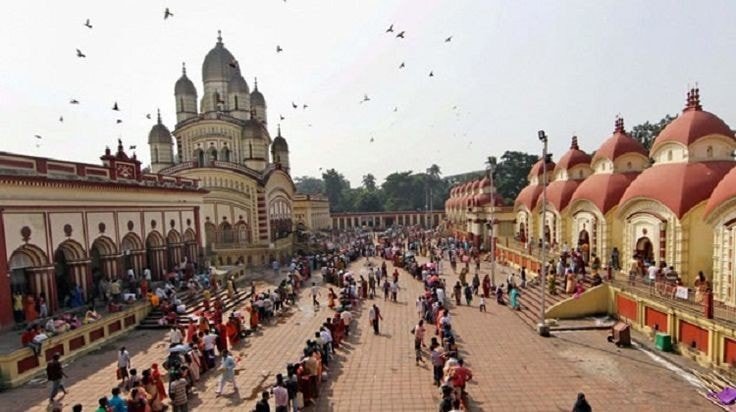
On the eastern bank of the Hooghly River, where water, ritual, and urban life have met for centuries, the Dakshineswar Kali Temple complex extends across roughly twenty acres in northern Kolkata. Dedicated to Bhavatarini, a form of Goddess Kali also known as Sri Jagadishvari Mahakali, the ensemble organizes shrines, courtyards, bathing ghats, and processional spaces into a coherent ritual landscape. While the principal structure is the nine-spired Navaratna temple, the twelve Shiva temples, a Radha-Krishna temple, the Natmandir, and a perimeter of service rooms create a multi-vocal sacred precinct with complex meanings and clear architectural order.
Built between 1847 and 1855 under the patronage of Rani Rashmoni, a wealthy zamindar and philanthropist of the Kaivarta community, the complex embodies a distinctive nineteenth-century synthesis of patronage, regionally rooted temple typologies, and selective European and Indo-Islamic influences. Accessibility-by road, rail, and air-has improved over time, with a skywalk bridge now connecting the entrance to nearby transport nodes. Yet the spatial core adheres to principles shaped by Hindu ritual logic and Bengal’s terracotta temple heritage.
The site’s cultural reach extends far beyond its riverside boundaries. The priesthood of Sri Ramakrishna Paramahamsa from 1856 until his death established Dakshineswar as a locus for spiritual inquiry and devotional practice during a period of intellectual and religious ferment. Set within the Bengal Renaissance and the wider frame of British colonial rule, the temple’s architecture and patronage reflect shifting negotiations around caste, faith, and public life. The result is not a monument isolated in time, but a living institution that entwines material form with social aspiration and enduring ritual practice.
Historical Background
The founding of the Dakshineswar Kali Temple in the mid-nineteenth century coincided with a transformative era in Bengal. The period’s many currents-colonial governance, new forms of philanthropy, changing social norms, and the Bengal Renaissance-formed the backdrop for a project that was, at once, an act of private devotion and a public architectural intervention. Construction began in 1847 and concluded in 1855, a concise yet intensive building campaign that resulted in one of eastern India’s most recognizable temple complexes.
Rani Rashmoni’s patronage is fundamental to the temple’s meaning. A wealthy zamindar and noted philanthropist of the Kaivarta community, she initiated the project following a divine vision. As the account holds, she was preparing for a pilgrimage to Varanasi when she was instructed in a dream to build a temple locally instead. This act redirected resources and religious attention to the Bengal delta’s own ritual geographies, highlighting a localized devotion that did not require validation through faraway sacred centers.
The procurement of land was itself emblematic. Rashmoni purchased the site from an Englishman, James Hastie. The parcel assembled for the complex included a former Muslim burial ground and part of a European garden. The temple would thus take root at a confluence of community histories, a spatial palimpsest that acknowledged Muslim and European presences while establishing a new center for Hindu worship. This plural substrate would later be mirrored in the complex’s architectural vocabulary and social reception.
Consecrated on 31 May 1855 through the installation of the deity, the temple’s inauguration was marked by the attendance of more than 100,000 Brahmins from across India. Such ceremonial scale emphasized the project’s regional and national religious standing. Within a year of consecration, Sri Ramakrishna Paramahamsa began serving as priest, a role he would continue until his death. His influence powerfully shaped the site’s spiritual identity and broadened its reception beyond local devotion. The association of Dakshineswar with Ramakrishna’s emphasis on religious harmony and universal love increased the temple’s prominence during the Bengal Renaissance, making it a place where the search for a modern Hindu ethos could be practiced in the cadence of daily worship.
The historical conditions of the temple’s establishment also reflected the period’s socio-religious dynamics, particularly around caste and colonial presence. Rashmoni, as a woman of the Kaivarta community, navigated orthodox restrictions to realize a major temple complex. The dedication of a shrine within the complex to Radha-Krishna employed a strategic accommodation to traditions that constrained who could found or consecrate a Kali temple, illustrating how architectural patronage could operate within, and reshape, existing social boundaries. In a colonial environment where European influence was widespread and mobility across religious and occupational spheres was shifting, the temple’s foundation crystallized a distinctly Bengali response: rooted in local forms, receptive to multiple strands of influence, and insistent on a broad, inclusive devotional public.
Architecture & Design
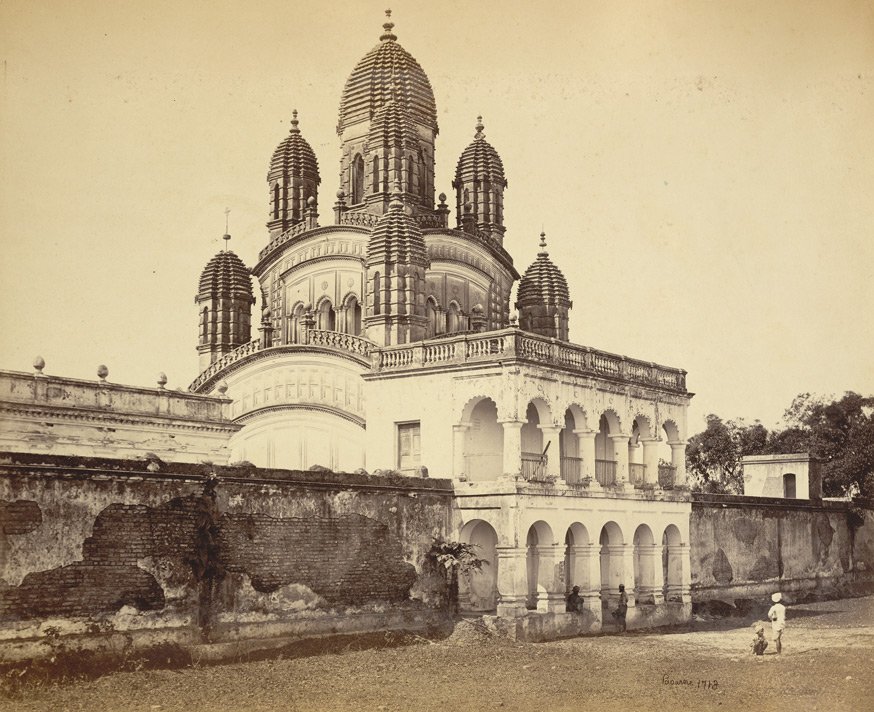
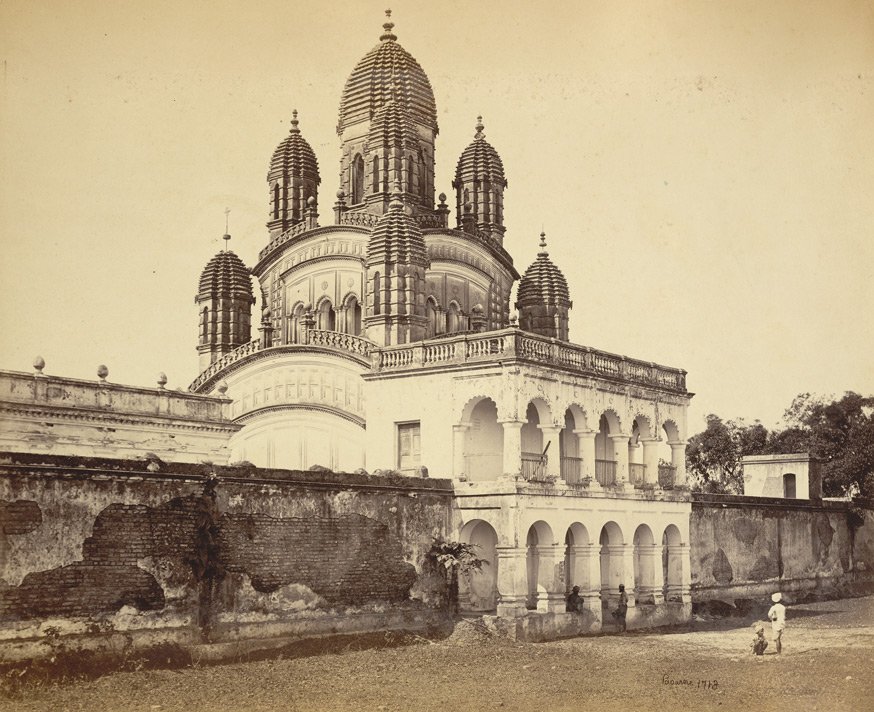
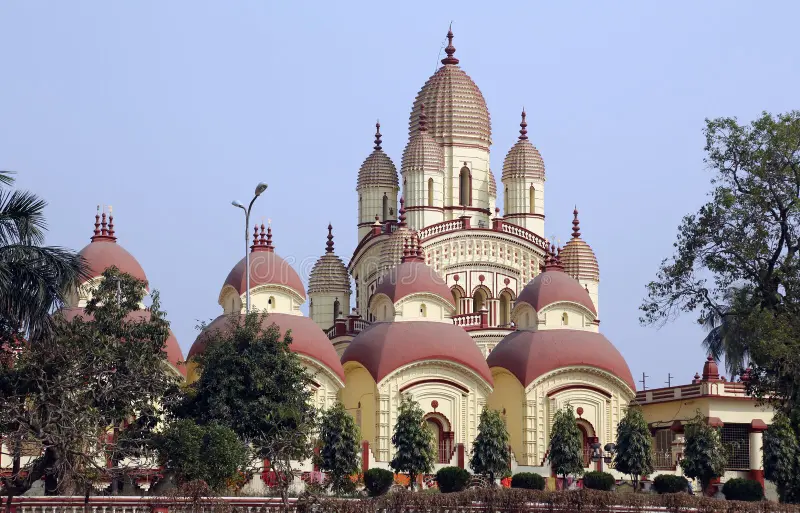
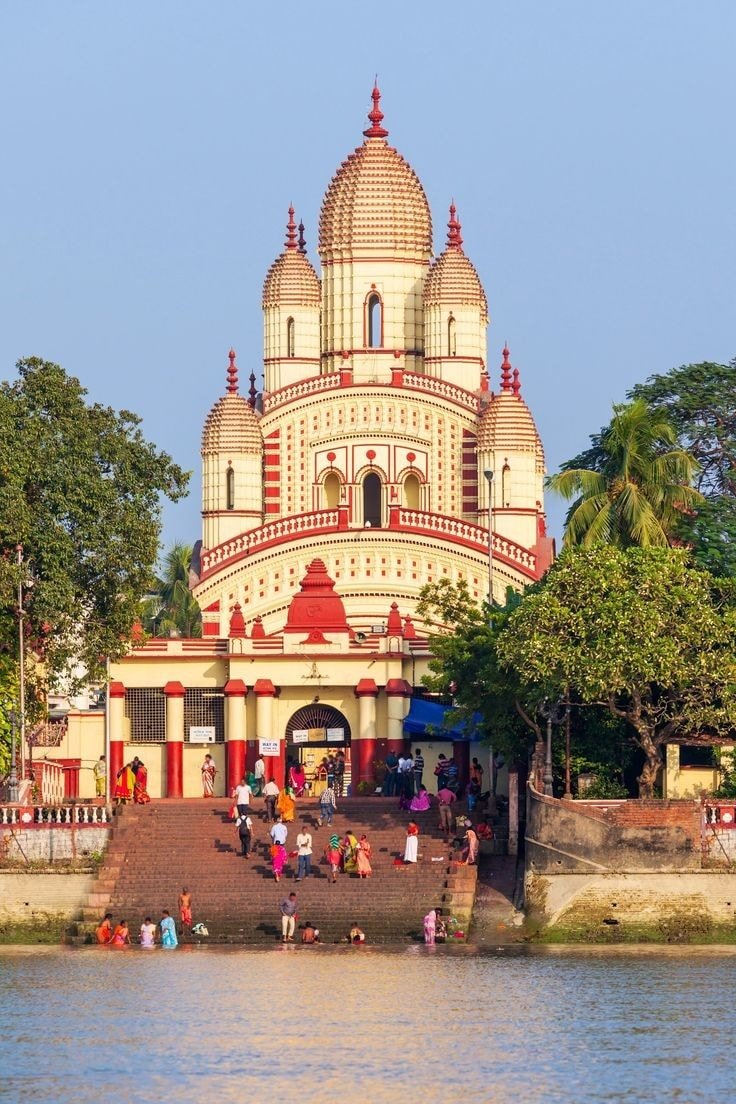
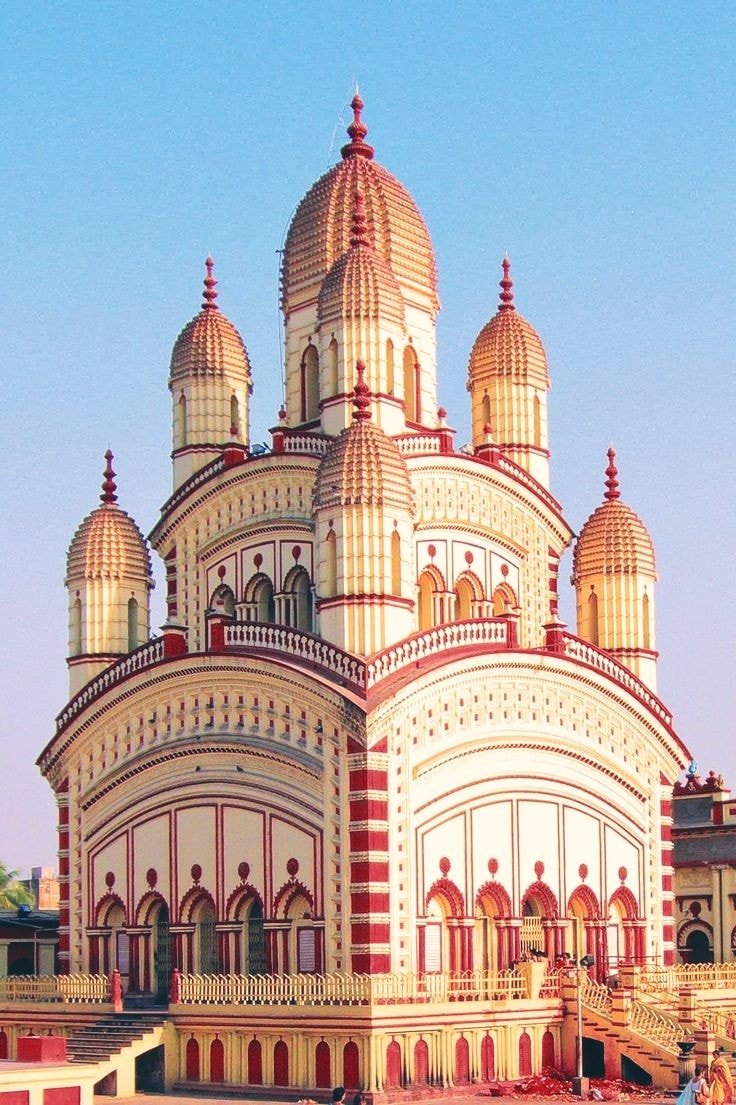
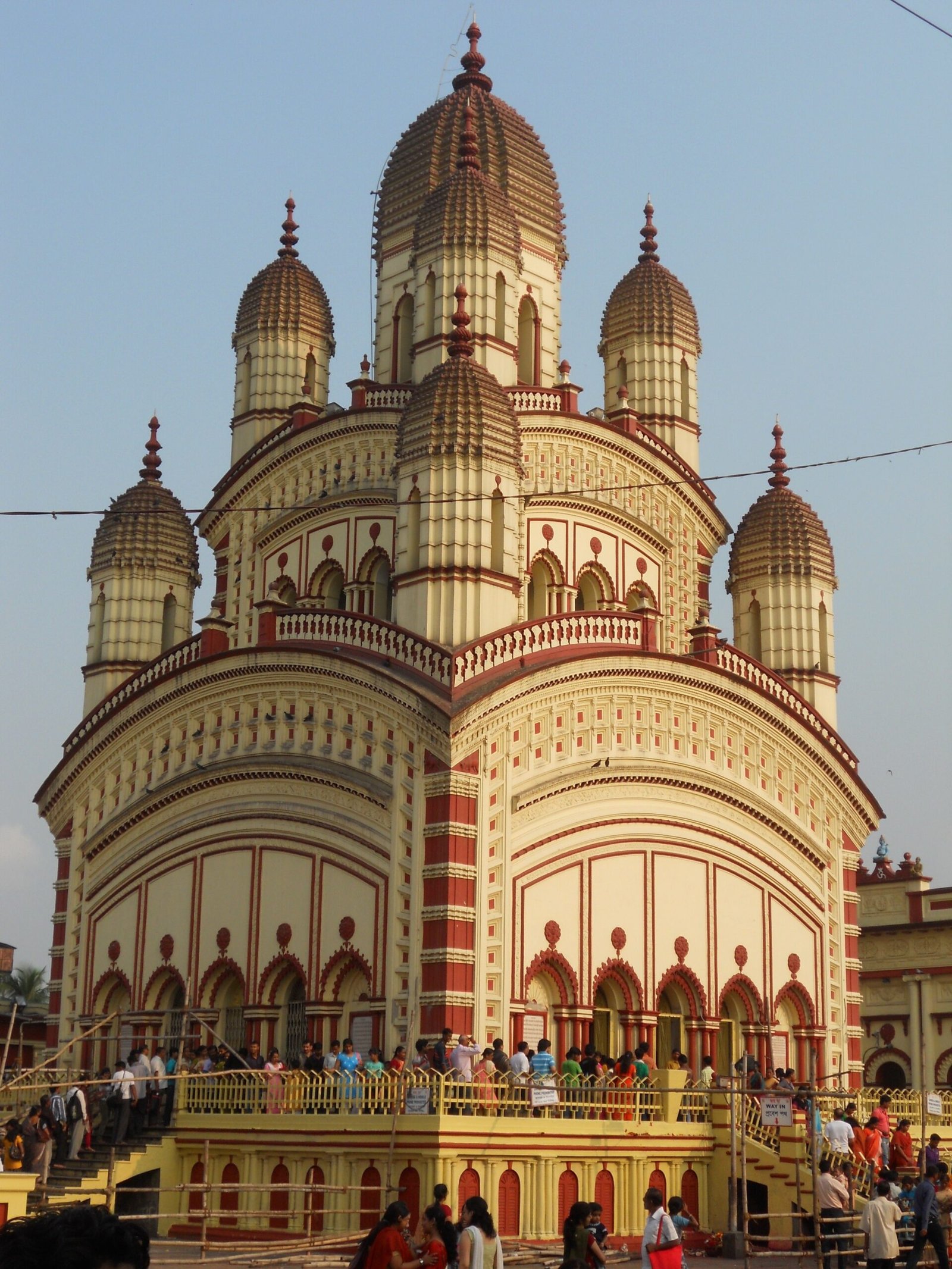
The Dakshineswar complex is a deliberate arrangement of structures configured to serve worship, movement, and contemplation. The main Navaratna temple sits on a high platform accessed by a flight of stairs, an elevated stance that effects both visual legibility and ritual hierarchy. With a plan approximately 46 feet square and a height exceeding 100 feet, the three-storeyed edifice builds mass and meaning vertically. The nine spires-distributed over the upper two storeys with four on each corner tier and a larger central turret above-perform a choreography of ascent culminating in the crown-like central spire. This Navaratna composition extends an 18th-century Bengali elaboration of the earlier Pancha Ratna form, demonstrating how regional temple typologies continued to be reinterpreted into the 19th century.

Materially, the temple employs brick and terracotta, a palette characteristic of Bengal’s riverine plains. The terracotta panels, with their mythological scenes, floral motifs, and symbolic figures, articulate surfaces into narrative and ornament. Their intricacy engages the eye at close range while contributing to the building’s textured silhouette from afar. The beige walls, contrasted with maroon traditional burnt bricks, sharpen the visual reading of spire profiles and horizontal courses, producing clarity against the shifting light along the river. As a visual field, the temple balances the color language of baked earth with a restrained chromatic discipline, reinforcing its regional identity.
The sanctum sanctorum (garbha-griha) houses the idol of Bhavatarini Kali standing upon a supine Shiva, placed on a thousand-petaled silver lotus. This image concentrates the theological narrative into the temple’s core, while the spatial organization-open access on all sides except the sanctum-expresses the layered thresholds of approach and intimacy. The ritual axis aligns with Hindu vastu shastra principles, cultivating a plan that frames circumambulation, darshan, and processional ceremonies. The sanctum’s comparative seclusion, contrasted with the openness of surrounding volumes, calibrates public and sacred space through controlled gradients rather than abrupt separations.
Arrayed around the principal shrine are twelve Shiva temples organized in two parallel rows of six, flanking the main approach. Each follows the Aat-Chala type, a Bengal hut-inspired form with eight eaves and two-tiered roofs. In repetition, these shrines create a rhythmic architectural cadence and amplify the complex’s visual depth. Functionally, the small Shiva temples distribute ritual activity across the precinct and offer moments of focused worship within the broader ceremonial life of the site. Architecturally, they anchor the Navaratna’s verticality with a low, compound-scale counterpoint, balancing hierarchy with reiteration.
The Radha-Krishna temple within the complex continues this adaptive dialogue. It adopts a flat-roofed form influenced by European architecture while retaining terracotta decoration and a rectangular plan. This stylistic inflection, introduced without displacing core Bengali temple forms, signals a measured openness to European building conventions. The Natmandir, a large open-pillared hall with a flat roof, functions as a stage for devotional music and religious gatherings. The hall’s open spans and unencumbered interior allow it to accommodate congregational activities while maintaining visual connectivity to adjacent shrines. In this way, the Natmandir integrates cultural practice directly into the architectural fabric, aligning performance with devotion.
The ensemble evidences a syncretic architectural heritage. The ratna or towered structures, though anchored in Bengali tradition, also register an Indo-Islamic lineage visible across centuries of temple and palace building in eastern India. Meanwhile, European flat-roofed styles find a contained place in specific structures such as the Radha-Krishna temple and the Natmandir. The overall complex, however, privileges the continuity of Bengali terracotta and brick architecture, absorbing other stylistic threads without diluting the primacy of regional typologies and ritual priorities.
River-facing bathing ghats connect the complex directly to the Ganges waters that border it to the west, fusing architecture with landscape and ritual sequence. Rooms along the boundary walls house functional requirements for staff and guests, while shops and service areas near the entrance support the day-to-day needs of devotees. Such programmatic layering points to a design philosophy that regards sacred precincts as comprehensive civic-religious spaces, not isolated monuments.
Conservation and stewardship of the complex have had to respond to the vulnerabilities of its materials and form. Recognized as a National Heritage Site, the temple benefits from legal protection and conservation oversight. The mid-19th-century core remains generally sound, but the combination of brick, terracotta, and wood demands sustained maintenance to counteract humidity and weathering. Intricate terracotta panels, by virtue of their relief and exposure, are susceptible to deterioration and require careful monitoring. The nine-spired profile of the Navaratna, while visually striking, introduces structural complexities that call for ongoing attention to foundation and spire stability. The riverbank setting necessitates maintenance of embankments, retaining walls, and bathing ghats to manage erosion and fluctuating water levels.
Modern interventions have focused on visitor management and safety while respecting the historic setting. A 400-meter-long skywalk with escalators channels pedestrian movement from transport nodes to the temple entrance, easing congestion and protecting the precinct’s immediate environment from vehicular pressure. Security provisions include the deployment of approximately eighty guards and the installation of fifty-six CCTV cameras, complemented by fire control resources provided by local authorities. Water logistics utilize filtered Gangetic water for cooking, drinking, and ritual use, maintaining continuity with tradition while meeting hygiene standards. These measures exemplify a pragmatic balance between heritage conservation and the realities of contemporary pilgrimage.
Some aspects of the architectural record, however, invite further research. The identities of the original architect and principal artisans remain unclear in the available documentation, a gap that limits fuller understanding of the craft networks and design authorship behind the project. The extent and exact nature of European architectural influence, beyond the flat-roofed temple and hall types, requires more precise study. Similarly, detailed measurements and spatial analyses of subsidiary structures such as the Natmandir and the Radha-Krishna temple would enrich the complex’s architectural documentation. Addressing these questions would not only deepen the historical record but also support more targeted conservation strategies for the ensemble.
Social Context & Cultural Memory
From its inception, the Dakshineswar complex has presented a social vision as deliberate as its architectural one. The temple is known for welcoming pilgrims across religious and cultural backgrounds, an inclusivity that resonates with its founding circumstances and its subsequent spiritual associations. The presence of shrines dedicated to Shiva, to Kali as Bhavatarini, and to Radha-Krishna within the same compound signals a theological range within Hinduism itself, allowing different devotional orientations to coexist in proximate, mutually legible spaces.
Rani Rashmoni’s patronage, as a woman of the Kaivarta community, challenged orthodox caste limitations of the time. The strategic use of a Radha-Krishna dedication within the complex to navigate prohibitions against a Shudra owning or consecrating a Kali temple exemplifies how built form can be mobilized to expand social access. This maneuver was not merely symbolic: it inscribed a more inclusive orthopraxy into the complex’s enduring routines of worship and maintenance.
The temple’s association with Sri Ramakrishna further shaped its social meaning. His teachings emphasized religious harmony, devotion, and universal love-values that influenced the Bengal Renaissance and modern Hindu thought. In this context, the complex served as a living platform where reformist and devotional energies could intersect. The Natmandir remains a site for devotional music, bhajans, and kirtans, placing cultural expression within daily ritual and ensuring that communal participation is integral to the precinct’s life rather than an occasional festival overlay.
Beyond specific teachings or patronage, the complex expresses a cosmological synthesis in material form. The image of Bhavatarini Kali poised on a supine Shiva, the serial presence of Shiva shrines, and the Radha-Krishna temple articulate Shakti, Shiva, and bhakti-centered love as parts of a larger whole. The architecture thereby becomes a spatial theology: a representation of unity within diversity that is continually rehearsed in the movements and practices of devotees. The bathing ghats, aligned with the river’s edge, complete this cosmology by knitting elemental water into the rhythms of purification and celebration.
Over time, the complex has become a pilgrimage destination that draws large congregations for major festivals such as Kali Puja, Durga Puja, Snana Yatra, and Kalpataru Day. These occasions intensify the site’s social visibility while reaffirming its role in the broader cultural identity of Bengal. The temple’s modern amenities, from shops to waiting rooms, have been integrated to support this sustained public use without eclipsing the sense of sacred order that gives the site its coherence. In doing so, Dakshineswar has continued to serve as a locus for religious practice and cultural memory, outlasting the particularities of any single epoch.
Visiting / Access Information
The Dakshineswar Kali Temple complex is open from dawn to dusk, with hours typically around 6 AM to 6 PM. Entry is free of charge. Most visitors allocate two to three hours to explore the principal sanctum, the twelve Shiva temples, the Radha-Krishna temple, and the Natmandir, allowing time for both worship and attentive observation of architectural detail. Photography is permitted without flash, and the site is wheelchair accessible.

The complex is well connected by road and rail, and can be reached from the city’s transport hubs by an elevated skywalk bridge designed to streamline pedestrian circulation. Facilities include car parking, waiting rooms, washrooms, and numerous shops selling religious items, souvenirs, and food. The cooler months from October to March are generally the most comfortable period for a visit. Major festivals such as Kali Puja and Durga Puja draw particularly large crowds, with special rituals and decorations that significantly shape the visitor experience.
Conclusion
Dakshineswar Kali Temple presents a rich synthesis of form, patronage, and public devotion. Conceived in the 1840s and realized under the patronage of Rani Rashmoni, the complex aligns traditional Bengali temple typologies with a measured openness to other architectural currents. Its Navaratna tower, Aat-Chala Shiva shrines, and flat-roofed halls, together with terracotta surfaces and brick construction, form a coherent material language. The ensemble’s spatial organization-open precincts around a protected sanctum, ghats that tie the complex to the river, and a processional continuity across shrines-sustains a living ritual grammar.
Set within the Bengal Renaissance and the colonial period, the temple’s history also tells a story of social navigation and expanded participation. Its association with Sri Ramakrishna broadened its spiritual reach and accentuated an ethos of inclusivity that has remained central to its identity. Modern interventions, including the skywalk and enhanced security and logistical systems, have been implemented to accommodate high visitation while supporting conservation imperatives. As a recognized National Heritage Site, the complex benefits from protective frameworks, though the care of terracotta carvings, spire stability, and river-edge structures requires constant attention.
Important areas of documentation-such as the names of the original architect and artisans, the precise mapping of European stylistic influence beyond the flat-roofed forms, and detailed measurements of subsidiary structures-await further study. Strengthening this research base will not only refine historical understanding; it will also underwrite more nuanced preservation strategies for the decades to come.
Ultimately, Dakshineswar endures because its architecture, patronage, and rituals are inseparable. The complex gives material shape to a theological synthesis-Shakti, Shiva, and Radha-Krishna-and to a social imagination that welcomes diverse devotees. It stands as both an artifact of nineteenth-century Bengal and a contemporary place of living worship, sustained by the river that borders it and by the communities that continue to inhabit its spaces with reverence and care.