
Chhau Dance: Martial Movement, Mask, and the Choreography of Epic Narrative
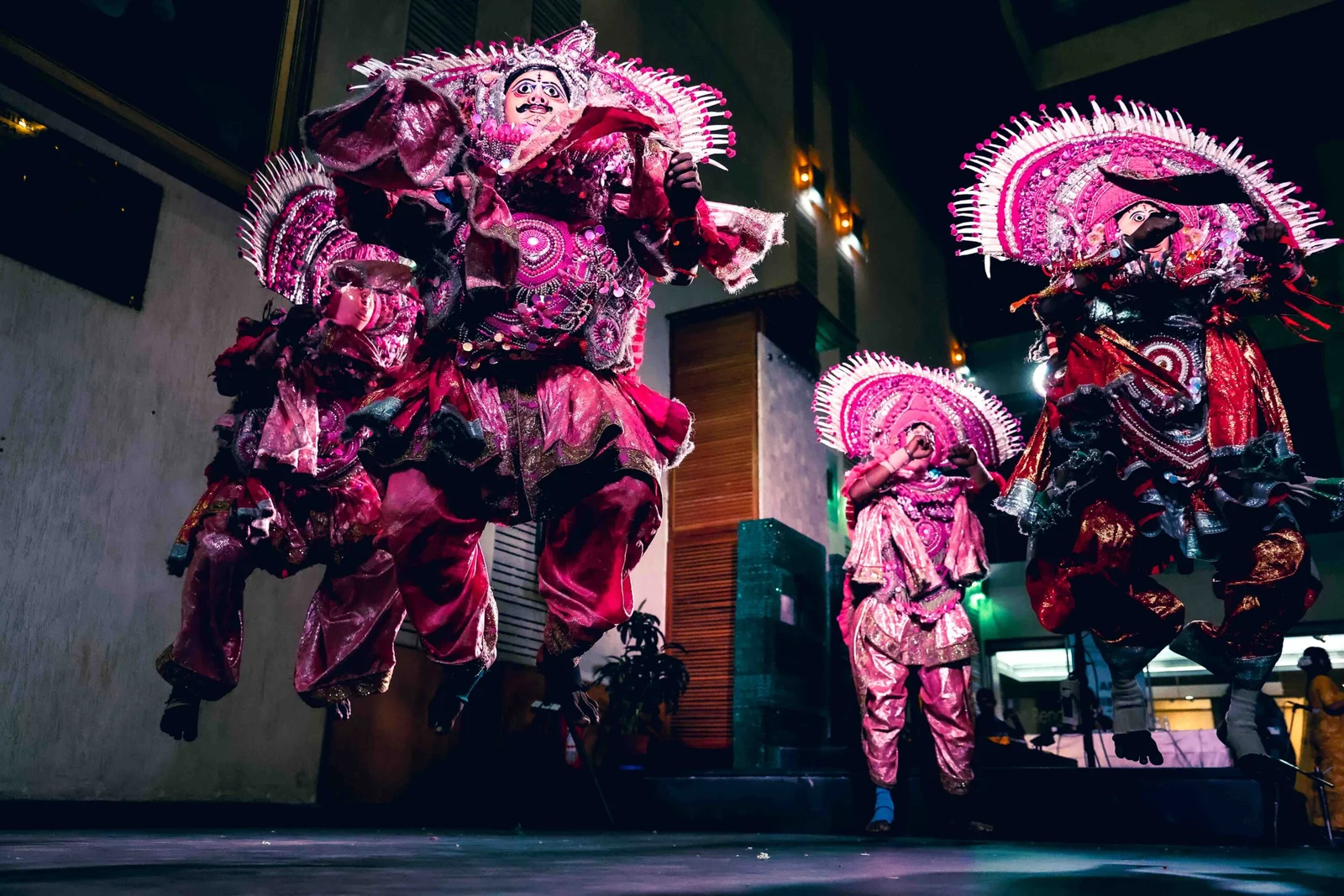
Chhau Dance, practiced across the contiguous regions of Jharkhand, Odisha, and West Bengal, constitutes a distinctive performance tradition where martial movement, tribal aesthetics, and dramatic storytelling converge. Though rooted in village life and ritual practice, it has developed into a semi-classical form with a refined vocabulary, a complex choreographic structure, and a nuanced narrative grammar. Performances stage episodes from the Ramayana, the Mahabharata, and the Puranas alongside local legends and occasionally abstract themes, translating well-known narratives into sequences of embodied gesture, rhythmic design, and symbolic color. The art is non-verbal, performed primarily by male dancers and accompanied by live folk music whose rhythms and melodic phrases drive dramatic tension and shifts of mood. The three regional styles-Purulia in West Bengal, Seraikella in Jharkhand, and Mayurbhanj in Odisha-share core principles yet maintain distinctive conventions, especially in the use of masks and the emphasis on facial expression. Chhau’s performance calendar is closely tied to seasonal rhythms and religious observances, notably the spring festival of Chaitra Parva, and its continued practice rests on interconnected communities of dancers, musicians, mask and costume makers, and local organizers. Recognized by UNESCO as an element of Intangible Cultural Heritage, Chhau endures as a living system where physical training, craft knowledge, ritual intent, and communal participation sustain an expressive tradition that is both anchored in place and adaptable to new contexts.
Origins & Historical Background
Chhau’s origins lie in the interweaving of indigenous tribal dances with martial practices once integral to community defense and ceremonial display. Etymological associations with the Sanskrit “chhaya,” implying shadow or mask, and the Odia “chhauni,” meaning military camp, point toward a tradition that evolved at the junction of masked impersonation and martial regimen. The dance’s movement vocabulary bears the imprint of parikhanda, the sword-and-shield combat training that shaped both its stances and its dynamic use of space. Over time, this functional repertoire was ritualized and dramatized, gradually absorbing influences from classical dance systems as well as expanding through contact with diverse local folk idioms. The process was cumulative rather than transformative, preserving a strong kinetic core while accommodating a range of expressive demands, from the depiction of deities and demons to animals and village life. Within this broad trajectory, the emergence of three regional styles reflects divergent historical contexts. In Seraikella and Mayurbhanj, royal patronage provided institutional continuity, supporting courtly performance and the systematization of repertoire. In Purulia, the form remained more explicitly folk in its social organization and aesthetic, even as it developed a theatrical syntax that enabled complex dramatic storytelling. While all styles share martial vigor and thematic engagement with epic and Puranic narratives, they diverge in performative strategies: Purulia and Seraikella emphasize the transformative power of the mask, whereas Mayurbhanj, without masks, relies on the face as a site of expressivity. The dance’s evolution thus demonstrates a capacity to integrate multiple influences while maintaining a recognizable identity: a kinetic theatre of myth and morality framed by village ritual cycles and cultivated through rigorous practice.
Ritual Structure / Performance Framework
Chhau is typically performed in open spaces known as akhadas or asars, often during spring observances such as Chaitra Parva when communities gather to honor Shiva and Shakti and to mark agrarian cycles. The performance environment is intentionally unconfined, with audiences arrayed around a central ground that becomes both stage and ritual space. While the temporal frame may be as brief as forty-five minutes, community events frequently unfold over several hours as multiple troupes present successive pieces. The dramaturgy is non-verbal: there is no sung dialogue or declamation by the dancers; instead, instrumental music articulates tempo, mood, and transition, acting as the principal indicator of emotional shading and narrative turn. Choreography draws upon three core movement categories that together furnish the grammar of the form. Khel comprises mock combat that recalls the discipline of armed training, with elevated stances, sharp directional changes, and forceful footwork. Chalis and topkas stylize the gait and behavior of animals and birds, distilling observation into emblematic motion that signals character type and dramatic function. Uflis translate everyday village activities-sowing, grinding, fetching water-into concise motifs, grounding epic narrative in recognizable human labor. The story advances through palas, or vignettes, which may portray episodes of divine encounter, cosmic battle, or moral testing; alternatively, they may explore abstract moods through kinetic contrast and musical development. The interplay of Tandava (associated with masculine vigor) and Lasya (signifying grace) shapes the overall tonal spectrum, with male performers often enacting female roles through the inflection of gesture and weight. Regional differences surface at the level of embodiment: Purulia and Seraikella deploy masks to fix character identity, requiring heightened clarity in torso and limb articulation, whereas Mayurbhanj, maskless, incorporates facial expression as an integral layer of communication. Across styles, the ritual environment, cyclical timing, and ensemble coordination position the dance as both spectacle and community rite.
Community & Social Meaning
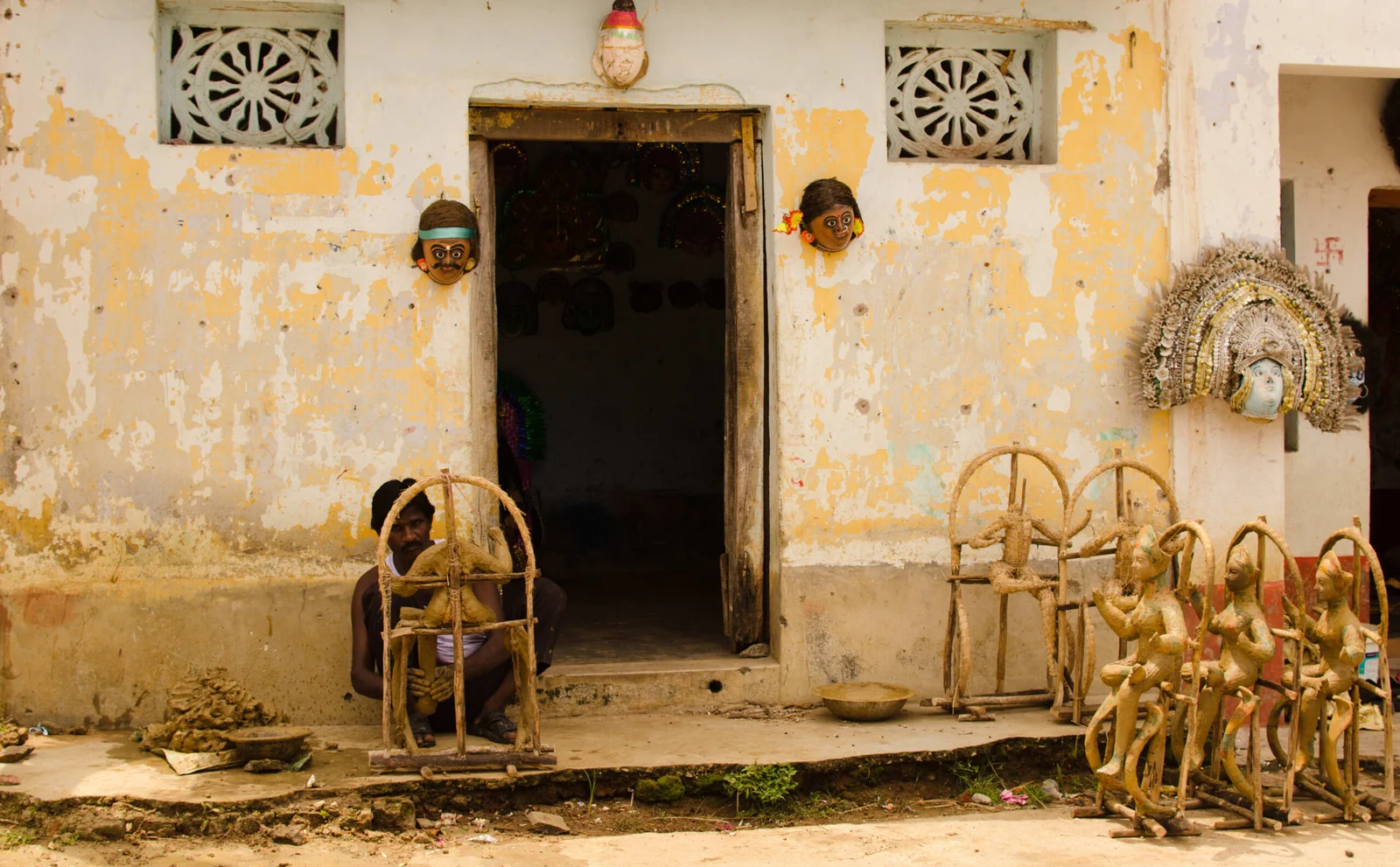
Chhau’s social life is organized through networks of families, neighborhood associations, artisan communities, and ritual committees that together ensure transmission and continuity. Historically, in Purulia and Mayurbhanj, dancers often came from Scheduled Castes and Tribes, with practice embedded in local customs and seasonal observances; in Seraikella, a Kshatriya lineage presided over a tradition supported by royal patronage. Such distinctions mark different pathways for training, repertoire, and institutional support, yet on the ground the performances bring together heterogeneous groups: dancers, musicians, mask makers, tailors, instrument makers, and community leaders. The Sutradhar community, centered in Charida village in Purulia, sustains the mask-making craft integral to particular styles, while specialized musician and artisan groups maintain instrument building and repair. Chhau functions as communal choreography in more than the theatrical sense; rehearsals, costume preparation, and performance planning tie the form to cycles of collective work, creating interdependence that reinforces social bonds across caste, tribe, and occupation. Its linkage to festivals devoted to Shiva and Shakti situates the dance within devotional frameworks without requiring doctrinal uniformity; the performance arena becomes a shared space of attention and emotion where narratives resonate with local ethical concerns and cosmological ideas. For many communities, participation in Chhau also asserts cultural identity and affirms continuity with ancestral practices, even as the repertoire and presentation adapt to contemporary audiences. Notably, the emergence of all-women troupes in recent decades has broadened participation, challenging earlier gender exclusivities and underscoring the form’s capacity to evolve while retaining its core movement and narrative principles. As an expressive system embedded in rural economies of craft and performance, Chhau also supports livelihoods through dance, music, and associated crafts, offering a model in which artistic transmission and social empowerment intersect. The tradition’s communal orientation thus is not only aesthetic but also structural, organizing work, ritual, and identity around a shared cultural resource.
Symbols, Music, Dance & Material Culture
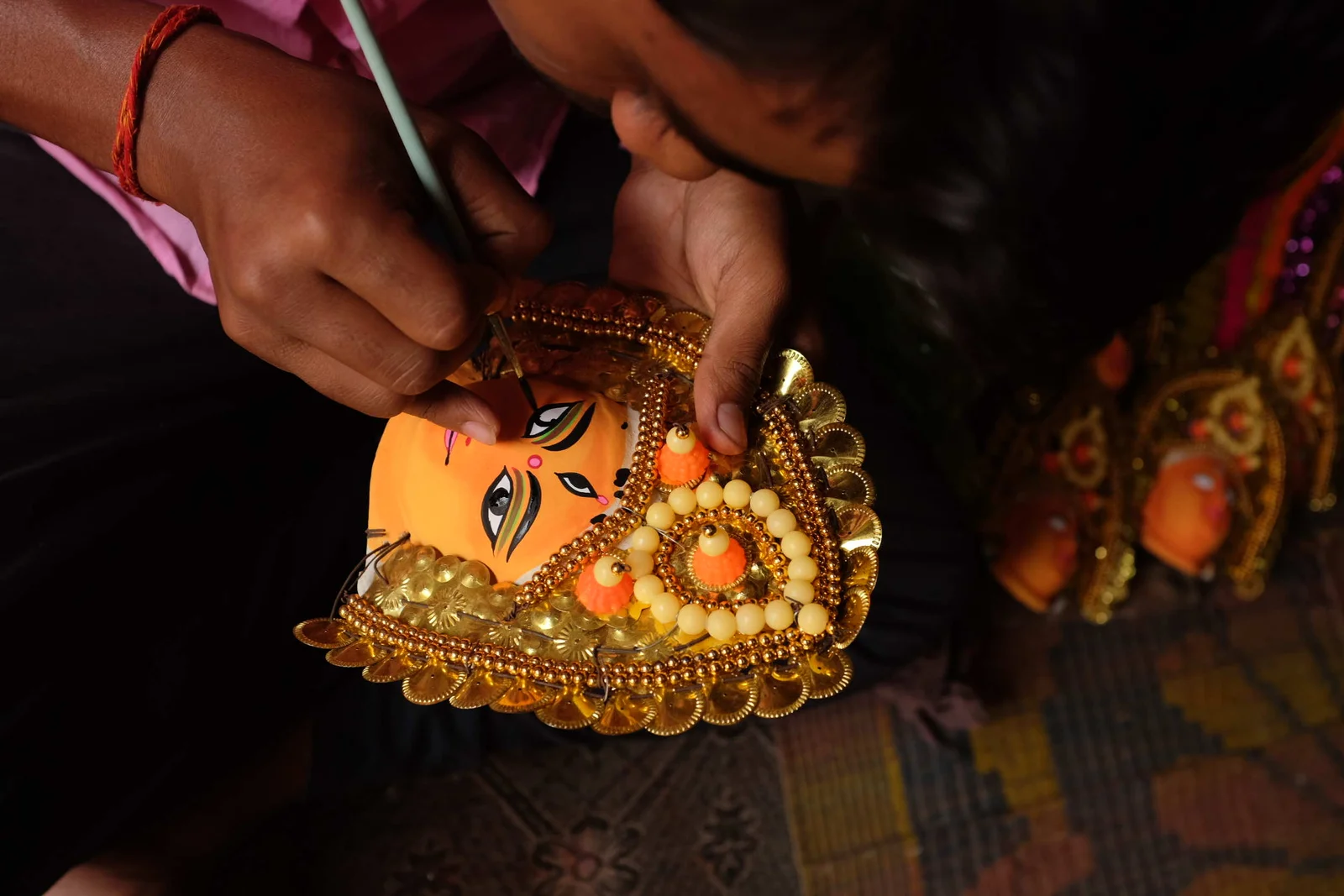
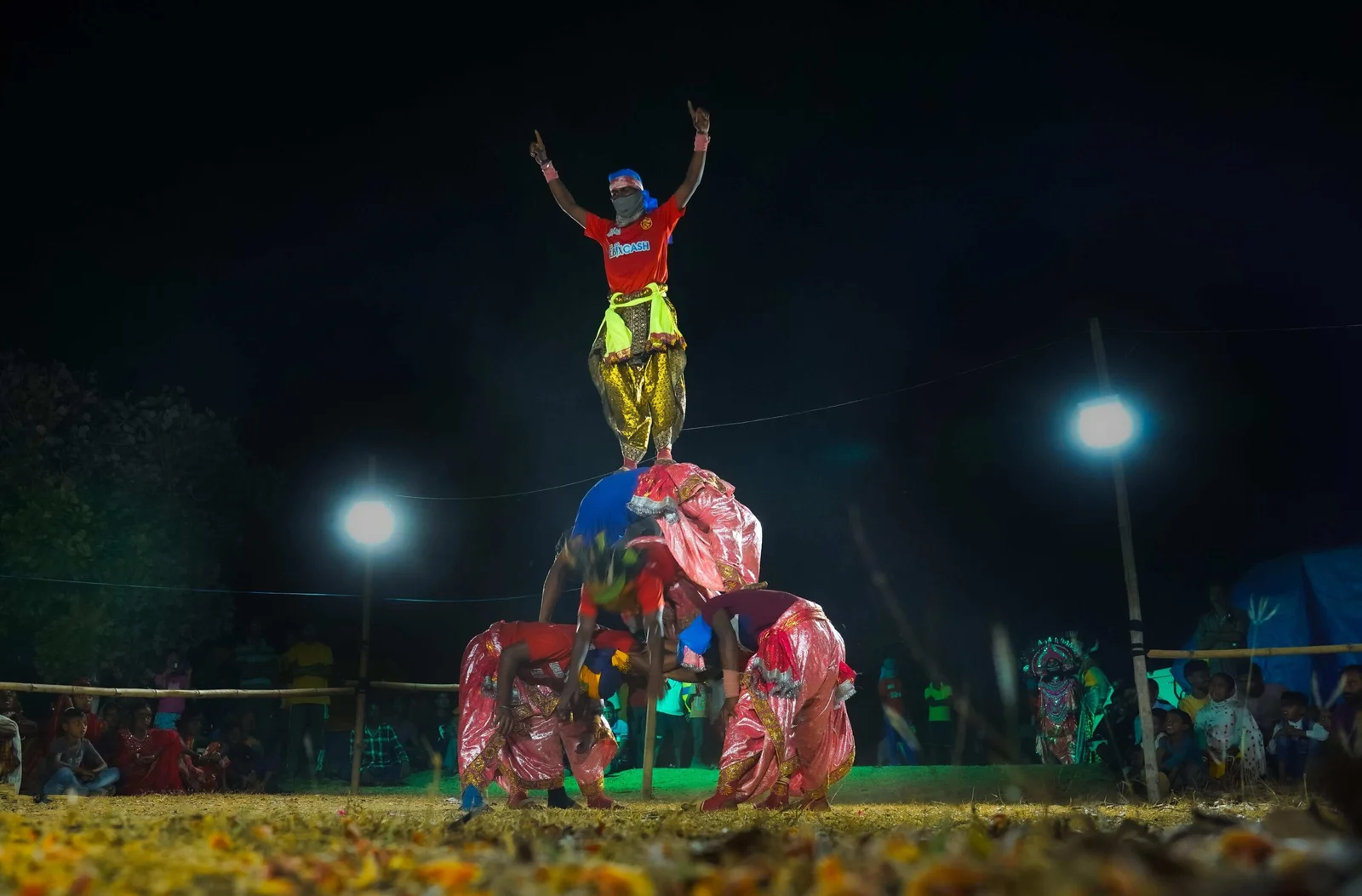
Chhau’s symbolic language operates across visual, sonic, and kinetic registers. In Purulia and Seraikella, masks are central: large, stylized, and vividly colored, they externalize the essence of gods, heroes, demons, and animals. Crafted primarily from clay and papier-mâché reinforced with cloth, the masks are built through successive layers, carefully dried, and then finished with paint and ornament. Artisans in Charida village have refined this process through hereditary transmission, using beads, sequins, feathers, and other embellishments to accentuate character traits. Color-coding supports quick recognition: blue for Krishna, green for Rama, pink for heroes, and darker tones such as black or green for demons. These choices are not arbitrary decorations but part of a semiotic system in which hues, contours, and adornments index mythic identity and moral valence. By masking the face, the dance shifts emphasis to the vocabulary of the body, demanding a high degree of clarity in posture, footwork, and gesture to convey emotion and intention. Costumes amplify this visual world, with silk, cotton, and satin forming robes, sashes, and armor-like elements that differentiate divine from demonic, human from animal. Crowns, jewelry, and shoulder pieces frame the head and torso, integrating with the mask to complete the picture of the character. Music provides the structural spine. The percussion section-dhol, dhamsa, nagara, and madal-lays down rhythmic cycles that announce entrances, escalate combat, or soften into processes of supplication and grace. Melodic reed instruments such as the mohuri and shehnai carry motifs that cue narrative shifts and emotional color.
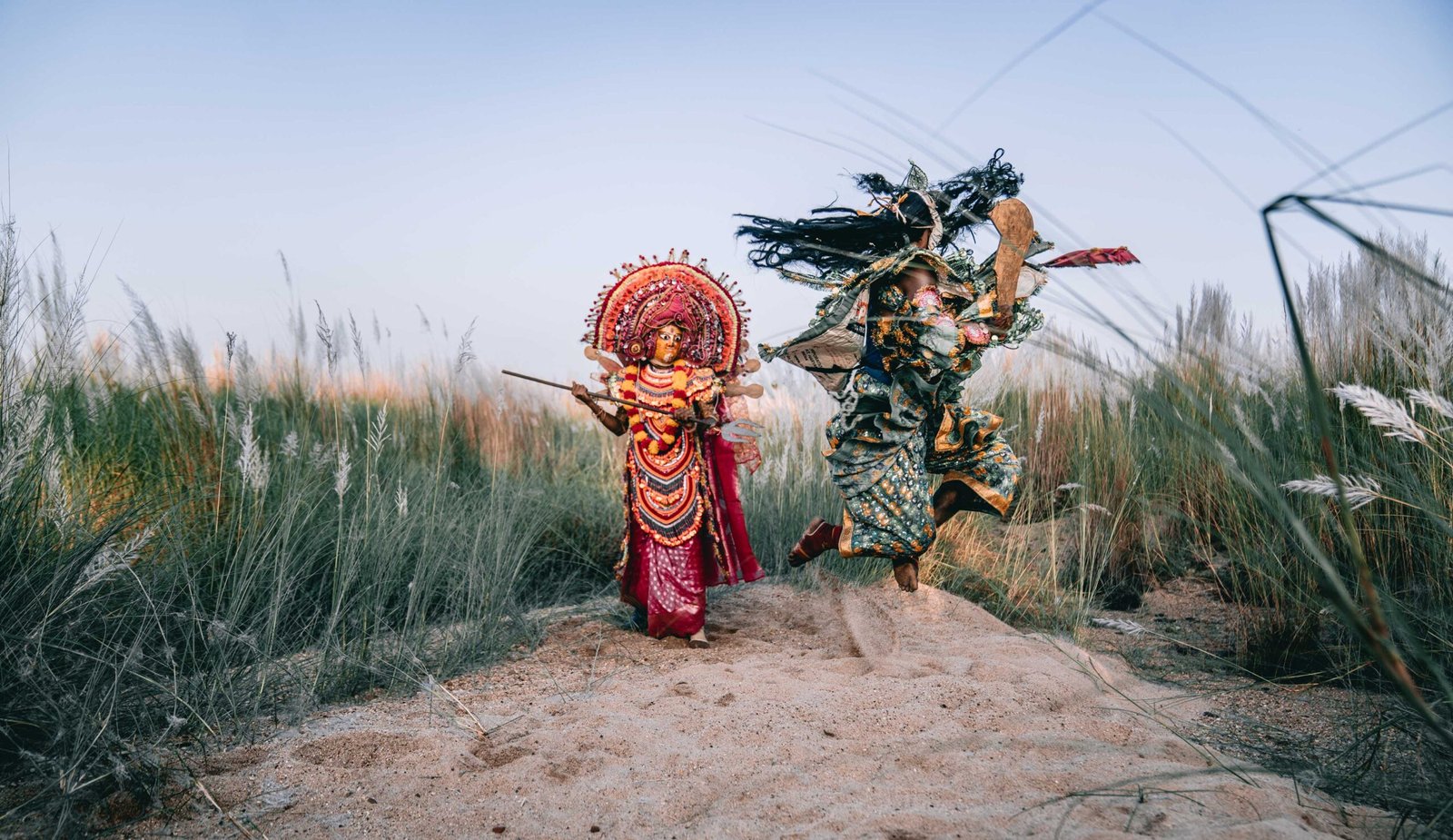
At times, vocal chanting or narrative songs accompany the ensemble, linking sonic motifs to textual memory even when the stage action remains wordless. Movement culminates this assemblage. Martial steps derived from combat training sustain a low, stable center of gravity from which leaps and turns explode; acrobatic feats such as somersaults knit athleticism to characterization. Animal gaits distill rhythm into archetypal signatures-the measured tread of an elephant, the dart of a bird-while uflis fold the routines of agrarian life into the performance, making the stage a mirror of the village. These elements, taken together, form a tightly coupled system in which color, sound, and movement communicate layered meanings about cosmic struggle, protection, devotion, and social reciprocity.
Viewing / Participation Context
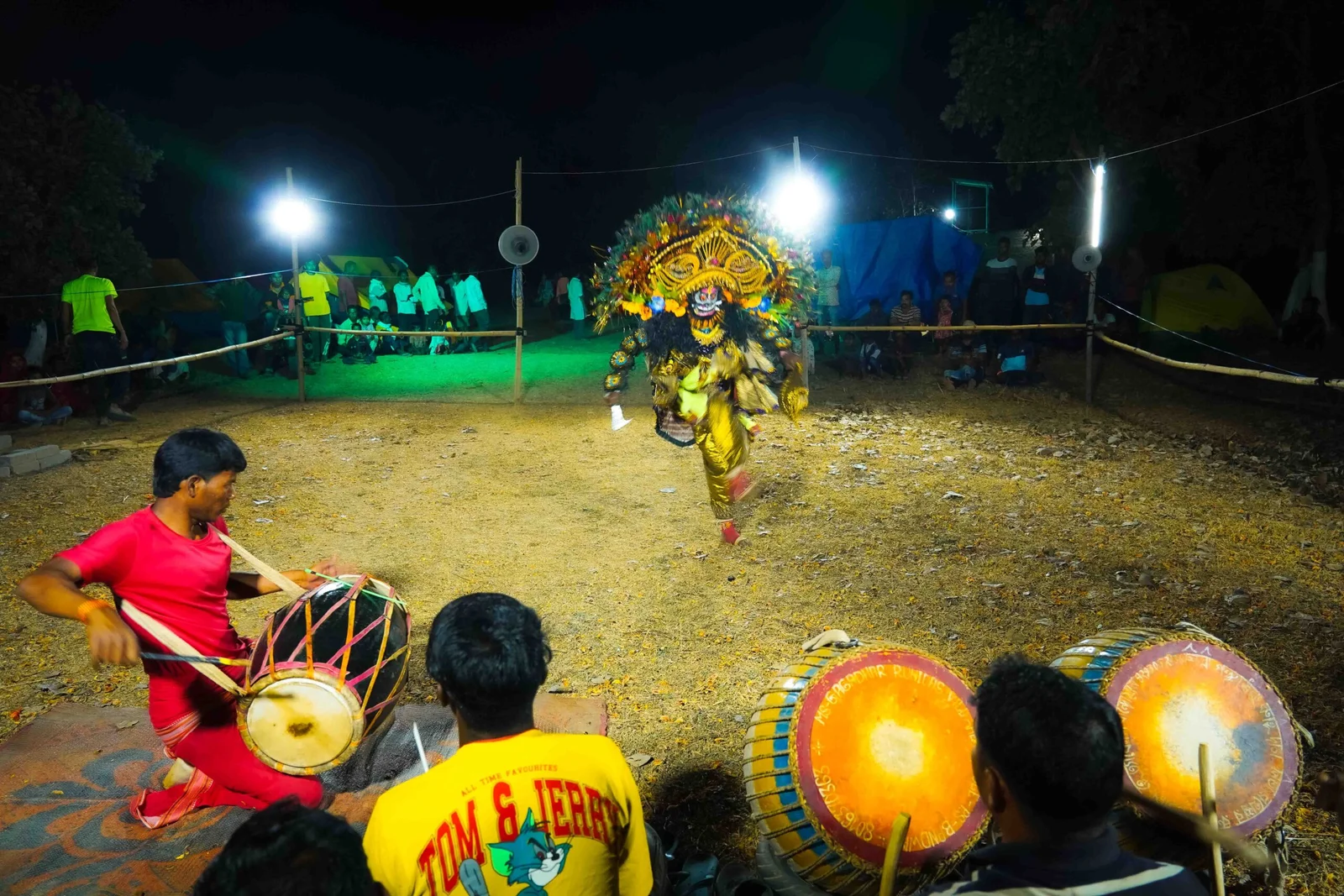
Chhau’s spatial and temporal settings are integral to its reception. Traditionally staged in village squares, courtyards, or open fields across Purulia in West Bengal, Seraikella in Jharkhand, and Mayurbhanj in Odisha, the dance unfolds under night skies by moonlight or torchlight. The audience encircles the performance ground, erasing rigid boundaries between stage and spectator and drawing the community into a shared field of attention. This proximity allows viewers to follow the precision of footwork, the sweep of a leap, or the tilt of a mask, and it heightens the collective energy essential to the form’s impact. During spring festivals such as Chaitra Parva, performances may proceed through the night, with troupes alternating in a continuous sequence that blends ritual, entertainment, and communal gathering. The non-verbal nature of the form makes it accessible beyond linguistic lines; narrative recognition rests on visual and musical cues, allowing audiences with varied backgrounds to engage with the unfolding story. In contemporary practice, Chhau has expanded into urban cultural festivals, auditoriums, and international stages. While the proscenium imposes a defined frame, careful curation can preserve the ensemble’s acoustic balance, the clarity of masked gesture, and the kinetic intensity derived from traditional spacing. Cultural organizations and educational institutions frequently support lecture-demonstrations and workshops that introduce audiences to the building blocks of the form-movement categories, mask handling, and music-fostering informed engagement. Mask-making workshops and exhibitions offer complementary entry points, connecting viewers to the craft processes that undergird performance. The recent emergence of women’s troupes has diversified participation, and community-based initiatives continue to emphasize the tradition’s non-verbal communicability and its rootedness in shared ritual time. Across these contexts, the continuity of core practice-ensemble music, clear movement categories, emblematic characterization-anchors adaptation and ensures that Chhau remains intelligible and compelling even as venues and audiences shift.
Conclusion
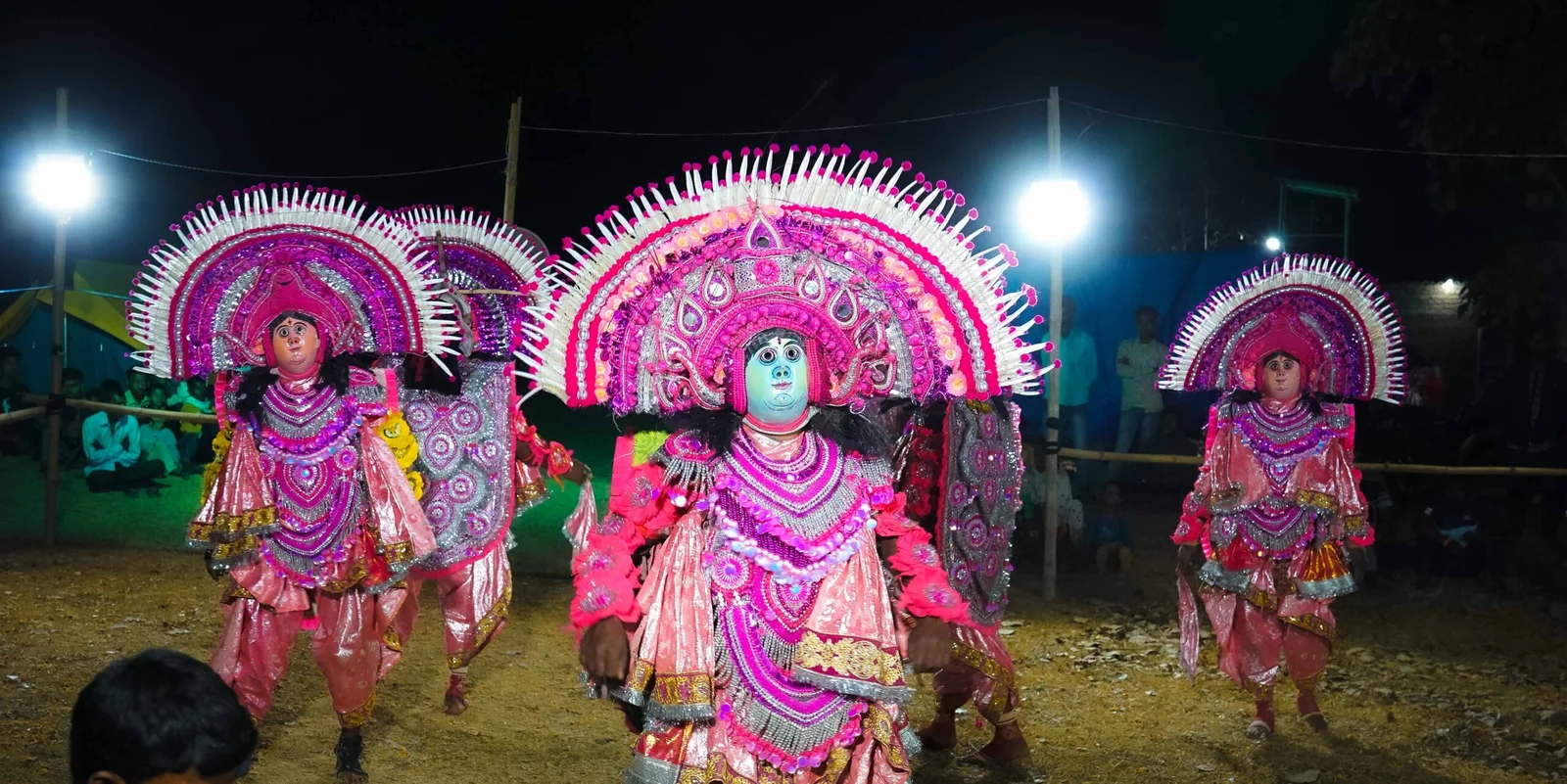
Chhau endures as a choreography of cultural memory, uniting martial discipline, craft knowledge, and narrative intelligence in a living system shaped by community, history, and ritual practice. Its three regional styles attest to the ways patronage, geography, and social organization can yield distinct yet related aesthetic solutions, from the transformative anonymity of masked performance in Purulia and Seraikella to the facially expressive intensity of Mayurbhanj. Within a rigorous performance framework, the dance realizes a broad thematic range: the combats and councils of epic heroes, the interventions of deities, and the patterned labors of village life all find form in precise physical vocabularies scaffolded by music and color. Socially, Chhau functions as both an arena of collective festivity and a conduit for intergenerational transmission, drawing together dancers, musicians, artisans, and audiences in recurring cycles of preparation and performance. The tradition also illustrates how cultural practice can support identity and empowerment without relinquishing its ritual grounding; the participation of women’s troupes alongside longstanding male ensembles broadens the circle of practitioners while respecting established structures of training and staging. As with many complex traditions, certain dimensions merit further documentation: how oral transmission and formal instruction interact, how modernization reshapes livelihoods for performer and artisan communities, and how new themes enter repertoire alongside epic and folk narratives. Yet the resilience of core principles-non-verbal storytelling, martial-derived movement, and the semiotics of mask and costume-anchors Chhau in its home regions even as it travels to new platforms. Recognized as Intangible Cultural Heritage, the dance’s vitality rests less on institutional designation than on the sustained, collaborative labor of communities who rehearse, carve, stitch, drum, and perform. In this durable ecology, Chhau’s masked heroes and unmasked faces continue to give body to stories that are local in texture and expansive in reach, reaffirming the capacity of folk performance to hold history, ethics, and aesthetics in a single, disciplined arc of movement.