
From Persepolis to Pataliputra: Achaemenid Currents in Early Indian Imperial Art
The visual and structural languages of ancient empires rarely respected political frontiers. From the ceremonial terraces of Persepolis in present-day Iran to the palatial compounds of Pataliputra in northern India, architectural and artistic forms circulated with administrators, artisans, merchants, and ideas. This article examines the Achaemenid Empire’s imprint on early Indian imperial art, with particular attention to the Mauryan capital at Pataliputra and the imperial pillar tradition. Drawing on archaeological, epigraphic, and stylistic evidence, it traces how a repertoire of forms-monumental columns, bell-shaped abaci, animal capitals, and courtly relief idioms-was adapted and reinterpreted within an Indian context. The analysis emphasizes historical settings, material assemblages, and iconographic programs, avoiding anachronism and remaining attentive to areas where evidence is still fragmentary. In doing so, it situates early Indian imperial art within a broader intercultural matrix shaped by Achaemenid models of governance and monumentality.
Historical Background
The Achaemenid Empire, founded by Cyrus the Great in the mid-sixth century BCE, expanded rapidly across western and central Asia. Under Darius I, the eastern reach of the empire included territories at the edge of the Indian subcontinent: Gandhara, Thatagush (Sattagydia), and Hindush (Sindh). These satrapies formed the easternmost provinces recorded in royal proclamations and administrative documents. Achaemenid control in these regions, while variable in intensity, persisted until the campaigns of Alexander of Macedon in the late fourth century BCE. After the disruption of Achaemenid authority and subsequent political transitions, the Mauryan Empire (c. 321–185 BCE) unified much of northern India, incorporating areas that had experienced Persian administrative and cultural influence.
Throughout this period, the northwestern Indian borderlands served as contact zones. Evidence for Persian administrative and military presence is most secure in these frontier regions, including Gandhara and Taxila, where both textual references and archaeological assemblages indicate structured interaction with Achaemenid systems. While local rulers often retained autonomy under nominal Persian suzerainty, the frameworks of imperial ideology-from standardized communication and coinage to architectural patronage-provided a model that subsequent Indian polities could observe and, in selective ways, adopt. The Mauryan state emerged in this aftermath as a centralizing power whose monumental projects echo, adapt, and transform elements of Achaemenid ceremonial art and architecture.
In this historical trajectory, the flow of forms was not a simple matter of borrowing. Rather, it involved the encounter of an imperial style forged from multiple sources-Mesopotamian, Egyptian, Elamite, Greek, and Median-reshaped within a Persian courtly program and then reinterpreted within Indian political and cultural environments. The convergence of these traditions created conditions in which early Indian imperial art could articulate its own monumental language while retaining traces of western Asian prototypes.
Architecture & Layout
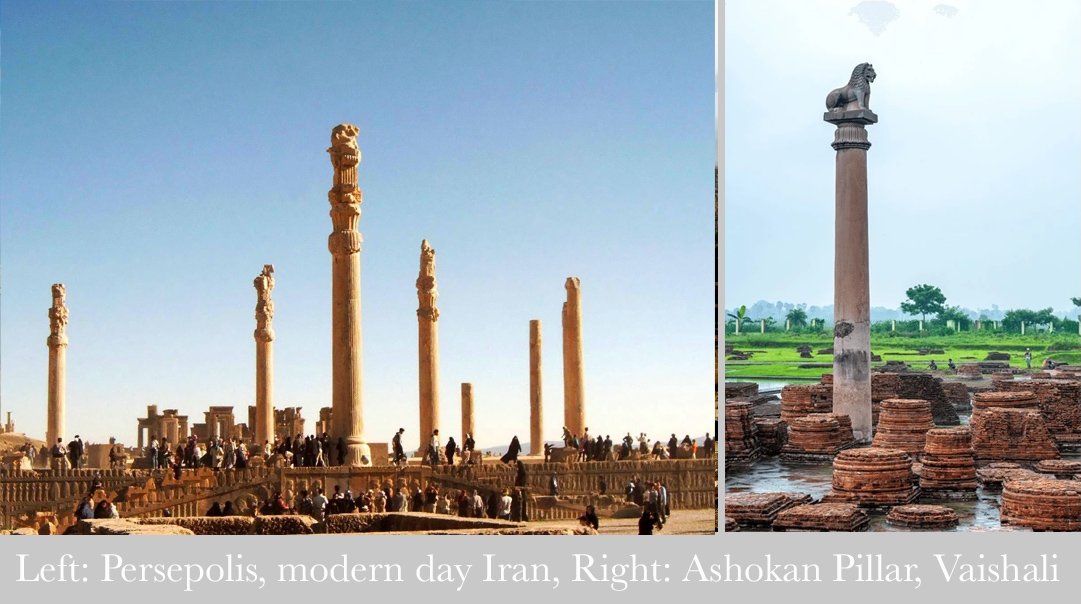
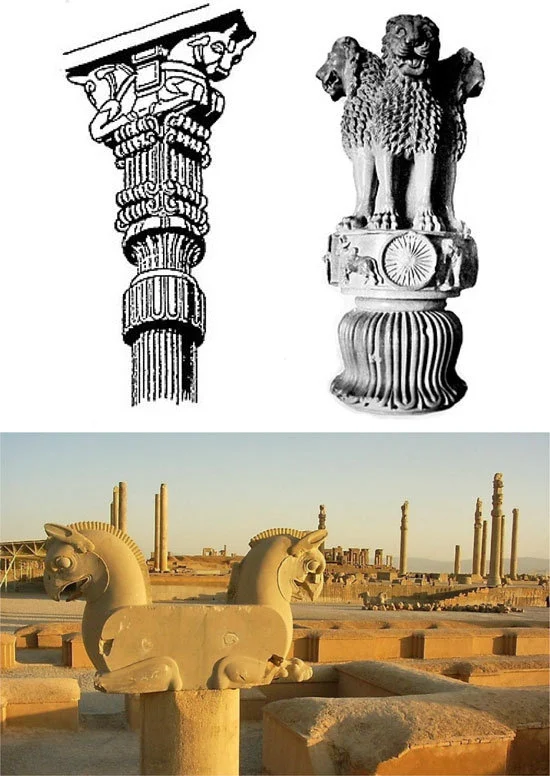
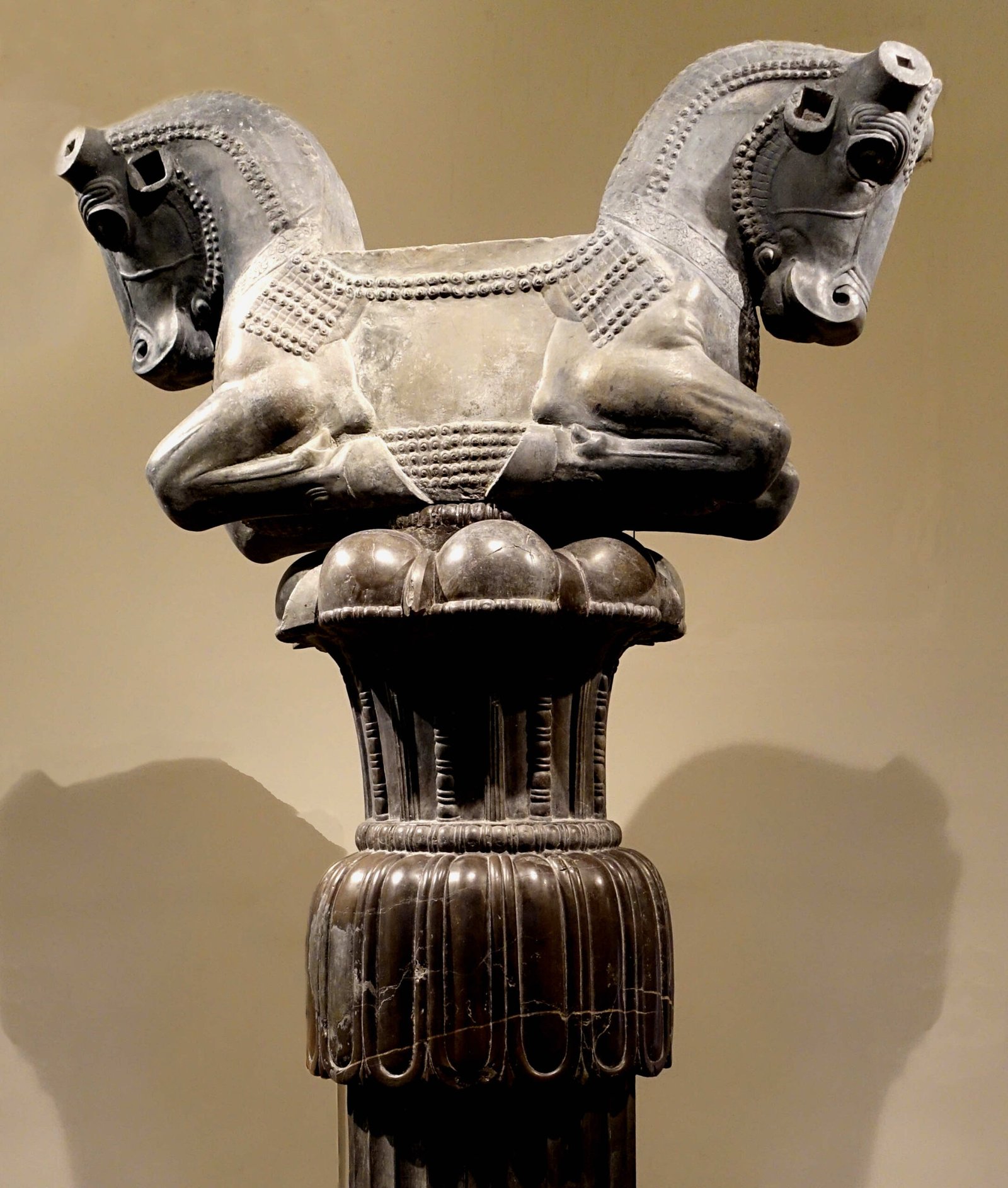
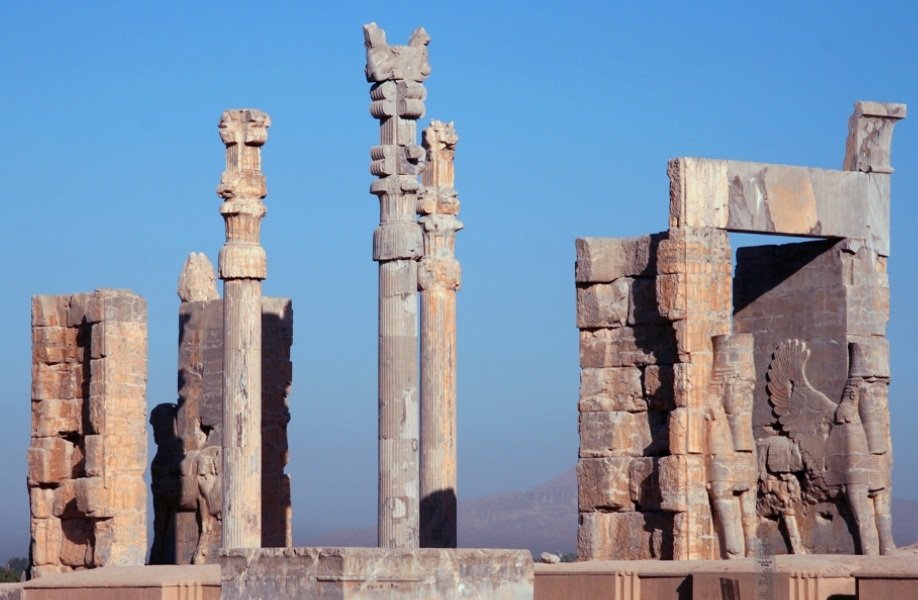
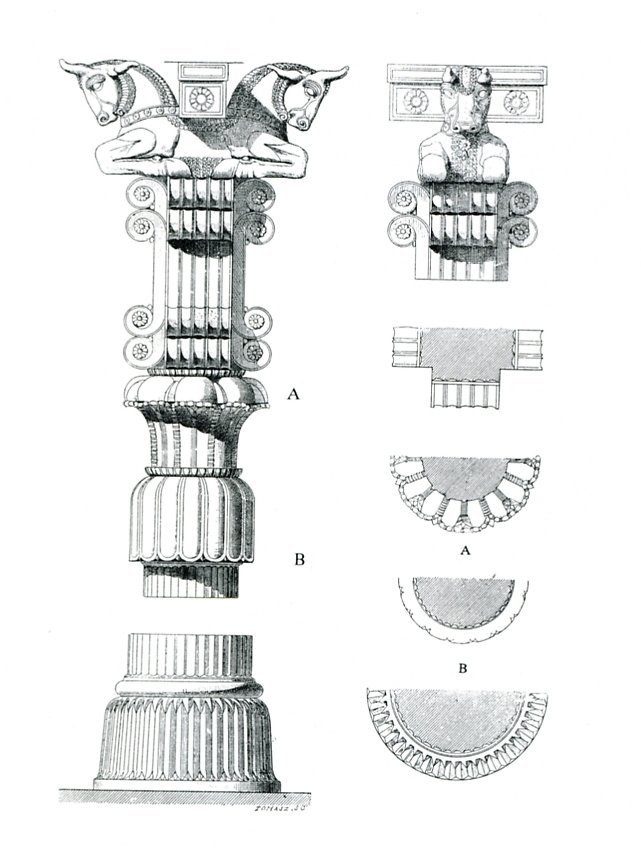
Achaemenid architecture is best known through the palatial ensemble at Persepolis, a ceremonial city characterized by expansive platforms, orthogonal halls supported by high stone columns, and processional stairways articulated by reliefs. The eclecticism of the Achaemenid style-its synthesis of diverse regional forms into a coherent imperial vocabulary-produced distinctive features such as elaborate double-bull capitals, carefully modulated column shafts, and sculpted abaci that supported roof beams. Beyond these formal attributes, the planning emphasized axiality and ritual movement, using monumental stairs and terraces to orchestrate processions and ceremonial display.
The architectural language of Persepolis was expressive of imperial order. Marble-smooth stonework and carefully controlled relief surfaces created a refined monumental aesthetic. The audience halls and gateways, while eclectic in iconographic detail, projected a consistent image of centralized authority through scale, material, and ornament. The Tomb of Cyrus the Great at Pasargadae, though architecturally distinct in its simplicity, further attests to Achaemenid mastery of stone construction and an ethos of dignified restraint. The monument’s balanced proportions, clarity of massing, and careful construction demonstrate a formal discipline that resonated beyond Iran.
The Mauryan capital at Pataliputra reflects significant shifts in building technology and planning that align with Achaemenid precedent. Whereas earlier Indian constructions frequently emphasized timber, the Mauryan court is associated with an increasing reliance on stone in palatial contexts. This transition did not merely replace one material with another; it introduced a new structural logic visible in the treatment of columns, capitals, and surface finishes. The coherence of columnar spaces-hall-like arrangements that depend on rhythm and module-parallels Achaemenid palatial halls, even as the Indian program reworks proportions and details to suit local conditions.
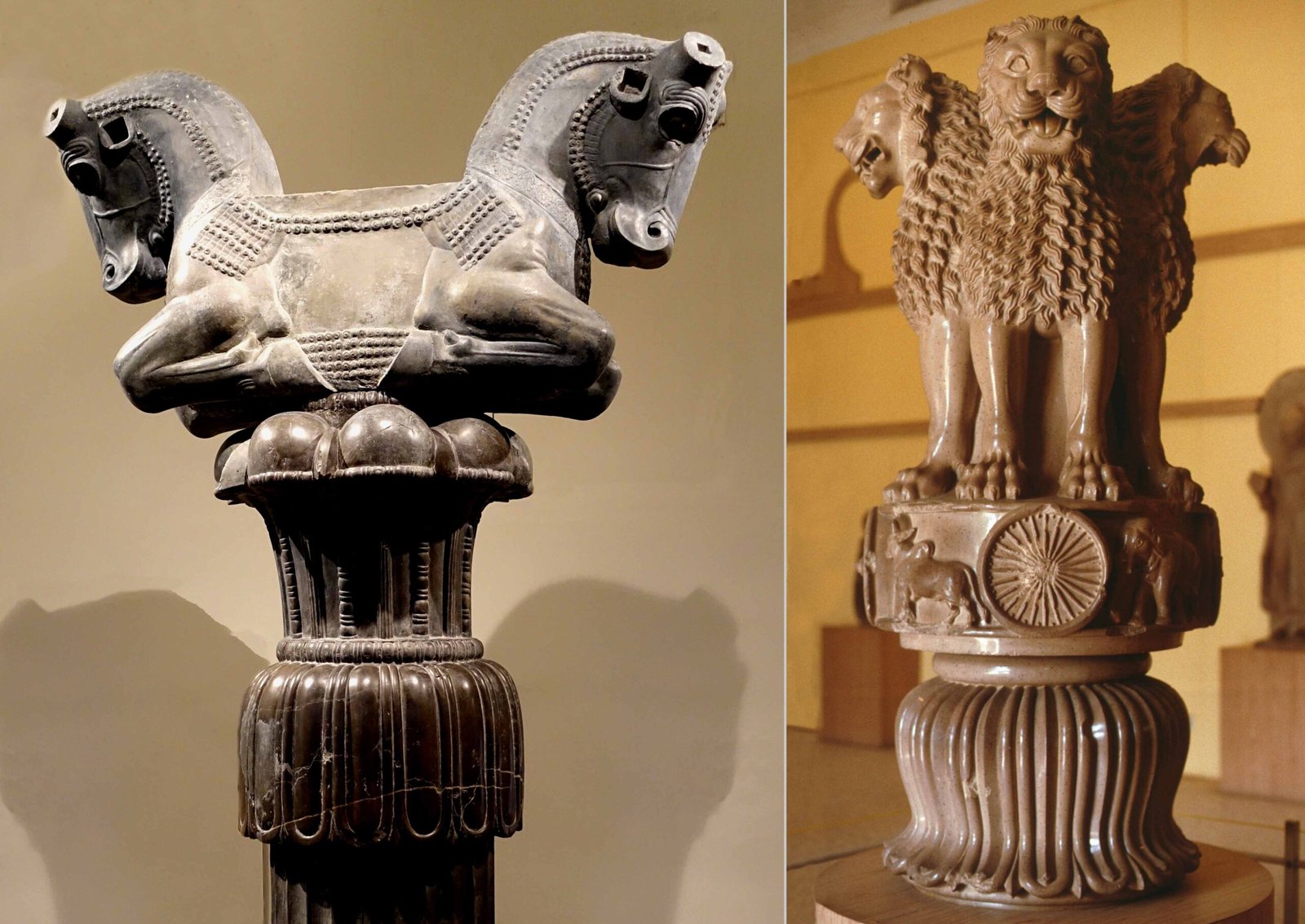
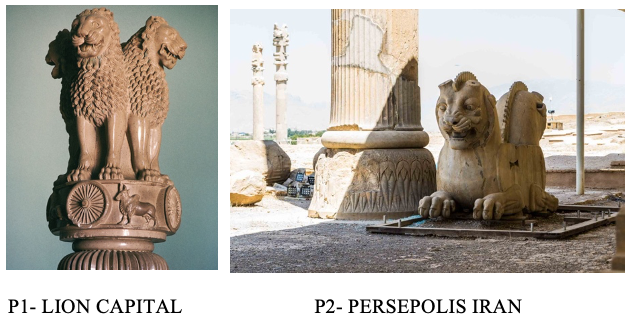
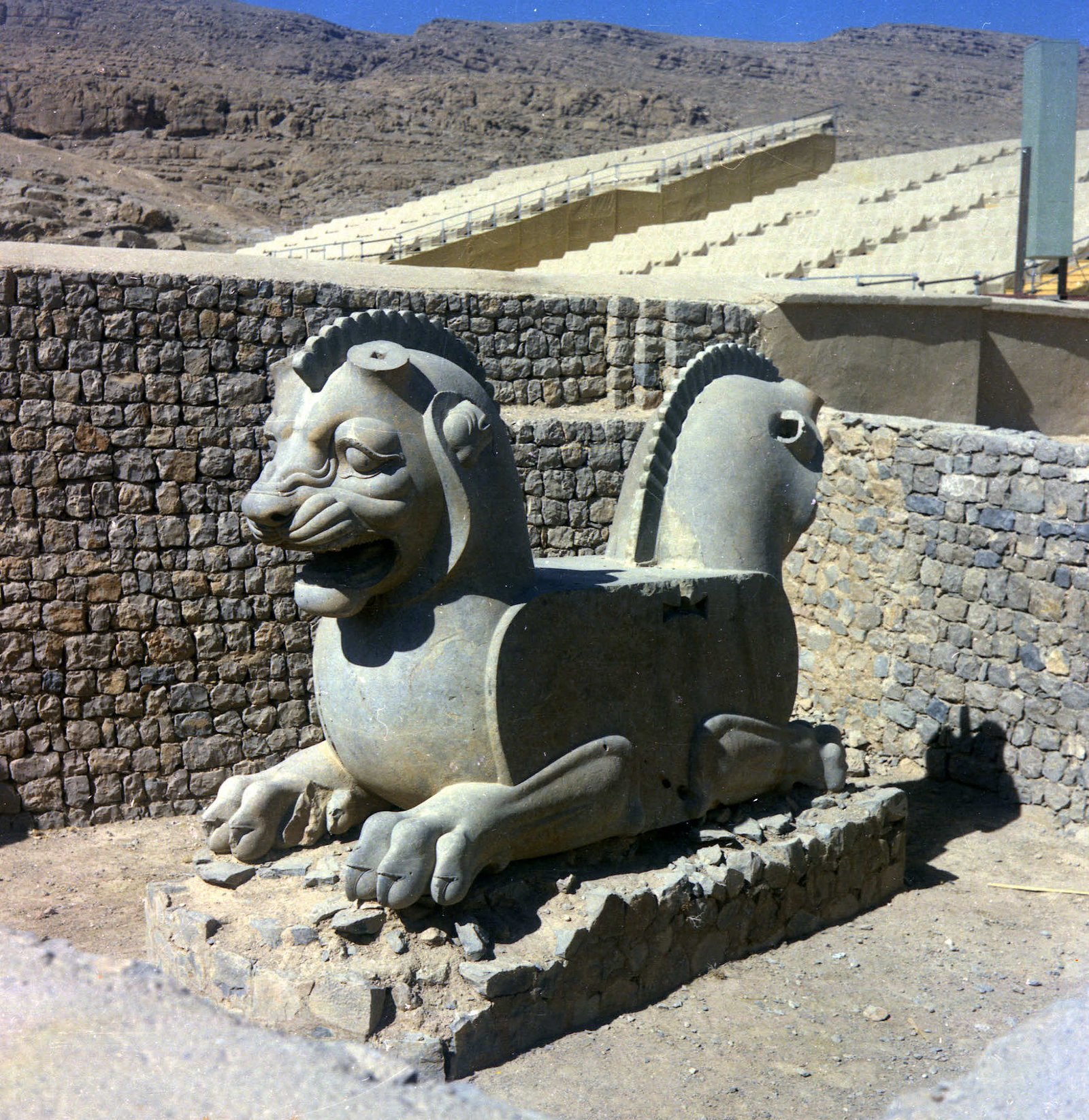
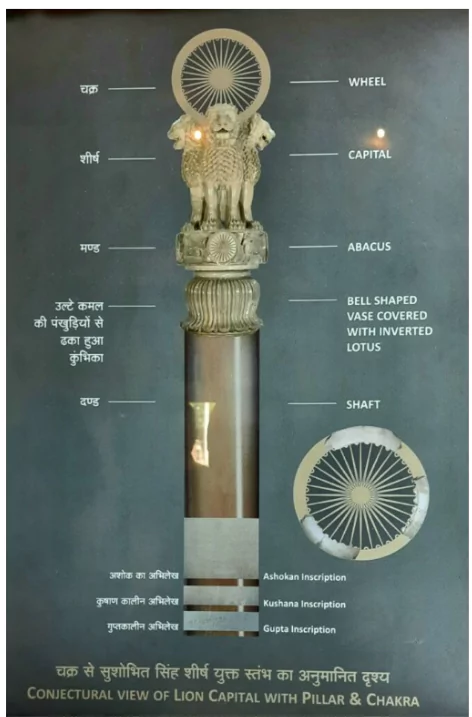
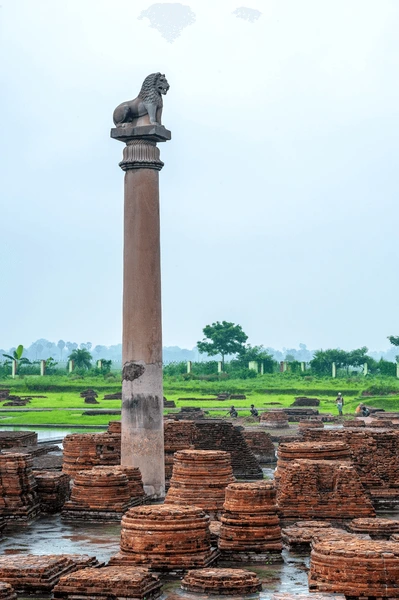
The imperial pillar tradition of the Mauryan era underscores this transformation. The monolithic, polished sandstone columns associated with royal patronage express a strong vertical emphasis, combined with animal capitals and abaci that articulate the interface between shaft and sculptural finial. The use of bell-shaped abaci and the deployment of winged animal forms as capitals have clear resonances with Persian prototypes, though the Mauryan interpretation invests these features with new symbolic and spatial functions. In India, the pillars not only mark administrative presence but also serve as carriers of moral and religious edicts, thus extending architectural language into a public, didactic sphere.
Archaeological remains in the northwestern subcontinent further support a narrative of architectural and cultural exchange. Sites such as Taxila and Gandhara have yielded material assemblages, including characteristic ceramics like tulip bowls, that are consistent with Achaemenid-era patterns. These finds, when read alongside the modified columnar forms and sculptural motifs in Mauryan stonework, suggest that artisans, templates, and design concepts circulated across the porous cultural frontier. While the precise mechanisms-whether through itinerant craftsmen, administrative procurement, or localized workshop adaptations-require further study, the architectural record supports a nuanced account of influence filtered through regional practices.
Sculpture, Inscriptions & Iconography
Persepolis integrates sculpture with architecture to communicate imperial cosmology. Reliefs along the grand stairways and audience halls depict delegations from subject nations, including Gandharans and Indians, who appear in distinctive attire and bearing tribute. The program constructs a visual narrative of unity-in-diversity under imperial sovereignty, with careful attention to ethnographic detail and standardized compositional fields. This didactic use of relief-anchored to processional routes-conveys both ceremonial order and an image of the empire’s geographic breadth.
The iconographic repertoire at Pasargadae offers a complementary register. Notably, the bas-relief of a four-winged guardian figure synthesizes Assyrian, Elamite, and Egyptian elements into a single apotropaic presence. Such syncretic guardianship motifs index the Achaemenid strategy of crafting an imperial visual language from diverse local idioms. These choices have formal as well as ideological implications: they underscore a vision of stabilized authority grounded in recognizable, regionally inflected symbols.
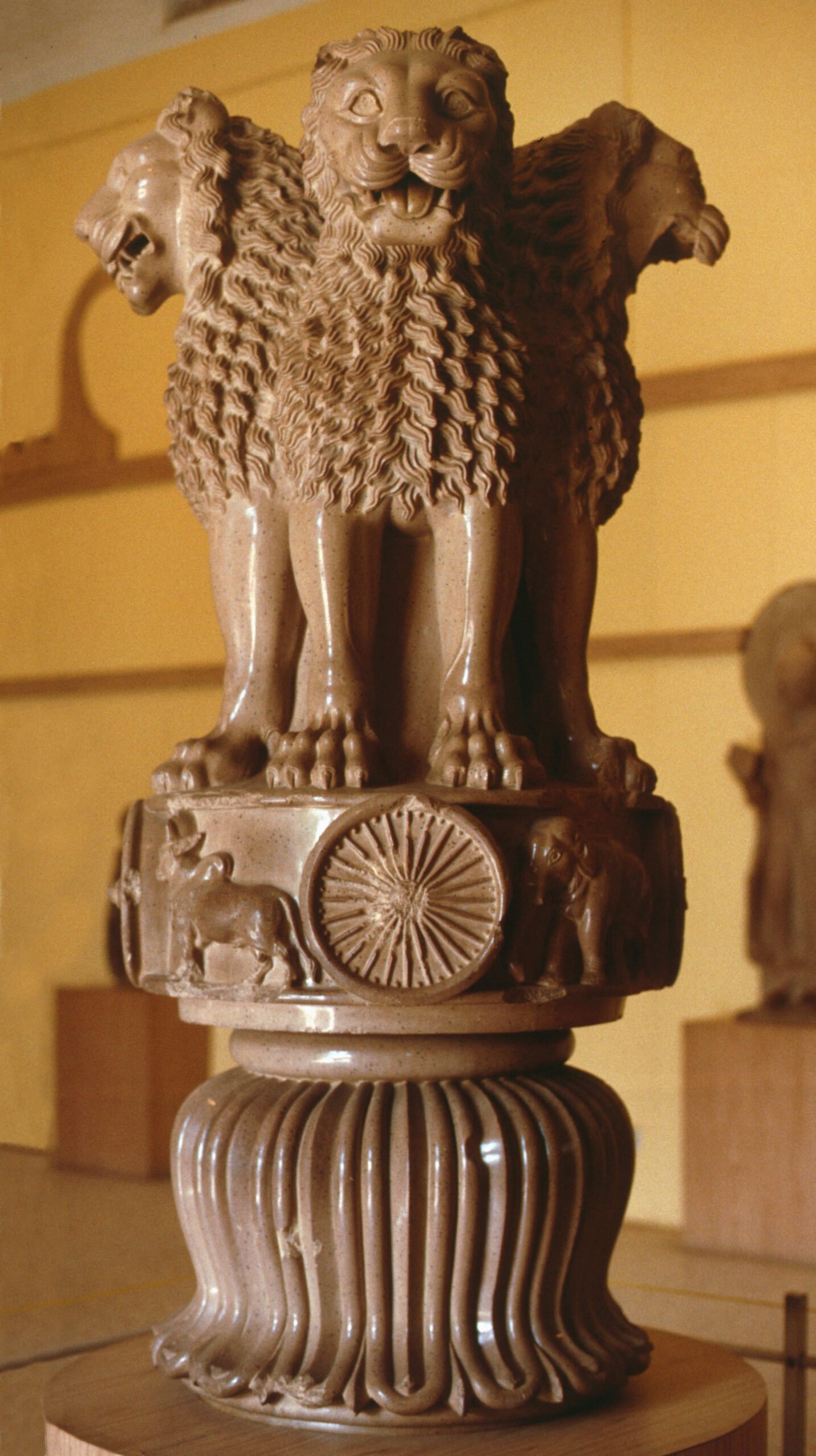
In the Indian context, the Mauryan pillar capitals-lions, bulls, elephants-provide a vivid locus for this cross-cultural adaptation. The surfaces display a high polish and an economy of form that align with Achaemenid preferences for clarity and refinement. Decorative programs incorporate floral motifs such as palmettes and rosettes, which likewise trace to Persian and Hellenistic repertoires. The Lion Capital of Ashoka from Sarnath exemplifies this synthesis: an animal ensemble rendered with local symbolic significance while participating in a broader Greco-Persian aesthetic conversation. The bell-shaped abaci beneath such capitals reiterate Persian structural grammar, now embedded in a South Asian epigraphic-architectural medium.
Sealings and minor arts in the northwest further attest to this dialogue. Greco-Persian seals combine imperial motifs, including taurine animals and the swastika, with local figures such as the zebu. These small objects imply that concepts of authority, auspiciousness, and identity were negotiated in portable formats, generated within workshop practices that were responsive to both Persian courtly and Indian regional demands. Their hybrid nature suggests local production under Persian influence, extending the cross-pollination of motifs beyond monumental architecture into administrative and commercial spheres.
Epigraphic and administrative records anchor this stylistic narrative in historical structures. The Behistun inscription of Darius I identifies Gandhara, Thatagush (Sattagydia), and Hindush (Sindh) as provinces of the Achaemenid Empire, confirming the political geography of eastern satrapies. The Persepolis Fortification Tablets record movement toward India and provisions for Indian personnel, indicating administrative integration that included rationing systems and controlled mobility. Inscriptions at Persepolis and Naqsh-e Rustam name and depict representatives from Indian satrapies, embedding these regions within the visual and textual rhetoric of empire.
On the Indian side, the pillar edicts associated with Mauryan rule were inscribed in scripts including Brahmi and Kharosthi. The latter’s derivation from Aramaic points to a linguistic channel of influence that parallels the architectural borrowings. The use of durable stone media for public proclamations resonates with Persian practices of monumental inscription, now deployed in the service of moral and religious teachings as well as governance. The epigraphic turn in early Indian imperial art thus combines script adoption, surface preparation, and placement strategies that together create a persuasive public text in stone.
Numismatic and ceramic evidence supports this interconnected picture. At Taxila, punch-marked coins exhibit influences traceable to Achaemenid silver bent-bar coinage, while Persian gold darics and silver sigloi were adopted in Indian territories. This currency circulation suggests standardized measures and imagery that would have facilitated trade and imperial accounting. In the ceramic record, forms such as tulip bowls in Gandhara and surrounding regions align with patterns of Achaemenid cultural influence, though the precise chronology and local uptake are still debated. Together, these materials provide a multi-scalar view of influence: from the level of court art and stone monuments to everyday instruments of exchange.
It is important to note the limits of current evidence. Archaeology confirms strong Achaemenid connections in the northwestern frontier, but direct administrative presence deeper into the subcontinent is less securely attested. Local rulers likely operated with considerable autonomy under Persian suzerainty. This context frames the Mauryan synthesis not as a passive inheritance but as a strategic appropriation of forms that had already circulated in border contexts, now reconfigured as part of an Indian imperial language.
Cultural Significance
The Achaemenid imperial system was noted for a policy of cultural and religious tolerance that allowed local traditions to continue within the structure of empire. In eastern satrapies, such an approach would have created conditions conducive to the coexistence of administrative integration and regional autonomy. The long-term effect of this policy is visible in the ease with which scripts, motifs, and ceremonial practices could pass into Indian polities. The introduction of the Kharosthi script, linked to Aramaic influence, underscores how writing systems could travel along administrative pathways and then serve new cultural functions.
In the Mauryan period, monumental pillars carry this synthesis into the public sphere. Their polished monoliths, animal capitals, and floral bands draw on Persian imperial symbolism, while their inscriptions articulate Buddhist moral and religious teachings. The result is a fusion that aligns the authority of the state with ethical instruction, using a visual language partly adapted from Achaemenid models. Far from constituting mere ornament, the pillars serve as nodes in a network that included administration, moral communication, and spatial marking across a large territory.
Economic and intellectual exchange amplified these cultural processes. Indian merchants and scholars operated within the wider Persian imperial network, providing channels for the movement of goods, techniques, and ideas between the subcontinent and western Asia, including Greece. The presence of Greco-Persian seals and coinage forms in the northwest attests to these interactions, while the palatial adaptations at Pataliputra reveal how structural concepts could be transformed in new contexts.
Ceremonial practices associated with royal ideology also crossed cultural boundaries. Elements such as the royal hair-washing ritual and the sacred fire, associated with Persian court ceremonial, were adopted by Mauryan rulers. In such adoptions, the symbolic charge of ritual intersected with the persuasive power of architecture. Courts could embed ceremonial authority in built form-through columnar halls, processional pathways, and standardized imperial markers-thus binding ritual to space in a way that could be seen, remembered, and imitated.
These developments had lasting implications. The Achaemenid model of imperial governance-its capacities for communication, its use of durable materials, and its ceremonial strategies-provided a template for subsequent Indian imperial art and administration. In this template, architecture and sculpture are not isolated arts but components of a broader statecraft in which visual clarity, standardized motifs, and monumental inscriptions contribute to the legibility of power across distances.
Conservation & Present Condition
The architectural remains that anchor this comparative history survive in varying states of preservation. Persepolis is a UNESCO World Heritage Site managed by the Iranian Cultural Heritage Organization, where ongoing conservation addresses environmental exposure, nearby development, and the risk of vandalism. Conservation at the site focuses on stabilizing stone surfaces, managing visitor impact, and documenting reliefs whose details are critical to understanding imperial iconography. The Tomb of Cyrus the Great at Pasargadae likewise benefits from UNESCO inscription, with preservation strategies emphasizing historical authenticity and careful management of the surrounding landscape.
In South Asia, many Mauryan pillars remain standing or have been relocated to museum contexts. Their monolithic character and high polish pose specific conservation challenges, including surface weathering and structural stability where original foundations are compromised. Damage accumulated over centuries has altered some capitals and inscriptions, but the surviving corpus remains a cornerstone for studying the Mauryan integration of Persian-inspired forms with Indian inscriptions and imagery. Continued documentation and protective measures are crucial for sustaining their evidentiary value.
Archaeological sites in the northwestern subcontinent, including Taxila and Gandhara, have been subject to excavation and conservation programs. These efforts have brought to light assemblages-ceramics, seals, coinage, and architectural fragments-that refine the chronology and substance of Achaemenid cultural influence. Nonetheless, some sites remain under-explored, and frontier conditions present ongoing challenges. Natural decay, modern land use, and uneven documentation affect the archaeological record, underscoring the need for sustained research and conservation cooperation across borders.
The preservation of Achaemenid and Mauryan remains thus proceeds on multiple fronts: stabilizing monumental stone architecture in Iran, safeguarding pillars and inscriptions dispersed across India, and consolidating archaeological contexts in Pakistan and adjoining regions. Each context contributes different pieces of a shared historical puzzle. Managing these resources holistically strengthens the evidentiary base for assessing the scope and character of Achaemenid influence on early Indian imperial art.
Conclusion
The passage from Persepolis to Pataliputra is not merely geographical. It marks the transmission of an imperial artistic logic-columnar monumentality, refined stonework, sculpted capitals, and disciplined relief programs-into a new political and cultural setting. In the Achaemenid world, eclectic sources were harmonized into a distinct Persian style that combined structural clarity with a ceremonial image of unity-in-diversity. In early India, particularly under the Mauryas, this repertoire was reconfigured to address local priorities: palatial architecture that replaced wood with stone, pillars that conveyed moral teachings in durable scripts, and sculptural programs that combined animal symbolism with floral motifs derived from western Asia.
Archaeological and textual evidence substantiates this arc. The Behistun inscription and the Persepolis Fortification Tablets establish the eastern satrapies within Achaemenid administration and point to the movement of people and provisions that would facilitate cultural exchange. Reliefs at Persepolis, syncretic guardians at Pasargadae, Greco-Persian seals in the northwest, and the Mauryan pillar tradition together map out a network of forms and ideas. Numismatic parallels and ceramic assemblages supply corroborating data on economic and artisanal flows. Yet these materials also counsel caution: beyond Gandhara and Taxila, secure evidence for direct Achaemenid administration is limited, and local polities likely operated with significant autonomy.
Several avenues of inquiry remain open. The boundaries and internal organization of the eastern Achaemenid provinces merit more precise definition through coordinated archaeological and textual study. The degree of architectural influence on early Indian imperial structures-how much derives from Persian prototypes versus indigenous innovation-requires fine-grained comparative analysis that integrates construction techniques, workshop practices, and regional resource use. Ceramic forms such as tulip bowls in northwestern India call for refined chronology and contextual interpretation. The roles of local rulers under Persian suzerainty, the pathways by which Kharosthi and other administrative instruments entered Indian polities, and the specific mechanisms of coinage transfer and adaptation invite interdisciplinary research. Addressing these questions will deepen understanding of how imperial art functions as a shared yet locally inflected language across vast spaces.
Across this landscape, one conclusion stands out: early Indian imperial art did not emerge in isolation. It took shape within a dynamic field of exchange structured by Achaemenid administrative reach and ceremonial style, and then transformed these influences into a distinctly Indian monumental idiom. The resulting synthesis-visible in the palaces of Pataliputra and the enduring stone pillars-demonstrates how architectural and iconographic forms carry political imagination across regions, even as they acquire new meanings in the places they come to inhabit.