
The Bengal School of Art: Nationalism and Aesthetic Identity
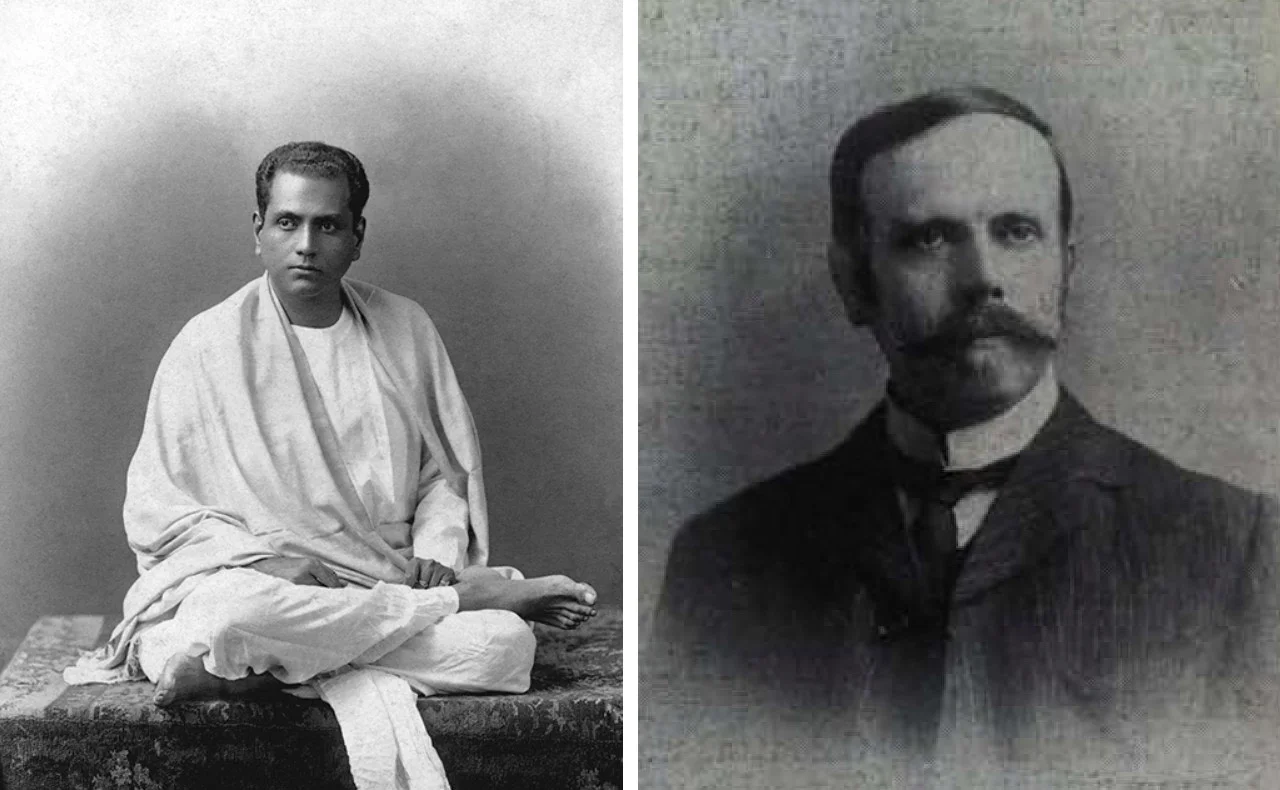
The Bengal School of Art stands as a defining chapter in the history of Indian art, crystallizing around 1905 in Bengal as a response to the pressures and possibilities of colonial modernity. Situated at the crossroads of cultural revival and political self-assertion, the movement sought to reorient artistic practice away from the Western academic realism that had taken root under British colonial art education and toward expressive forms drawn from Indian visual traditions. Its artists adapted idioms from Mughal and Rajput painting, the Pahari and Ajanta mural legacies, and living folk cultures, and they embedded these references in a distinctive language of wash, line, and mood. At once nationalist and aesthetic in ambition, the School framed art as a vehicle for reclaiming spiritual and cultural identity, aligning with the contemporaneous Swadeshi movement’s broader project of self-reliance and cultural pride. Founded by Abanindranath Tagore and supported by figures such as E.B. Havell, Sister Nivedita, Rabindranath Tagore, and Ananda Coomaraswamy, it nurtured artists whose work shaped the landscape of modern Indian art while challenging inherited hierarchies of taste. Its trajectory—emergence, consolidation, and eventual eclipse by mid-century modernisms—illuminates how Indian artists grappled with tradition, technique, and the idea of national form. More than a stylistic school, it functioned as a conceptual platform that made indigenous materials, themes, and sensibilities central to visual culture, producing an enduring repertoire of images and methods that continue to inform art education and practice in India today.
Historical Context
The rise of the Bengal School occurred at a moment when traditional systems of patronage and pedagogy in the subcontinent had been deeply unsettled. The decline of Mughal and princely support for the arts, combined with the ascendancy of British institutional models, redirected training toward oil painting, life study, and the mechanics of naturalist illusion. At the Government College of Art and Craft in Calcutta, Principal E.B. Havell introduced reforms aimed at restoring the dignity and study of Indian traditions, countering the prevailing emphasis on Western academic realism.
These institutional interventions intersected with intensifying nationalist sentiment around the 1905 Partition of Bengal, and the Swadeshi movement provided a social framework in which visual culture could act as both symbol and pedagogy for collective identity. Within this climate, Abanindranath Tagore’s initiative to revive and reinterpret historical Indian forms—miniature painting conventions, Ajanta-inspired fresco aesthetics, and motifs from folk visual culture—was not simply a stylistic preference. It articulated a program of cultural self-definition aligned with an anti-colonial resurgence that valued spiritual content and ethical ideals transmitted through art. The founding of the Indian Society of Oriental Art in 1907 by Havell and Abanindranath broadened this effort, arranging exhibitions and discourse that legitimized Indian methods and promoted Swadeshi principles. Support from Rabindranath Tagore and Ananda Coomaraswamy further embedded the School within an intellectual network advocating the recovery of Indian aesthetic philosophy. With time, however, the Bengal School’s nationalist and revivalist ethos faced critique and fatigue, and by the 1920s–1940s its influence waned as artists explored new vocabularies. The Progressive Artists’ Group, founded in 1947, explicitly rejected revivalism to embrace global modernism and individual freedom. While this shift marked a generational change, it also reveals ongoing debates about the School’s internal dynamics and the degree to which its ideology was uniform or susceptible to ossification, areas that remain open to further research and interpretation.
Stylistic Characteristics
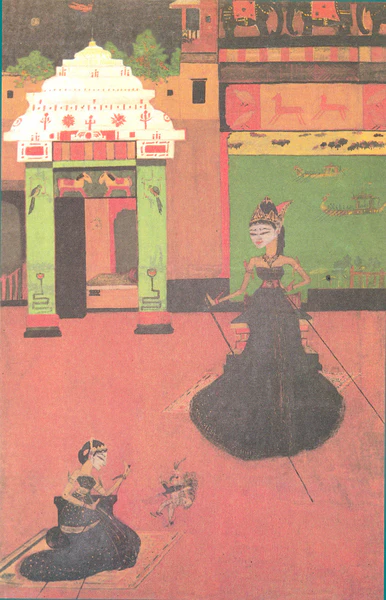
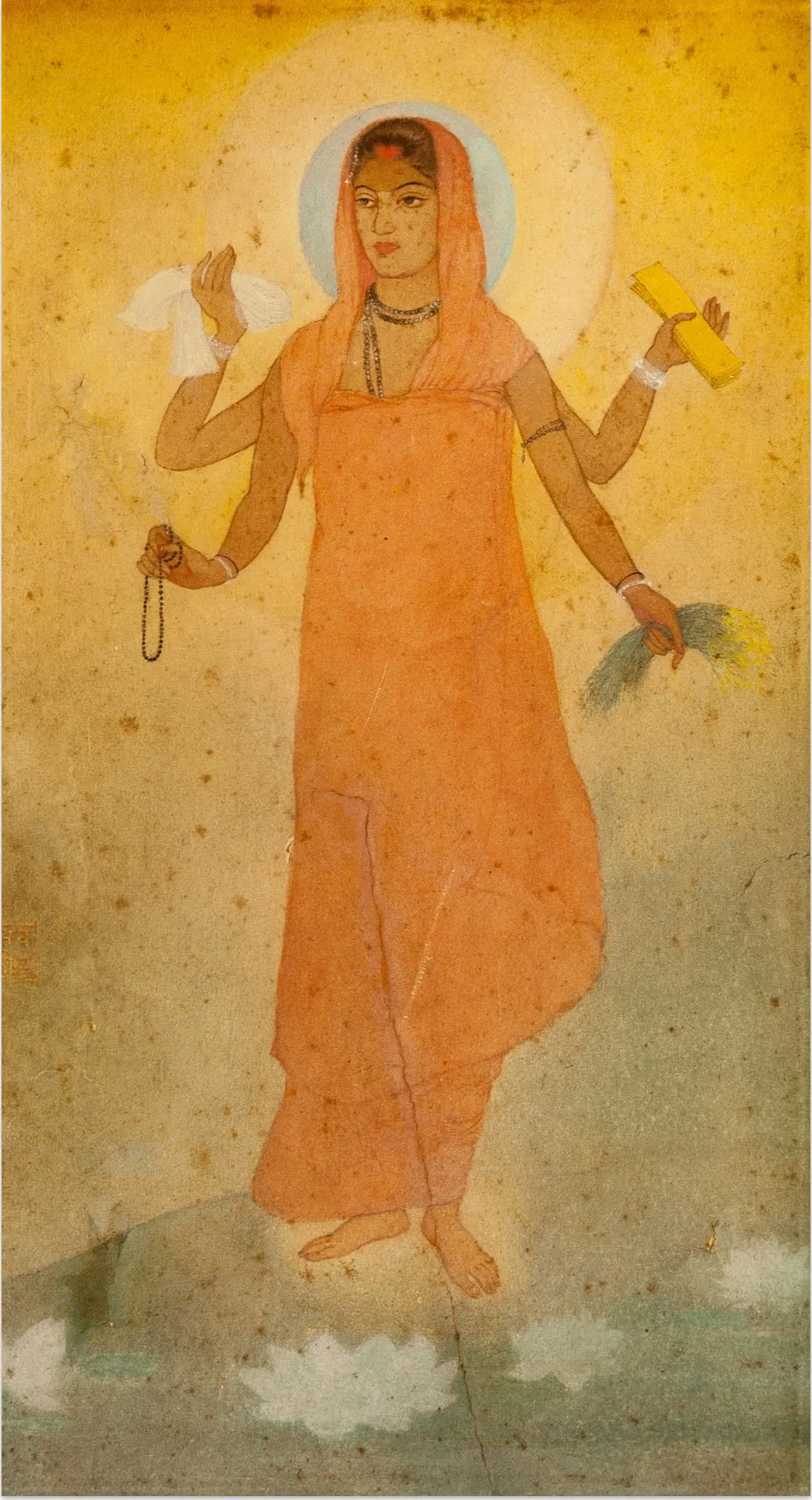
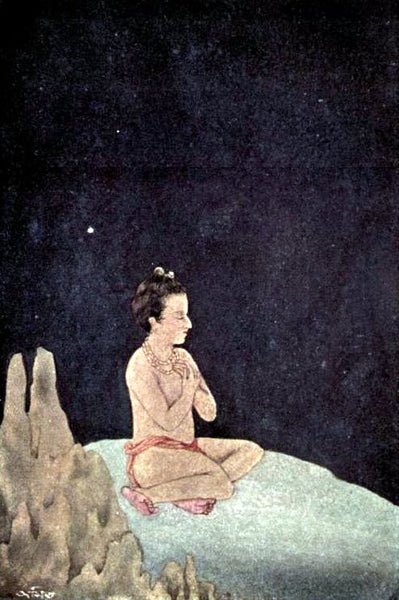
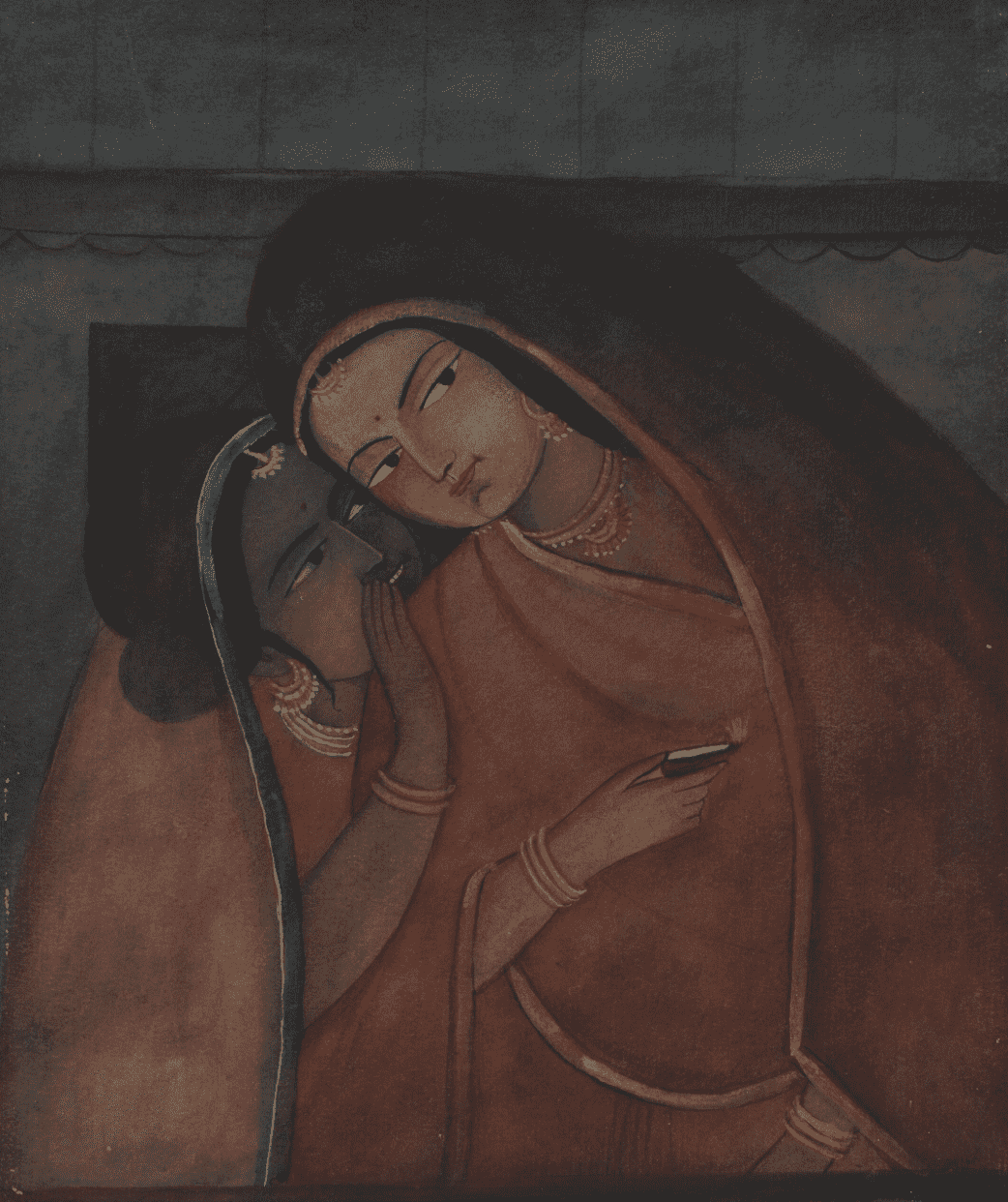
At the level of visual language, the Bengal School developed a grammar of restraint and lyricism intended to cultivate bhava, or the felt emotional and spiritual tenor of a scene, rather than the empirical detailing celebrated by academic realism. Artists favored two-dimensional compositions that appear contemplatively flat, with stylized forms and rhythmic, delicate contouring. Space is suggested rather than measured, and the play of line assumes a leading role in guiding perception. Calm, muted, and earthy palettes—sienna, olive, smoky blues, and soft umbers—take precedence over high-chroma color and the drama of Western chiaroscuro, producing images whose quiet tonality aligns with themes of devotion, myth, and moral reflection. Influences from Mughal, Rajput, and Pahari miniature painting can be recognized in the attention to ornament, controlled brushwork, and the emblematic staging of figures, while the Ajanta murals supply models of flowing biomorphic line, graceful posture, and panel-like organization. This revivalist matrix was neither antiquarian nor static: it was reinterpreted through modern techniques of tempera and watercolor washes, and—in an important transnational gesture—through the adaptation of the Japanese wash (morotai) technique. The circulation of pan-Asian ideas provided a language of brush and wash sympathetic to the School’s emphasis on atmospheric mood and spiritual depth. Although the Japanese influence is frequently cited, the precise scope of its impact beyond the adoption of morotai warrants further verification. Across the movement, allegory and symbolism operate as quiet carriers of ethical and nationalist ideals, and mythological or epic subjects from the Ramayana and Mahabharata coexist with images of rural life and nature. By rejecting oil painting and illusionist modeling, the Bengal School aligned style with ideology, proposing that fidelity to indigenous modes and the cultivation of inwardness could together anchor an Indian modernity distinct from colonial pedagogies.
Key Artists & Works
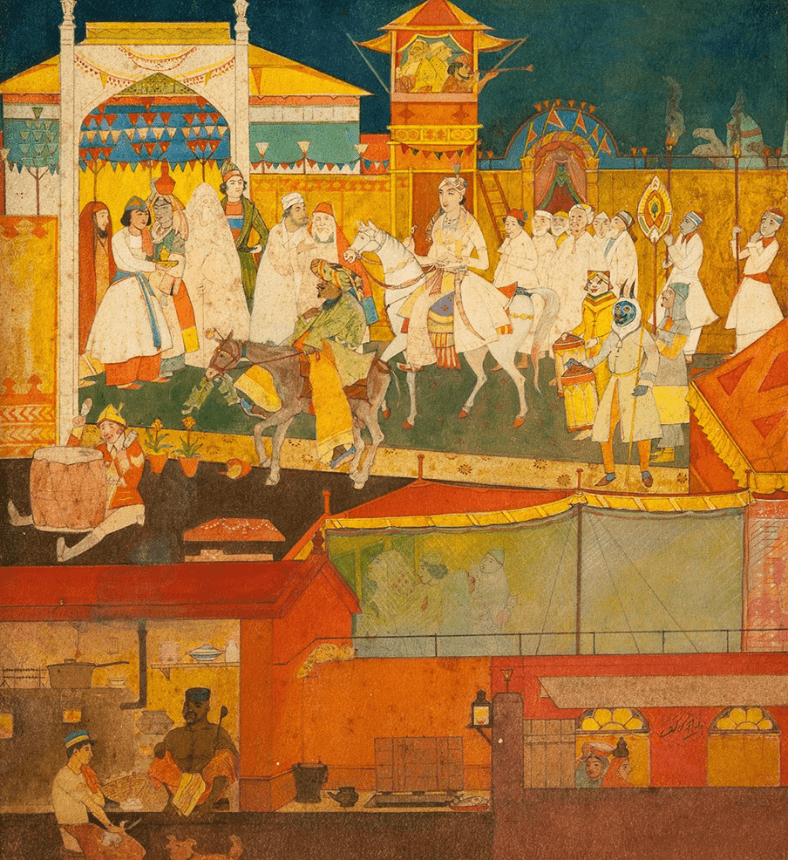
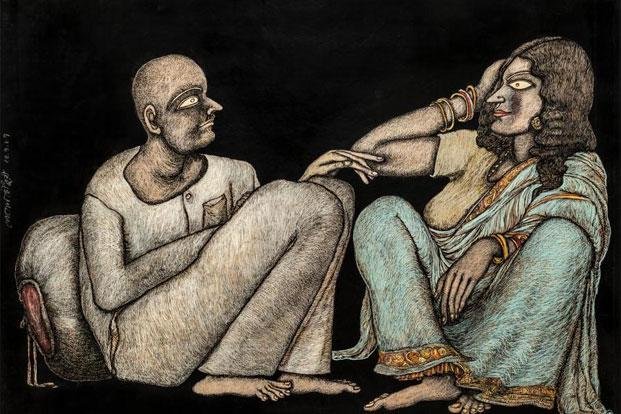
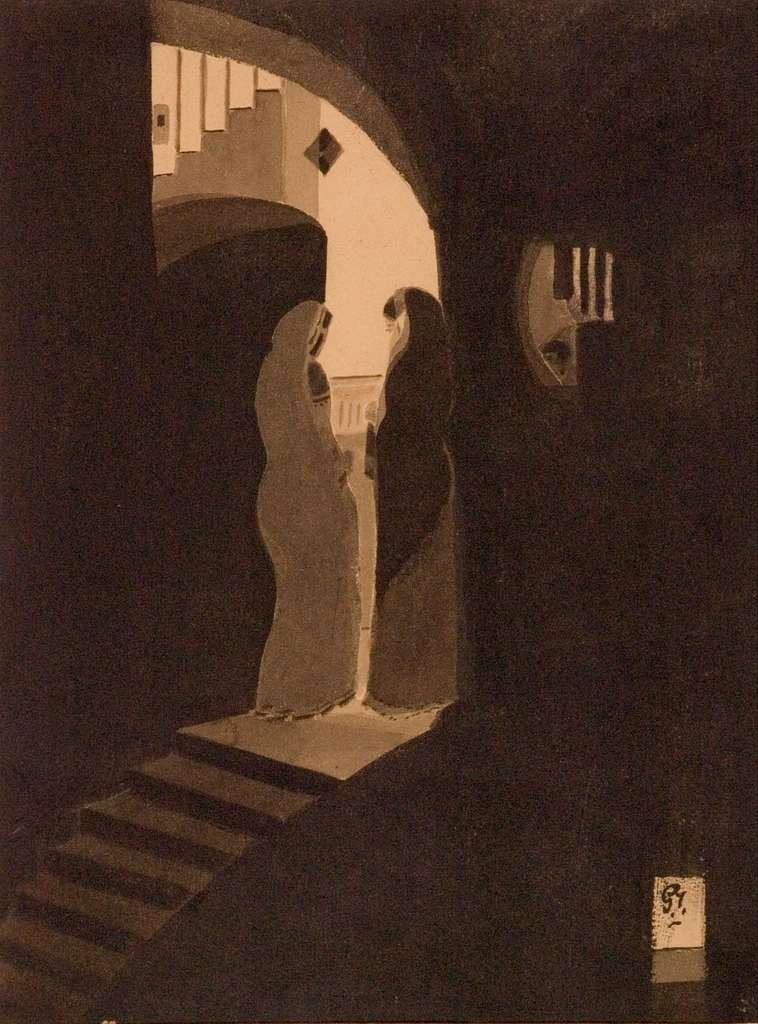
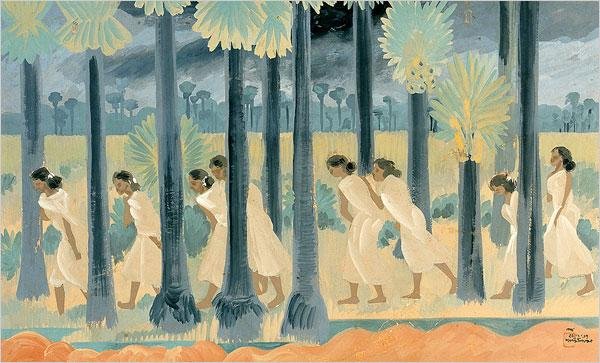
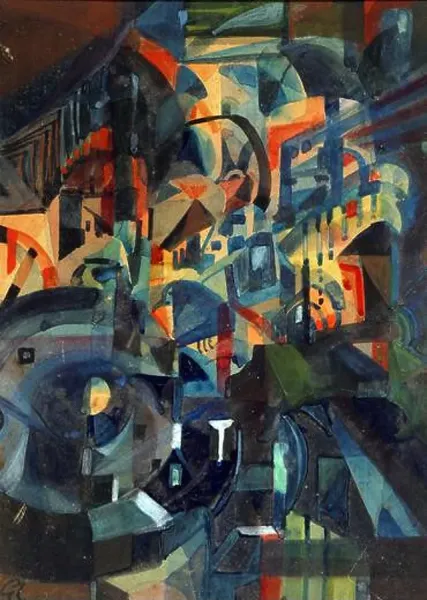
Abanindranath Tagore, the movement’s founder, shaped its intellectual and formal direction. His works present a touchstone for the School’s synthesis of revived tradition and contemporary purpose. Bharat Mata (1905) encapsulates a program in which national sentiment is conveyed with a symbolic and spiritual temper, revealing how muted color, gentle line, and devotional sensibility could frame collective identity. In The Passing of Shah Jahan, the evocation of historical memory joins with an elegiac mood nurtured by delicate washes, while the Krishna Lila series demonstrates how epic themes could be reframed through a refined pictorial syntax that prioritizes intimacy rather than monumental display. Nandalal Bose, Abanindranath’s student, extended this visual language across diverse subjects and media. His Sati and Shiva Drinking the World Poison reaffirm the School’s commitment to mythic narrative, emotion, and moral inquiry; his Haripura Posters show how a distilled, indigenous idiom could speak to public contexts, fusing pedagogy with design. Gaganendranath Tagore, Abanindranath’s brother, added an experimental dimension by engaging with Cubism and caricature alongside a sensitivity to atmosphere evident in his Darjeeling landscapes, suggesting that the School’s core principles could coexist with formal innovation. Asit Kumar Haldar bridged epic and Buddhist subjects, as in Yashoda Krishna and Ravana, translating narrative intensity into a poised orchestration of line and planar color. Beyond this core circle, the movement’s reach is visible in artists who were influenced by its ideals and then charted individual paths. Jamini Roy, initially shaped by the Bengal School, later developed a powerful folk-inspired style that reengaged with the vernacular on new terms, demonstrating the School’s catalytic rather than prescriptive influence. In sculpture, Ramkinkar Baij’s Santhal Family and Mill Call signal how the Bengal School’s reclamation of indigenous subjects could nourish three-dimensional form and social thematics, even as his approach anticipated subsequent modernist developments. Binode Behari Mukherjee brought together abstraction and representation in painting and murals, extending the dialogue between tradition and experiment into architectural space. M.A.R. Chughtai, working with a sensibility informed by Mughal and Persian miniature painting, achieved a refined synthesis in works such as Radhika, where lyrical line and contemplative wash resonate with the School’s ideals. The network also includes Kshitindranath Majumdar, Surendranath Ganguly, Mukul Dey, Shailendra Nath De, Hemendra Nath Mazumdar, Atul Bose, Rabindranath Tagore as painter, Manishi Dey, Bireswar Sen, Bishnu Dey, Indra Dugar, Kalipada Ghoshal, and Sailoz Mokokerjea, among others. While their individual contributions vary, their association reflects a shared conversation about how revival, technique, and subject could be mobilized to craft an Indian aesthetic identity. The details of each artist’s position within the School’s evolving discourse, and the internal diversity of approaches, remain fruitful areas for further documentation and study.
Materials & Techniques
The Bengal School’s material practice was integral to its redefinition of Indian art. Predominantly working in watercolor and tempera on handmade paper, artists embraced media aligned with miniature painting and mural traditions, signaling a conscious departure from oil-based, canvas-oriented practices. The use of natural dyes and pigments drew both on historical precedents and on the movement’s ethos of cultural self-reliance, while the handling of washes promoted a soft, vaporous atmosphere suited to introspective themes. The Japanese wash technique, known as morotai, was adapted and localized, enabling the creation of veils of tone that could register emotional nuance rather than depict optical fact. In parallel, the School emphasized the expressive charge of brushwork and the clarity of contour, treating the drawn line as a carrier of rhythm and sentiment. Techniques associated with miniature painting—such as finely modulated line, ornamental patterning, and the placement of figures within flattened fields—were not reproduced as pastiche but reinterpreted to serve the School’s modern objectives. Compositionally, artists favored planar structures that avoid deep perspectival recession, allowing figure, ground, and motif to interrelate through tonal gradation and line rather than volumetric modeling. Even where narrative subjects are present, the pictorial surface remains serene and ordered, focusing attention on mood and archetype. Although the School resisted oil painting and the conventions of Western academic realism, it was not technophobic; certain artists explored printmaking as a means of dissemination and design. Nandalal Bose notably introduced linocut and woodcut, underscoring the movement’s capacity to bridge artisanal technique and graphic clarity. This technical matrix—tempera and watercolor on absorbent papers, natural pigments, wash-based atmospherics, disciplined line, and selective adoption of print processes—formed the material armature for the School’s commitment to indigenous aesthetics.
Influence & Legacy
The Bengal School’s enduring significance lies in its formulation of an Indian modernity grounded in cultural memory and indigenous technique. By rehabilitating precolonial and folk sources as engines of innovation, it provided artists with a repertoire of forms and methods through which to craft an aesthetic identity distinct from colonial models. This project intersected with nationalist aspirations during the Swadeshi movement, positioning visual art as a site of ethical education, cultural pride, and symbolic community. The establishment of institutions reinforced these aims. The Indian Society of Oriental Art, founded in 1907 by E.B. Havell and Abanindranath Tagore, organized exhibitions and advanced discourse around Indian art traditions; Kala Bhavana at Santiniketan, established in 1901 under Rabindranath Tagore, became a center for Bengal School artists and for modern Indian art education more broadly; and the reorientation at the Government College of Art and Craft in Calcutta demonstrated how curricular reform could shift artistic values. Exhibitions in Calcutta, Delhi, and Bombay helped circulate the School’s work, establishing visibility within a national art public. Over time, however, the School’s revivalist and nationalist framework was challenged by artists and groups who sought greater formal autonomy and global dialogue. The Progressive Artists’ Group, founded in 1947, explicitly rejected the School’s revivalism, favoring individual freedom and international modernism. This critique did not erase the School’s achievements; rather, it clarified the multiple pathways that modern Indian art would take. The School’s influence persists in the continued use of its techniques, in art education that privileges the study of Indian traditions, and in institutional retrospectives at venues such as the National Gallery of Modern Art in New Delhi and the Victoria Memorial in Kolkata. Its role in the discourse on identity, cultural revival, and resistance to colonial cultural dominance remains foundational, even as scholars call for further verification of aspects of its history: the exact contours of Japanese influence, the timeline and texture of its decline, the heterogeneity among its practitioners, its regional impact beyond Bengal, and its intersections with other nationalist cultural movements. These open questions underscore that the Bengal School is not a closed chapter but an evolving field of research and interpretation.
Conclusion
Seen in retrospect, the Bengal School of Art offered more than a return to the past. It proposed a coherent, forward-looking aesthetic in which revived forms, indigenous materials, and contemplative mood redefined what modern Indian art could be. By prioritizing bhava over mimesis, wash and line over modeling, and symbolism over spectacle, the School articulated a visual ethics closely tied to cultural self-understanding and the nationalist aspiration for self-determination. Its artists and institutions created frameworks that subsequent generations could adopt, adapt, or contest. Even as later modernist movements superseded its revivalism, the School’s investments in pedagogy, technique, and subject matter continued to shape practice and discourse. Today, the Bengal School remains a reference point for artists and scholars seeking to understand how tradition and innovation interlace, how aesthetics and ideology inform one another, and how visual culture can participate in the making of collective identity. Its legacy endures not as a fixed style but as an intellectual project—one that catalyzed the terms through which Indian art addressed history, modernity, and the nation’s aesthetic self-image.