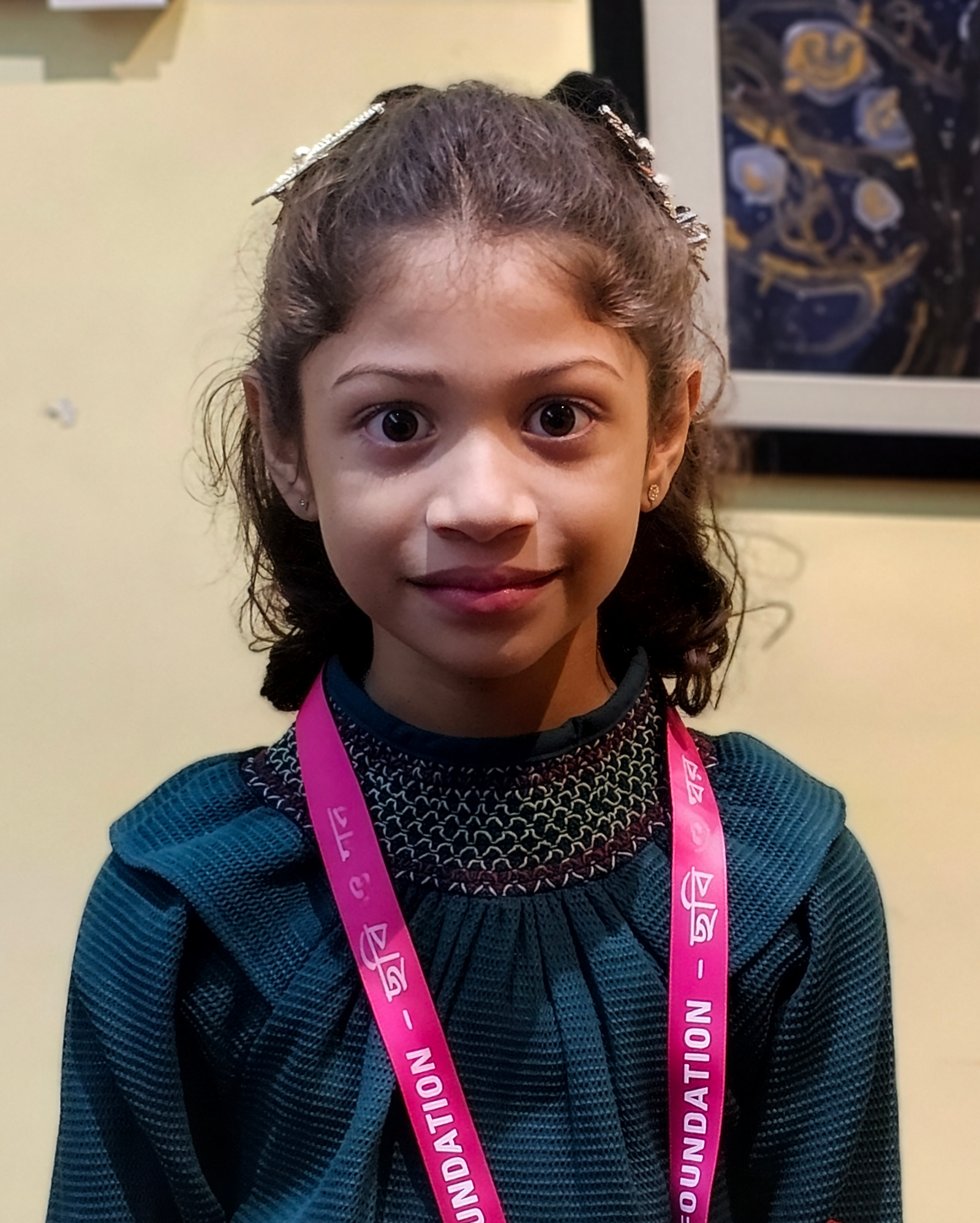

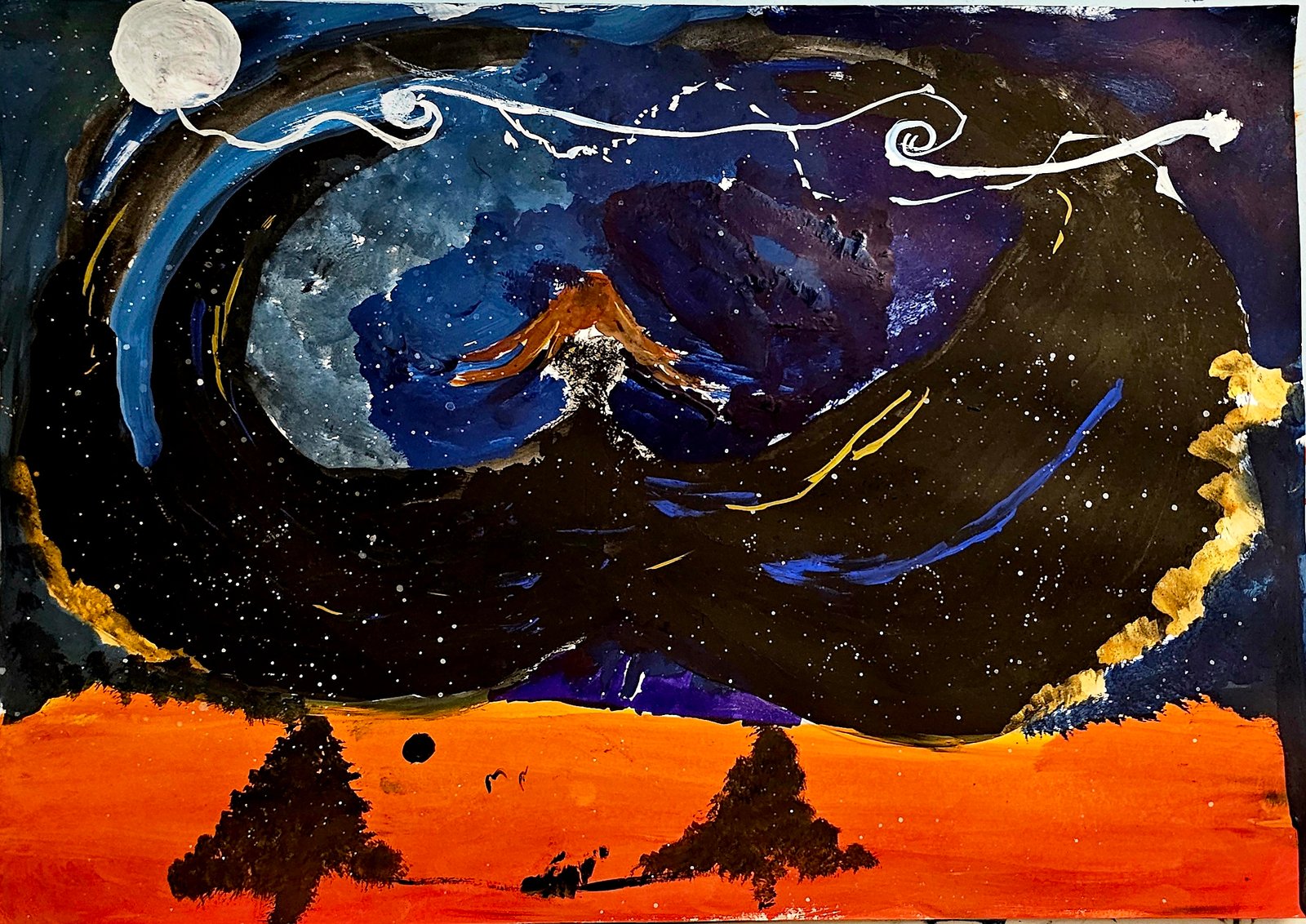
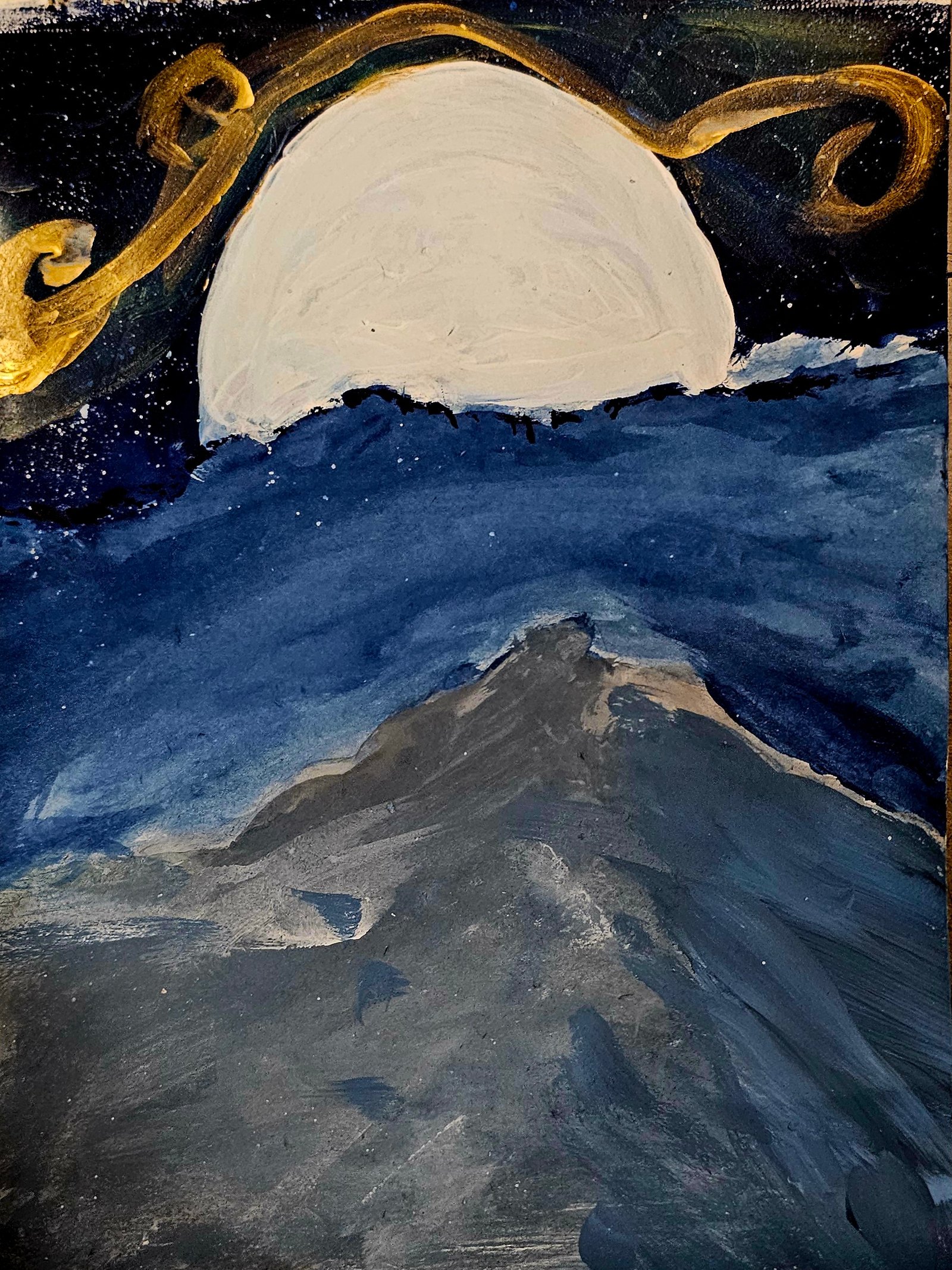
She is only eight years old, yet her artistic world already stretches far beyond the classroom. While most children begin drawing with outlines and figures, Gauri began with colour itself. There were no pencil sketches, no human forms carefully constructed with lines. Her earliest language was the brush, and her first subject was not people, but the sky.
A student of Griffin’s International School, Gauri started painting when she was just two and a half years old. What appeared to be playful experimentation soon revealed a distinct instinct. She worked with multiple colours at once, never limiting herself to a single shade. Even at that early age, her work leaned naturally toward abstraction—toward feeling rather than form.
For COG India, Gauri’s journey reflects the importance of recognising creative expression in its earliest stages, not as a skill to be disciplined immediately, but as a voice to be listened to.
Growing Through Abstraction
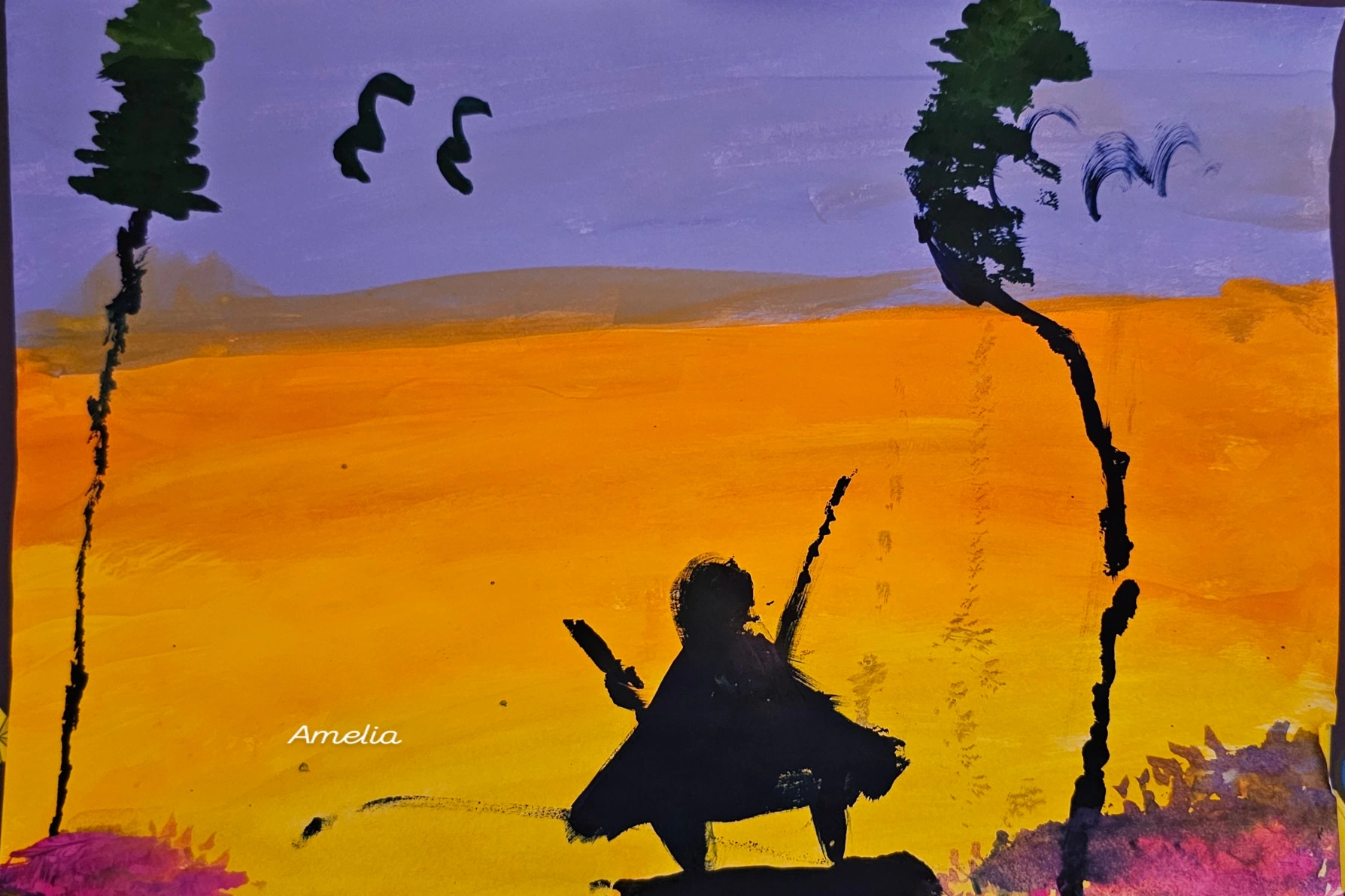
Unlike many children who begin with human figures and familiar objects, Gauri never focused on anatomy or structure. From the beginning, her paintings were abstract—layered with colours, floating shapes, and emotional tones rather than defined outlines.
By the time she turned six, her paintings began to reveal something more complex. Characters started appearing within her abstract compositions. Stories formed behind the colours. Each artwork became a narrative space rather than a simple image. These stories, however, were never ordinary. They were always tied to something larger—nature, the sky, or the cosmos. Her mother observed that nearly every painting carried a sense of looking upward, as though the child behind the canvas was searching for meaning beyond what she could see around her.
The Sky as a Theme
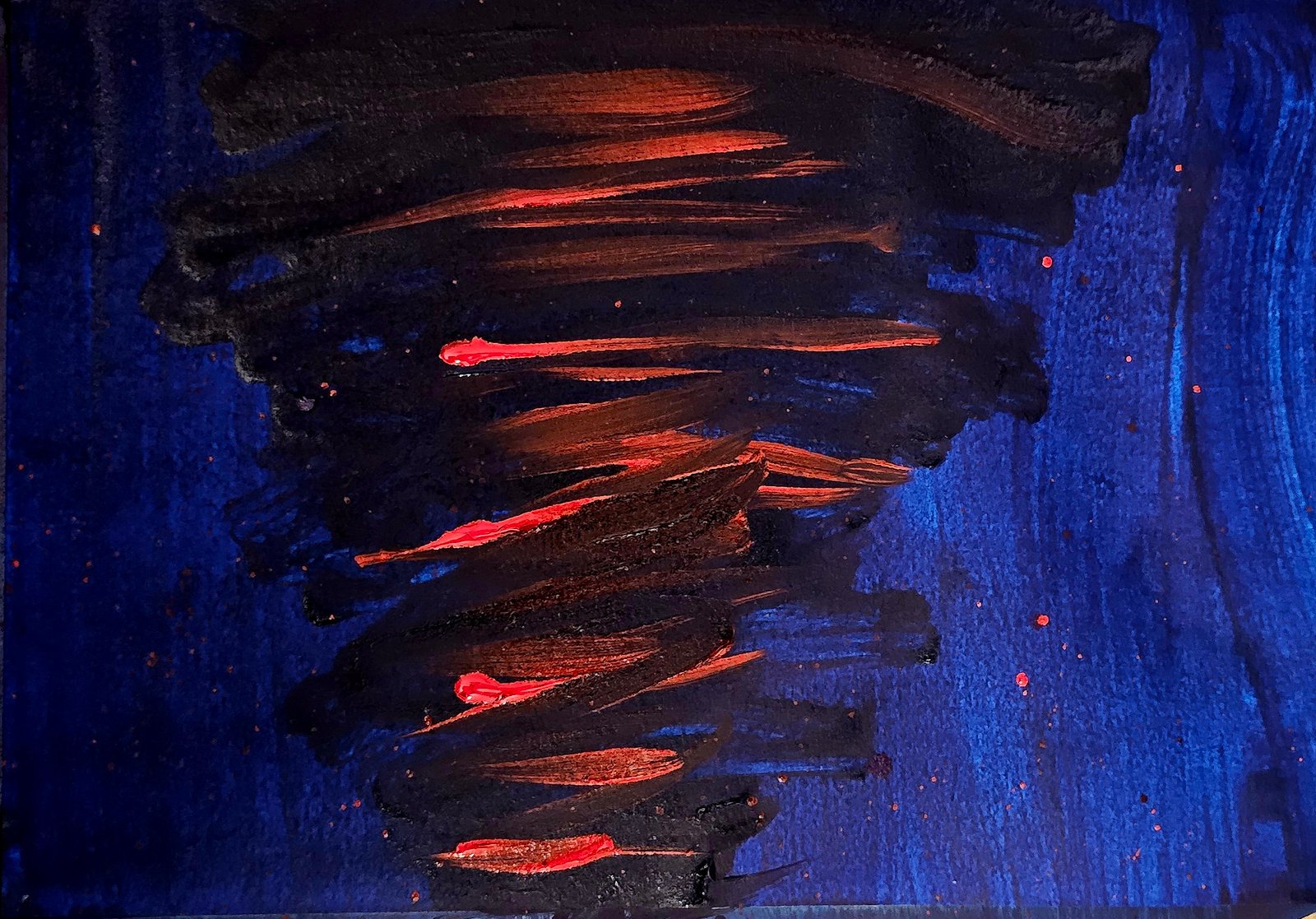
A recurring feature of Gauri’s work is the presence of a central figure standing beneath an expansive sky. The skies themselves are never the same—sometimes glowing, sometimes stormy, sometimes dreamlike. They are not backgrounds; they are subjects.
Her fascination with astronomy and natural elements shapes her artistic world. Stars, astral forms, and celestial movement appear again and again, creating a visual language rooted in curiosity and wonder. In these paintings, the universe becomes intimate, and vastness becomes personal. For COG India, this repeated return to the cosmos is significant. It shows how children interpret complexity not through facts, but through imagination—by translating the unknown into colour and story.
Learning from the Masters
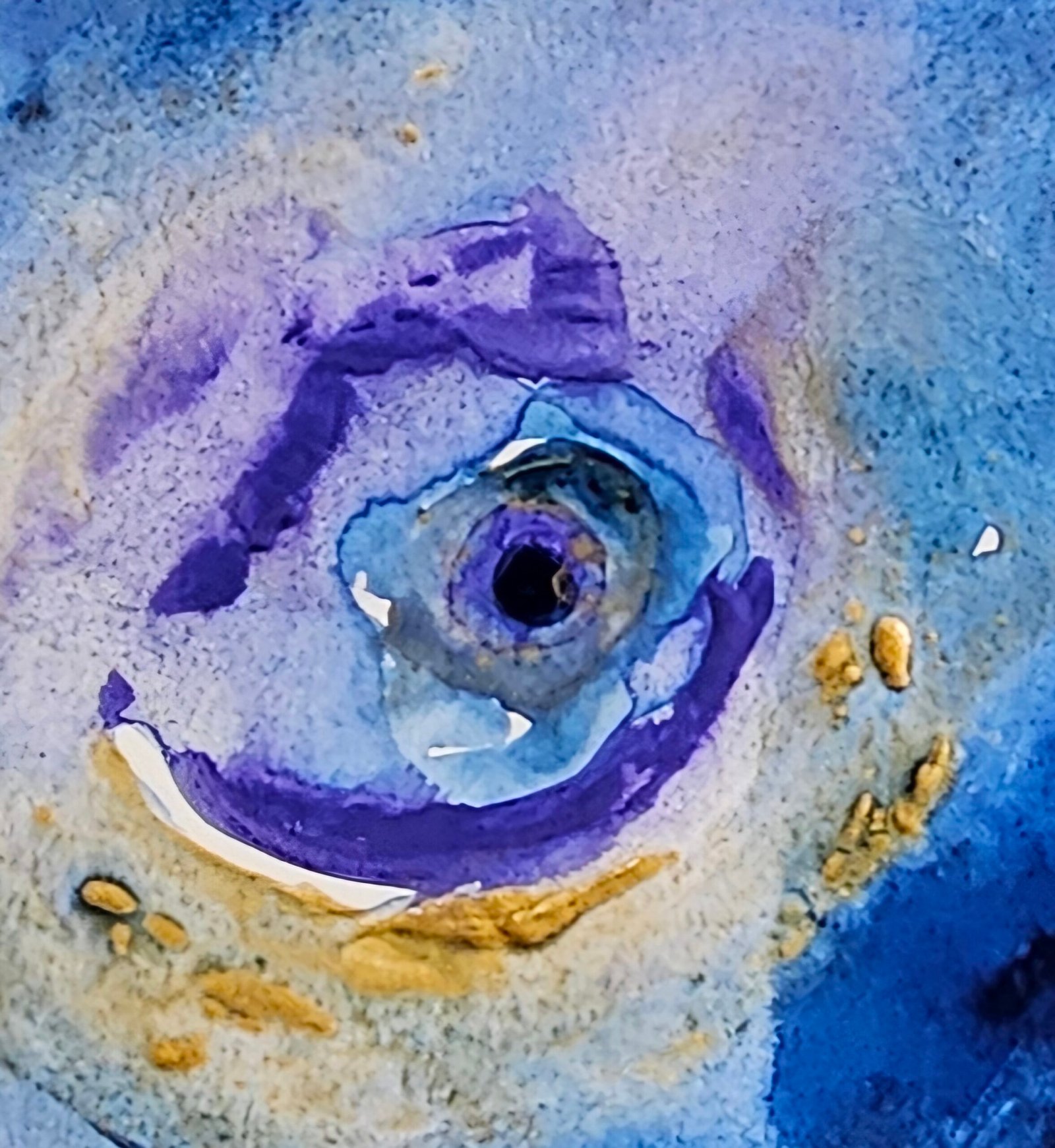
Gauri’s artistic curiosity is also nurtured through observation. She reads about different painters and studies their work, absorbing ideas without imitation. Among them, Vincent van Gogh remains a key inspiration. She is especially drawn to the Impressionists and their ability to depict motion within stillness.
What interests her most is how painters create a sense of movement—how skies can swirl, how light can vibrate, how emotion can be suggested without words. This fascination with motion is visible in her own paintings. Her skies seem to breathe, her colours appear restless, and her compositions feel alive. This balance between instinct and learning reflects a growing artistic awareness rarely seen at such a young age.

When Paint Meets Language
Gauri’s artistic journey does not stop with paint. Each of her works is accompanied by a short-written piece. These texts are not explanations but extensions of the painting itself—small reflections that reveal the story behind the image.
Initially, she shared her ideas verbally with her mother, who helped frame them in words. Recently, however, Gauri has begun writing on her own. Through short narrations and recorded reels, she now presents both her paintings and her thoughts in her own voice. For COG India, this combination of visual art and personal narration highlights an essential aspect of childhood creativity: the urge not only to create, but to communicate meaning.

A Family That Supports the Imagination
Behind Gauri’s evolving artistic world stands a family that believes in nurturing rather than directing talent. Her parents do not impose expectations; they support her curiosity. When she says she wants to become an artist, they listen.
In an era where childhood is increasingly shaped by performance and competition, such support becomes crucial. Her parents see her art not as an achievement to be measured, but as a journey to be protected. This environment allows Gauri to explore freely, without fear of being “wrong.”
Why Gauri’s Story Matters
For COG India, Gauri’s story is not about prodigy or early success. It is about process, expression, and trust. It is about a child who chose brushes over pencils and the cosmos over conventional subjects. Her paintings remind us that creativity does not always begin with structure. Sometimes it begins with wonder. Sometimes it begins with colour. And sometimes, it begins with a child who looks at the sky and decides to tell its story.
At eight years old, Gauri is still discovering who she is. Yet her art already carries a quiet clarity—that imagination, when supported, finds its own form. Through stories like hers, COG India continues to spotlight the voices of young creators, showing how early expression can shape confident, thoughtful individuals. And every time Gauri paints another sky, she shows us that the universe does not always need a telescope—sometimes, it only needs a brush.
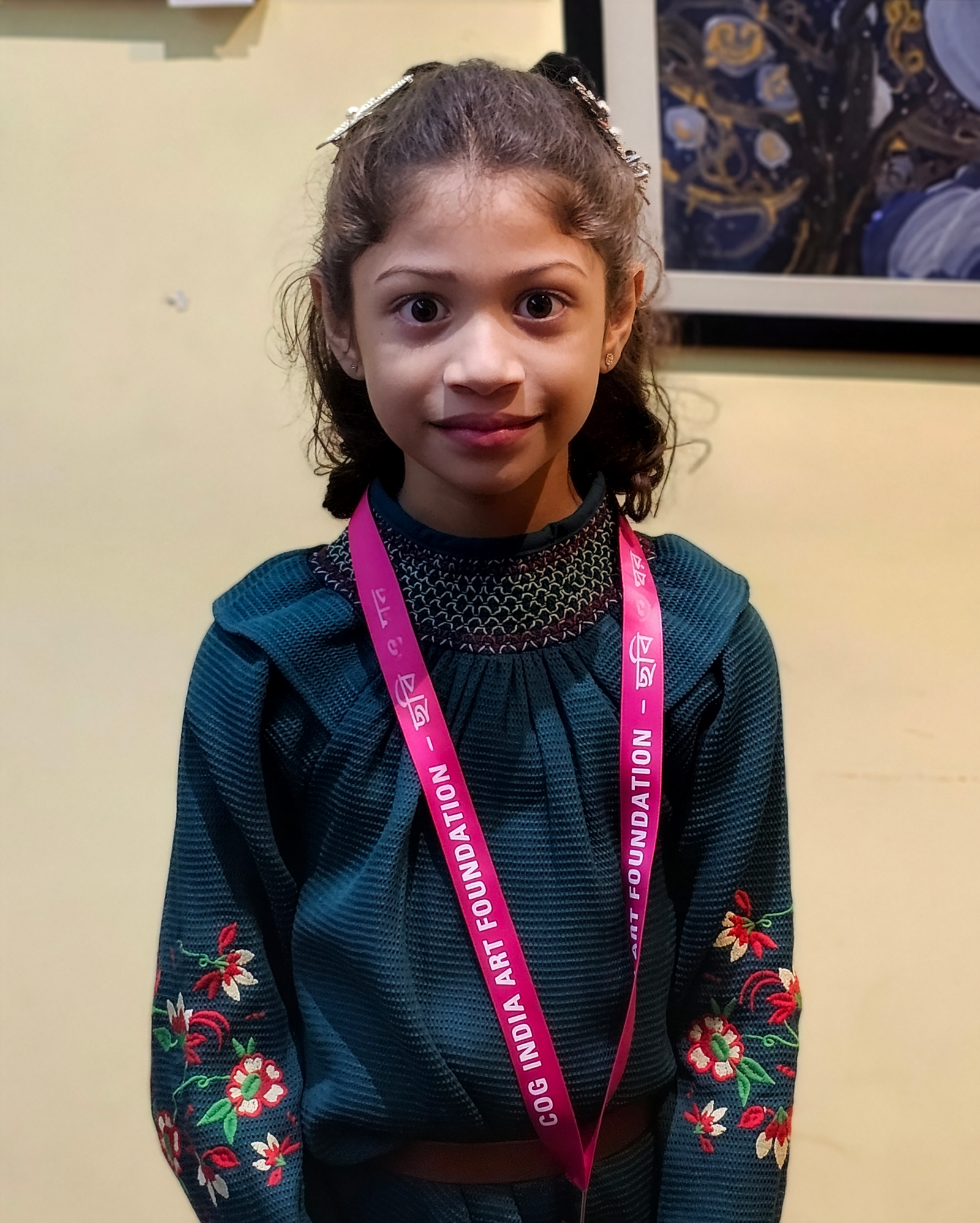
Gauri Amelia Lahiri
Griffins International School